Chimney Cap Replacement NZ — Costs & When to Replace
NZ chimney cap replacement guide — the four jobs a working cap performs (rain, wildlife, sparks, downdraught), the seven cowl types stocked in NZ (anti-downdraught, bird guard, rotating, spark arrestor, Dektite flashing, fire damper, blanking cap), Building Code Clause B2 durability tiers (50 / 15 / 5 years), and full installed pricing $80–$5,000+. Includes coastal salt-air guidance and the cascade from $500 cap failure to $25,000 chimney rebuild.
Quick Answer
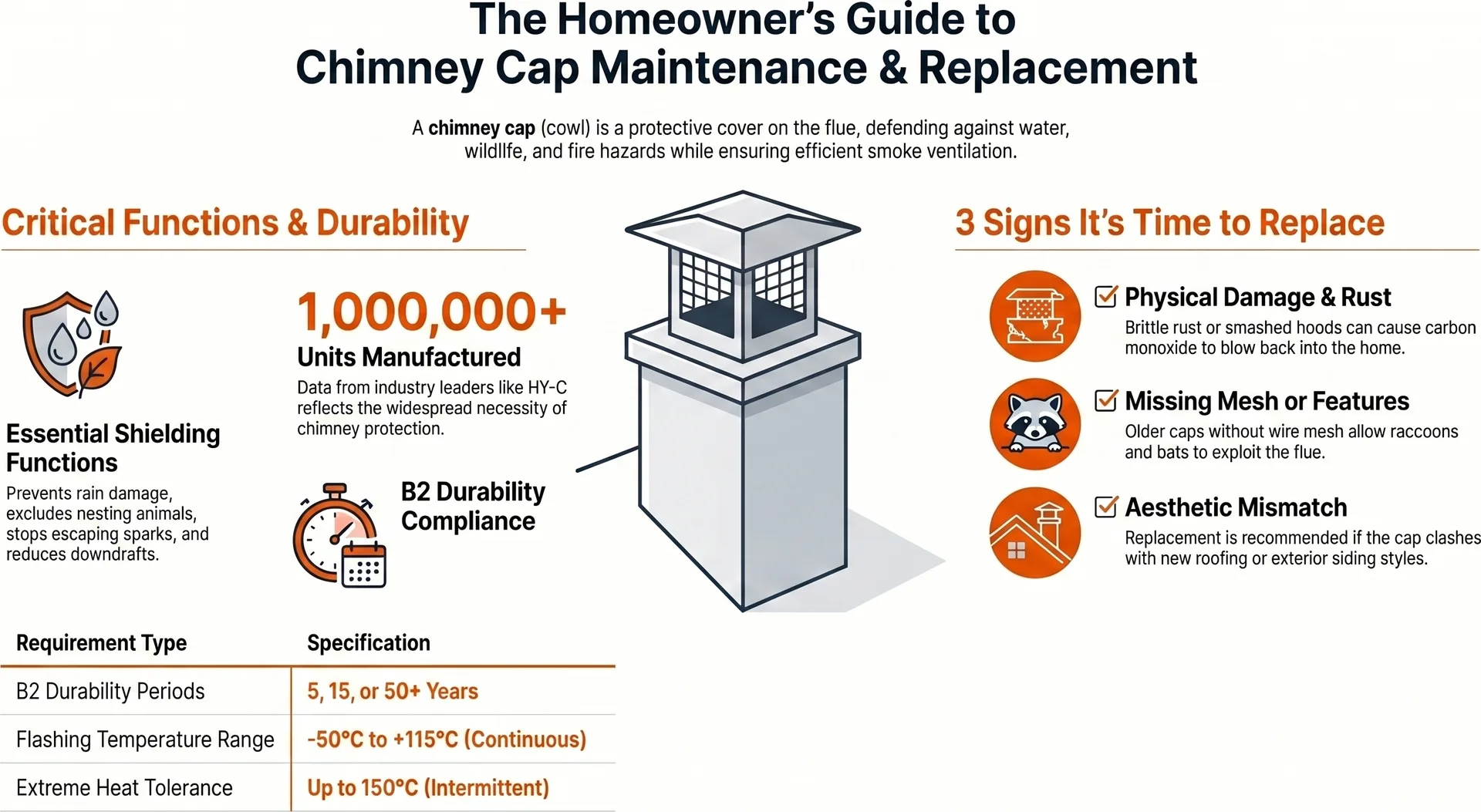
A chimney cap (or cowl) is the metal hood at the top of your flue. It performs four jobs: keeps rain out, blocks birds and animals from nesting, arrests sparks before they hit the roof, and prevents wind-driven downdraught blowing smoke back into the room. NZ Building Code Clause B2 sets the durability framework — 50 years for structural elements, 15 years for moderately replaceable components, 5 years for easily accessible parts — and most modern stainless caps target the 15-year tier. NZ-installed pricing: galvanised $300–$600, stainless $400–$900, copper $700–$1,800. Replace at the first sign of rust, missing wire mesh, water staining inside the firebox, or after a chimney fire. A $500 cap problem becomes a $5,000 problem in 3 years and $25,000 in 5 years.
Key Answers
- What does a chimney cap actually do?
- Four functions: weather protection (deflects rain, sleet, hail away from the flue), wildlife exclusion (wire mesh blocks birds, possums, rats from nesting inside), spark arresting (catches hot embers before they escape onto the roof — required by FENZ guidance for combustible roofs), and downdraught reduction (anti-downdraught cowls stop wind blowing smoke back down into the living room).
- What types of cowl or cap are available in NZ?
- Seven distinct designs are stocked nationally: anti-downdraught cowls (high-wind and coastal areas), bird guard cowls (mesh-only animal exclusion), rotating cowls (wind-driven draft boost for poor-drawing flues), spark arrestors (fine mesh for ember capture in wildfire zones), flexible Dektite flashings (UV/ozone-resistant rubber, EPDM rated to 115°C, silicone to 200°C), fire dampers (reduce exhaust flow on demand), and blanking caps (permanently seal an unused flue).
- How long does a chimney cap last under NZ Building Code?
- NZ Building Code Clause B2 (Durability) sets the framework: 50 years for structural elements, 15 years for moderately accessible components, 5 years for easily replaced parts. Most modern caps are designed to the 15-year tier. Real-world NZ lifespans: stainless steel 15–25 years inland, 10–15 years coastal; galvanised 10–15 years; copper 30–50 years; bird-screen retrofits 5–10 years. Pre-2005 installations may need a council compliance review to confirm they still meet current standards.
- What signs mean my cap needs replacement?
- Five reliable indicators: (1) total absence — flue tile completely exposed at the top with no cover. (2) missing modern features — older caps without removable hoods or wire mesh sides. (3) visible rust through the metal or rust streaks on the chimney brick below. (4) physical damage — bent fins, animal-chewed mesh, smashed or sagging hood from wind or fallen branches. (5) aesthetic misalignment — major roof or siding changes that warrant a different material or colour to match.
- Why is a damaged hood a safety risk, not just a cosmetic one?
- When the hood sits too low above the flue tile — from impact damage, animal damage, or wind deformation — it physically obstructs the draft path. Fireplace exhaust gases including smoke and carbon monoxide cannot escape vertically and start to back-flow into the room below. As the industry source puts it: "If [the hood] isn't [high enough], fireplace gasses (like smoke or carbon monoxide) could blow back into your home." That is why annual ground-level visual inspection plus the sweep's written cap-condition report is the minimum maintenance standard.
Key Takeaways
- A working chimney cap performs four jobs — rain protection, wildlife exclusion, spark arresting, and downdraught control. Failure in any one cascades into expensive damage.
- NZ Building Code Clause B2 sets the durability framework: 50 years (structural) / 15 years (moderately replaceable) / 5 years (easily accessible). Most modern caps target the 15-year tier.
- NZ-installed pricing — galvanised $300–$600, stainless steel $400–$900, copper $700–$1,800, heritage replicas $1,500–$5,000+, bird-screen retrofits $80–$250.
- Coastal salt air halves cap lifespan — within 1km of the NZ coast specify 316 stainless or copper. Galvanised fails in 5–8 years coastal versus 10–15 inland.
- A $500 cap replacement done at first sign of failure prevents $2,000–$25,000 of downstream water damage, liner corrosion, and structural masonry damage over 3–5 years.
How long does cap replacement take on the day?
2-4 hours total.
2-4 hours total. Roof access setup (15-30 min), old cap removal (15-30 min), new cap installation (30-60 min), test and clean up (15-30 min), documentation (5-10 min). Plus 1-2 weeks of lead time for ordering the cap.
Do heritage properties need special caps?
Often yes.
Often yes. Listed buildings or homes in conservation areas may require like-for-like replacement (lead caps, decorative copper, cast iron). Council heritage planning rules can mandate specific materials. Get the council heritage officer to sign off before ordering.
Will my insurance cover cap replacement after a chimney fire?
Yes if you have a current chimney sweep certificate.
Yes if you have a current chimney sweep certificate. Cap damage is a typical chimney-fire repair line item — insurance usually covers it under the broader fire claim. Document the cap damage with photos before any cleanup or replacement work.
What does a chimney cap actually do?
Four functions: keeps rain out (prevents creosote degradation and rust), keeps animals out (birds, possums, rats), keeps embers in (FENZ-required spark arrester), and manages downdraft (prevents wind-induced smoke back-puff).
Four functions: keeps rain out (prevents creosote degradation and rust), keeps animals out (birds, possums, rats), keeps embers in (FENZ-required spark arrester), and manages downdraft (prevents wind-induced smoke back-puff).
Why are coastal caps more expensive?
Salt air accelerates corrosion.
Salt air accelerates corrosion. Galvanised caps fail in 5-8 years within 1km of the coast; stainless 304 fails in 10-15 years. For coastal Auckland, Tauranga, Wellington, Christchurch, and Dunedin, 316 stainless steel or copper are worth the price premium.
Should I replace the cap during the annual sweep?
Yes if the sweep flags a defect.
Yes if the sweep flags a defect. Combining cap replacement with the annual sweep visit saves the call-out fee. Most sweeps either install caps themselves or coordinate with a roofer the same day.
| cap_type | material_summary | lifespan_years_coastal_nz | lifespan_years_inland_nz | supplied_price_nzd_low | supplied_price_nzd_high | installed_price_nzd_low | installed_price_nzd_high | best_use_case | key_failure_mode | Source |
|---|---|---|---|---|---|---|---|---|---|---|
| 316 Stainless Steel | Marine-grade stainless steel with superior resistance to chloride and salt corrosion. | 20+ | 50+ | 120.00 | 250.00 | 280.00 | 550.00 | Coastal properties and harsh salt-spray environments. | Extreme physical damage or structural weld failure. | [1, 2] |
| 304 Stainless Steel | High-quality, rust-resistant stainless steel suitable for standard residential applications. | 10-15 | 25+ | 70.00 | 167.00 | 220.00 | 450.00 | Modern residential wood burners and outdoor pizza ovens. | Tea staining or surface pitting in coastal salt spray zones. | [1, 3] |
| Galvanised Steel | Economical metal with zinc coating for corrosion resistance; often used for outer casing blanking caps. | 5-10 | 15+ | 60.00 | 66.50 | 210.00 | 350.00 | Standard residential flue systems in non-coastal areas. | Rust and corrosion over time, especially in high-moisture environments. | [1, 3] |
| Copper | Premium, highly durable metal that develops a protective patina over time. | 30+ | 50+ | 250.00 | 600.00 | 450.00 | 900.00 | Luxury homes and historical restorations looking for aesthetic longevity. | Theft due to high scrap value or mechanical joint failure over decades. | [1] |
| Heritage Replica / Anti-Downdraught | Specialized designs (Butterfly, H-Pot, Conical) in stainless steel to solve airflow or aesthetic needs. | 15 | 25+ | 80.00 | 130.00 | 230.00 | 400.00 | Windy areas (e.g., Kapiti/Wellington) prone to smoke blow-back. | Soot buildup in complex geometries reducing draft efficiency. | [3, 4] |
| Bird-Screen Retrofit | Mesh additions (wire mesh or 'Bird Guards') added to existing caps to exclude wildlife. | 5-10 | 15 | 40.00 | 90.00 | 150.00 | 250.00 | Preventing birds/wildlife from nesting in flues. | Mesh clogging with soot/creosote or physical damage from wildlife. | [1, 4, 5] |
Data compiled from research by Chimney Guys
Frequently Asked Questions
What is a chimney cap and why does my home need one?
A chimney cap (or cowl) is the metal hood at the top of your flue. It is the primary defensive barrier against rain, animals, embers, and wind-driven downdraught. Industry expert advice from NZ chimney specialists: "A good chimney cap doesn't cost much, and it can save you from a lot of future frustration and repairs." Without one, the flue tile is exposed to weather and wildlife, and slow-developing chimney problems start within 12–24 months.
How does NZ Building Code Clause B2 apply to chimney caps?
Clause B2 (Durability) requires that all building components must continue to satisfy the performance requirements of the Building Code throughout their specified intended life with only normal maintenance. Three tiers apply to chimney systems: 50 years for structural elements (the chimney itself and structural masonry), 15 years for moderately accessible components like flashing and caps, 5 years for easily replaced parts (sealants, gaskets, mesh inserts). Most modern stainless steel and copper caps are designed to the 15-year tier. Pre-2005 installations may require a council compliance assessment to confirm they still meet current Building Code standards.
What is Dektite and why is it the modern flashing standard?
Dektite is a NZ-distributed range of flexible EPDM and silicone polymer flashings that bond to round flue penetrations. EPDM is rated to 115°C continuous; silicone to 200°C continuous with 250°C intermittent peaks. Compatible with zincalume, galvanised steel, aluminium, copper, lead, and timber. UV- and ozone-resistant. Cheaper and faster to install than custom lead aprons, more forgiving on roof movement, and now the default specification for new NZ wood-burner installs under Building Code C/AS1 watertightness requirements.
Can I install a replacement cap myself?
Technically yes for a single-storey home with accessible roof — materials cost $150–$400 and the install is 2–4 hours. But the insurance maths usually does not work. Most NZ home insurers require fixed-structure repairs (which include the chimney cap) to be performed by a qualified tradesperson. DIY work voids most manufacturer warranties. WorkSafe height-work rules technically apply to homeowners working on their own property. The $200–$400 saved is not worth the downside risk of a denied $5,000–$25,000 fire claim because the work was not professionally documented.
How does coastal salt air affect cap lifespan?
Within 1km of the NZ coast, salt air accelerates corrosion dramatically. Galvanised steel caps fail in 5–8 years versus 10–15 years inland. 304 stainless steel fails in 10–15 years coastal versus 15–25 years inland. For coastal Auckland, Tauranga, Wellington, Christchurch, Dunedin, and any property where salt spray is visible on windows, specify 316 stainless steel or copper. The price premium of $100–$300 buys an extra decade of service life.
What if I have a heritage or pre-2005 chimney?
Listed buildings and homes in conservation areas may require like-for-like material replacement — lead aprons, decorative copper, cast iron. Council heritage planning rules can mandate specific materials and dimensions, so engage the council heritage officer before ordering. Replacement caps for heritage homes are often custom-fabricated with 4–8 week lead times. Pre-2005 chimneys may also need a council compliance assessment to confirm the existing system meets current Building Code C/AS1 fire-safety and B2 durability standards.
Why does a smashed or bent cap cause smoke to come back into the room?
When the hood of the cap sits too low above the flue tile (whether from impact damage, animal damage, or wind deformation), it physically obstructs the draft path. Fireplace exhaust gases — including smoke and carbon monoxide — cannot escape vertically and start to back-flow into the room below. This is the same risk profile as a partially blocked flue and is why an annual ground-level visual inspection plus the sweep's written cap-condition report is the minimum maintenance standard for any NZ chimney.
Think You've Got It?
10 questions to test your understanding — instant feedback on every answer
Question 1 of 10
Under the New Zealand Building Code Clause B2, what are the three minimum durability periods that building materials and components must satisfy?
Question 2 of 10
Why is a rusted chimney cap considered a safety hazard rather than just an aesthetic issue?
Question 3 of 10
What is the primary function of an 'Anti-Downdraught' cowl?
Question 4 of 10
According to the product specifications for Dektite flexible flashing, what is the maximum continuous temperature the rubber can withstand?
Question 5 of 10
What is a potential 'downstream' consequence of neglecting a damaged chimney cap or leaking flue?
Question 6 of 10
For properties in New Zealand, why might a 'Rotating Chimney Cowl' be installed instead of a standard rain hat?
Question 7 of 10
What is the primary benefit of a 'Butterfly' style cowl compared to a standard blanking cap?
Question 8 of 10
When considering New Zealand council compliance, which installations are specifically mentioned as requiring assessments against current standards?
Question 9 of 10
What is a 'Spark Arrestor' cowl specifically designed to prevent?
Question 10 of 10
Why is the height of the chimney cap hood above the flue tile considered a critical measurement?
Need a chimney sweep?
Tell us where you are and what you need. We'll match you with a verified local sweep and have them in touch within one business day.