Wood Burner Replacement Subsidies NZ: What Help Is Still Available in 2026?
NZ wood burner replacement subsidies changed sharply in 2026. Warmer Kiwi Homes no longer accepts new wood or pellet burner grant applications, but regional help still exists. Canterbury has the clearest pathway with ECan subsidies up to $5,000 for eligible owner-occupiers replacing expired or expiring burners in Clean Air Zones. Rotorua, Hawke's Bay, Otago, and Nelson are driven by point-of-sale rules, airshed restrictions, and approved appliance lists.
Quick Answer
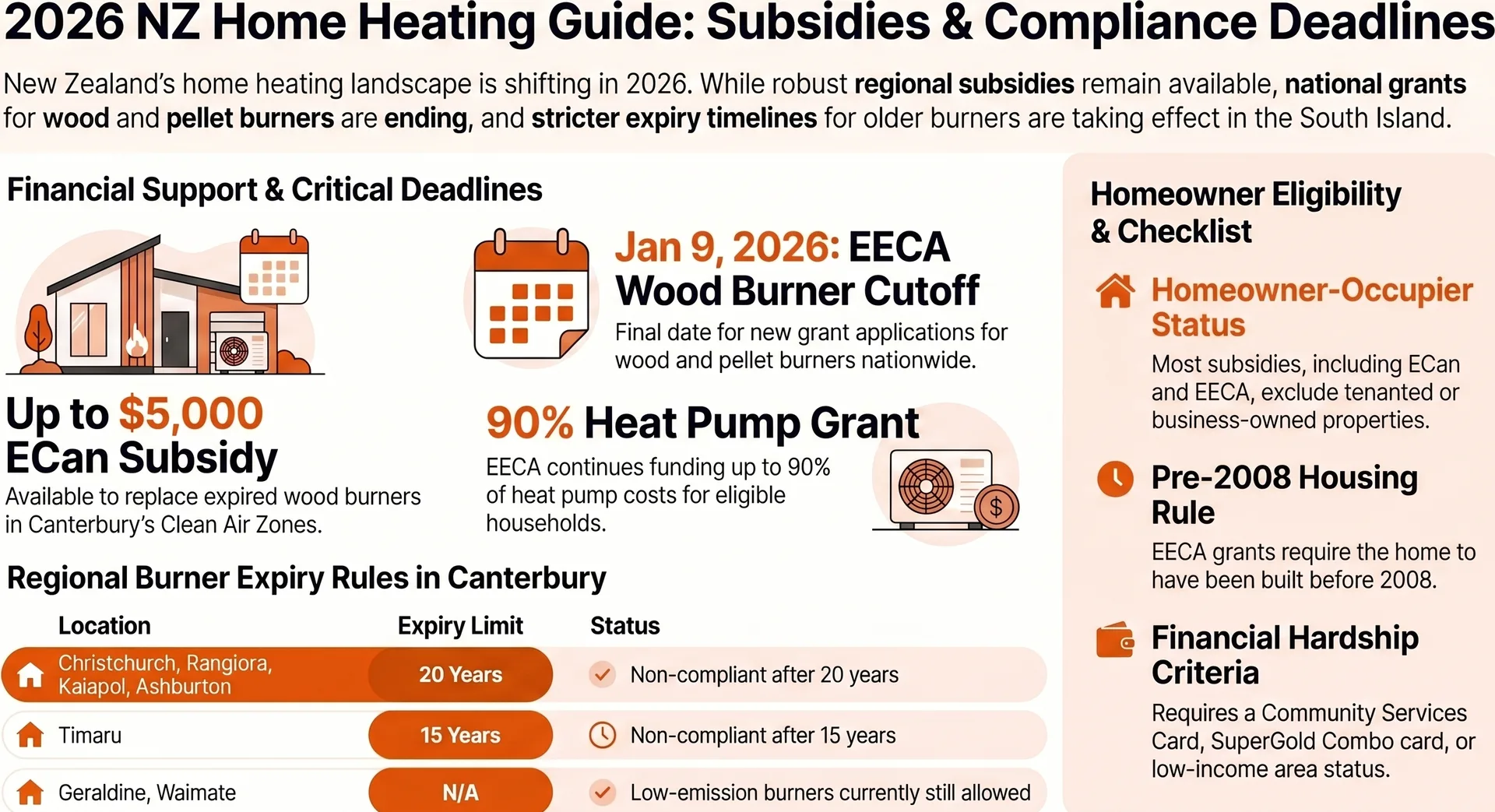
National Warmer Kiwi Homes funding no longer accepts new wood or pellet burner grant applications from 9 January 2026. The money has shifted toward heat pumps, with eligible households able to receive up to 90% of heat pump cost capped at $3,450. Wood burner help is now mostly regional. ECan offers up to $5,000 for eligible owner-occupiers replacing expired or expiring burners in Canterbury Clean Air Zones. Rotorua and Hawke's Bay focus on point-of-sale compliance. Otago Air Zone 1 and Nelson airsheds apply strict approved-burner rules. Apply before buying or installing anything.
Key Answers
- Can I still get a national grant for a wood burner in 2026?
- No new Warmer Kiwi Homes applications for wood or pellet burner grants have been accepted since 9 January 2026. Existing wood or pellet burner quotes had to be accepted and processed by the service provider by 27 February 2026. Heat pump grants continue for eligible households.
- Which region has the clearest wood burner replacement subsidy?
- Canterbury. ECan offers home heating subsidies up to $5,000 for eligible homeowners replacing an expired or expiring burner with an ultra-low emission burner or heat pump in a Clean Air Zone. The strongest eligibility match is owner-occupier, hardship or qualifying card, old burner, and no efficient fixed heater already in place.
- What appliance can I replace an old burner with?
- It depends on the region. ECan allows eligible funding toward a ULEB or heat pump. Rotorua replacement wood burners must be on the Ministry for the Environment authorised list and meet the local 0.60 g/kg limit. Otago Air Zone 1 requires less than 0.7 g/kg. The national baseline for properties under two hectares is less than 1.5 g/kg and at least 65% efficiency.
- Do rentals qualify for subsidies?
- Often no. Warmer Kiwi Homes applies to the home you own and live in, not rentals, businesses, baches, Airbnbs, or holiday homes. ECan also says tenanted properties are not eligible for its home heating subsidies. Landlords still have to meet heating and air-quality rules, but the grant path is usually narrower.
- Should I install first and apply later?
- No. Treat pre-approval as mandatory. Most subsidy and finance pathways require eligibility checks, quotes, approved providers, and local rule confirmation before the work starts. If you buy and install first, the work may still be compliant but unfunded.
Key Takeaways
- Warmer Kiwi Homes stopped new wood and pellet burner grant applications on 9 January 2026.
- Eligible Warmer Kiwi Homes heat pump grants continue, up to 90% capped at $3,450.
- ECan offers up to $5,000 for eligible owner-occupiers replacing expired or expiring burners in Canterbury Clean Air Zones.
- Rotorua and Hawke's Bay use point-of-sale rules that can force burner removal or replacement before title transfer.
- Otago Air Zone 1 requires less than 0.7 g/kg; Rotorua Airshed replacement burners must be no more than 0.60 g/kg.
- Rentals, baches, Airbnbs, businesses, homes outside the right airshed, and homes with an efficient fixed heater are common subsidy exclusions.
- Check the council rule for your address before you speak to a showroom or installer.
What changed for wood burner subsidies in 2026?
Warmer Kiwi Homes stopped accepting new wood and pellet burner grant applications from 9 January 2026. National funding now points mainly toward eligible heat pumps, while wood burner help is mostly regional.
This is the fact that makes a lot of older advice wrong. Warmer Kiwi Homes still funds insulation and heat pumps for eligible households, but new wood and pellet burner grant applications closed on 9 January 2026. Existing wood or pellet burner quotes had to be accepted and processed by 27 February 2026 for the old grant route to apply. So a 2026 homeowner looking for a wood burner subsidy should start with local council rules, not the national grant page.
Which wood burner subsidies still exist in NZ?
The clearest cash subsidy is Canterbury. ECan offers up to $5,000 for eligible owner-occupiers replacing expired or expiring burners in Clean Air Zones. Other regions often use compliance rules, advice, loans, or partner funding.
The 2026 funding map is uneven. Canterbury has the cleanest pathway because ECan still publishes a home heating subsidy for eligible replacements. Rotorua and Hawke's Bay are more about forced compliance at property sale. Otago and Nelson are more about strict airshed rules and approved models. EECA still matters nationally, but for heat pump funding rather than new wood burner funding. The practical answer is address-specific: your council, airshed, burner age, ownership status, and income or hardship eligibility decide the route.
How does the ECan $5,000 subsidy work?
ECan subsidies up to $5,000 can help eligible Canterbury owner-occupiers replace an expired or expiring burner with a ULEB or heat pump in specified Clean Air Zones.
The strongest ECan match is an owner-occupier with an expired or expiring burner, a qualifying card or hardship basis, and a property in a Clean Air Zone such as Christchurch, Rangiora, Kaiapoi, Ashburton, Timaru, Waimate, or Geraldine. The property generally needs to be under two hectares and not already have an efficient fixed heater. Tenanted properties are not eligible for the home heating subsidy. ECan also excludes burners that expired before 25 October 2016, which catches some older installations out.
How do Canterbury burner expiry dates affect replacement?
Canterbury gives wood burners a legal lifespan. Low-emission burners are generally non-compliant after 20 years in major Clean Air Zones, but Timaru is stricter at 15 years.
ECan has warned that many homeowners do not realise their burner has expired or is close to expiry. In Christchurch, Rangiora, Kaiapoi, and Ashburton, low-emission burners can be used for 20 years from installation. In Timaru, the limit is 15 years. After that, the burner becomes non-compliant and cannot legally be used. If the burner was installed around 2006, the question is no longer theoretical. Check the installation date before winter demand hits.
What changed with Warmer Kiwi Homes?
Warmer Kiwi Homes still funds eligible insulation and heat pumps. It no longer funds new wood or pellet burner grant applications after 9 January 2026.
EECA says eligible households may receive 50% to 90% off insulation and, for those most in need, up to 90% off heating capped at $3,450 for high-wall heat pumps. To qualify for a heater grant, the homeowner must own and live in a pre-2008 home, meet card or low-income area criteria, have insulation to EECA standards, and not already have an operational fixed heater in a living area. Wood and pellet burners can still be installed if they suit the home, but Warmer Kiwi Homes no longer funds new applications for them.
What are the Rotorua and Hawke's Bay point-of-sale rules?
Rotorua and Hawke's Bay can make burner compliance a property-sale issue. In affected areas, non-compliant burners may need to be removed or replaced before title transfer.
Rotorua has one of the clearest point-of-sale processes. Non-compliant burners must be removed or replaced before property title transfers, and replacement wood burners in the Rotorua Airshed must be on the authorised list with no more than 0.60 g/kg emissions and at least 65% efficiency. Hawke's Bay also prohibits non-compliant wood burners or open fires in Airzone 1 when a property under two hectares transfers to a new owner. Buyers should check the burner before going unconditional; sellers should not leave this until settlement week.
What should Otago and Nelson homeowners check?
Otago homeowners need to know their Air Zone. Nelson homeowners need to know their airshed and whether the existing burner was lawfully established and not already phased out.
Otago Air Zone 1 covers Alexandra, Arrowtown, Clyde, and Cromwell and requires burners below 0.7 g/kg with at least 65% efficiency. That is much stricter than the national 1.5 g/kg baseline. Nelson is strict in a different way: in parts of the urban area, new enclosed solid-fuel burners are limited unless replacing a lawfully established burner that has not already been phased out. Airshed B2 and Airshed C have ULEB pathways. These are not regions where you buy first and ask council later.
What are the most common eligibility traps?
The big traps are rentals, holiday homes, existing fixed heaters, old expired burners outside the funding window, properties outside the right airshed, and installing before approval.
Warmer Kiwi Homes applies to the home you own and live in, not a rental, bach, Airbnb, holiday home, or business-owned property. ECan also excludes tenanted properties from its home heating subsidy. Warmer Kiwi Homes heater grants also exclude homes that already have an operational fixed heater in a living area, including a heat pump, wood or pellet burner, flued gas heater, or central heating. ECan has an extra date trap: burners that expired before 25 October 2016 are not eligible for current funding. And almost everywhere, installing before approval is a bad move.
What should you do before replacing an old burner?
Check your council and airshed, confirm the burner installation date, check whether it is compliant or expiring, confirm funding eligibility, then get a quote from an installer who knows the local air plan.
The right order is boring but it saves money. First, find the council rule for your address. Then check the burner age and model against the relevant database or council advice. Then decide whether you are replacing with a ULEB, heat pump, pellet fire, or another compliant option. Then get the quote. Keep every document: building consent, code compliance certificate, installer invoice, appliance model details, warranty, funding approval, and annual sweep certificates. Those papers matter when the house is sold, when an insurer asks about maintenance, when FENZ fire-safety guidance is relevant, and when a council or building professional asks whether reasonable steps were taken to maintain Building Code Clause B2 durability.
What is the bottom line?
The national wood burner grant route has closed for new applications, but regional help still exists where old burners are an air-quality problem. Start with the council rule for your address.
If you want funding in 2026, do not start with the showroom. Start with the rule for your exact address. Canterbury homeowners may have a strong subsidy pathway through ECan. Rotorua and Hawke's Bay homeowners may have a sale-triggered compliance problem. Otago and Nelson homeowners need to respect strict airshed rules. Nationally, Warmer Kiwi Homes now points new heater support toward heat pumps, not new wood or pellet burners. The homeowners who save money are the ones who check eligibility before they buy.
| Scheme or council | Eligibility trigger | Maximum subsidy or finance support | Eligible appliance types | Owner-occupier or rental restrictions | Clean-air-zone requirement | Key deadline or phase-out rule | Application contact | Source |
|---|---|---|---|---|---|---|---|---|
| EECA (Warmer Kiwi Homes) | Homeowner-occupier; house built before 2008; Community Services Card (CSC) or SuperGold holder, or living in a low-income (social deprivation) area; no existing fixed heater in main living area. | Up to 90% of heating cost (capped at $3,450). | High wall heat pumps (Wood and pellet burner funding to be phased out by Jan 2026). | Must be homeowner-occupier; rentals and businesses are excluded. | Not in source | No new wood or pellet burner applications accepted after 9 January 2026. | 0800 749 782 | [1] |
| Environment Canterbury | Homeowner-occupier with an expired or expiring burner; must hold CSC/SuperGold card or live in a high Social Deprivation Index area. | Up to $5,000 subsidies; historical interest-free Clean Heat loans. | Ultra-low emission burner (ULEB) or heat pump. | Must be homeowner-occupier; tenanted properties are ineligible. | Must be located in Clean Air Zones: Rangiora, Kaiapoi, Christchurch, Ashburton, Timaru, Waimate, or Geraldine. | Burners expired before 25 Oct 2016 are ineligible. Burners expire after 15 years (Timaru) or 20 years (other zones). | 0800 324 636; Community Energy Action (specific areas). | [2, 3] |
| Bay of Plenty Regional Council (Rotorua) | Point of Sale rule (must replace non-compliant burner before title transfer); replacement of existing permitted or consented burner. | Funding available to remove or replace illegal burners; "Hot Swap" loans ended June 2021. | Wood burners < 0.60g/kg emissions and > 65% efficiency (on MfE list); heat pumps; cleaner heating. | Not in source | Rotorua Airshed. | Wood burners installed before Sept 2005 and all coal/multi-fuel burners are non-compliant. Replacement mandatory at Point of Sale. | 0800 884 880 (Consents); 0800 884 883 (Pollution Hotline). | [4] |
| Nelson City Council | Replacing a lawfully established solid-fuel burner in the Urban Area; lack of existing burner (for ULEB/Pellet); or property transfer (triggering non-compliance). | Not in source | Ultra-low emission wood burner (ULEB) in B2/C; ultra-low emission pellet burner; gas; diesel; electric (heat pump). | Not in source | Specific rules for Airsheds A, B1, B2, C, The Glen, and Nelson Urban Area. | Airsheds A/B1 (pre-1996) and B2 (pre-1991) phased out 2010/2012. Open fires banned from 1 Jan 2008. | +64 3 546 0200; enquiry@ncc.govt.nz | [5] |
| Otago Regional Council | Replacement of older or inefficient burners in specified Air Zones. | Not in source (refers to EECA and local trusts such as Aukaha). | Air Zone 1: ULEB, pellet fires, heat pumps, flued gas (< 0.7g/kg). Zones 2/3: MfE guidelines (< 1.5g/kg). | Aukaha program allows private rental, social housing, or owner-occupied properties. | Air Zone 1 (Alexandra, Arrowtown, Clyde, Cromwell) and Air Zones 2/3 (remainder of Otago). | Burners must meet 0.7g/kg limit in Zone 1. No region-wide phase-out date specified in text. | 0800 474 082; Pollution Hotline: 0800 800 033 | [6] |
| Hawke's Bay Regional Council | Property transfer of houses < 2ha in Airzone 1; replacement of non-compliant burners. | Not in source (refers to genless.govt.nz for funding). | Heat pumps, gas fires, pellet burners, and wood burners (limits of 1.0g/kg or 1.5g/kg depending on zone). | Not in source | Napier and Hastings Airsheds (Zones 1 and 2). | Open fires and non-compliant burners in Airzone 1 prohibited from use upon property transfer. Outdoor burning banned May–August. | +64 6 835 9200; info@hbrc.govt.nz | [7] |
Data compiled from research by Chimney Guys
Frequently Asked Questions
Can I still get Warmer Kiwi Homes funding for a wood burner?
Not for a new 2026 application. Warmer Kiwi Homes stopped accepting new wood and pellet burner grant applications from 9 January 2026. Existing quotes had to be accepted and processed by 27 February 2026. The programme still funds eligible heat pumps.
How much is the ECan wood burner replacement subsidy?
ECan says home heating subsidies up to $5,000 are available for eligible owner-occupiers replacing expired or expiring burners in specified Canterbury Clean Air Zones. Funding is subject to eligibility and availability, so check before committing to a quote.
Which Canterbury areas are covered by ECan Clean Air Zone funding?
ECan lists Rangiora, Kaiapoi, Christchurch, Ashburton, Timaru, Waimate, and Geraldine as Clean Air Zone locations for the home heating subsidy rules. The property generally also needs to be under two hectares and owner-occupied.
Why does Timaru have a different burner expiry rule?
In Canterbury, low-emission burners are generally non-compliant after 20 years in Christchurch, Rangiora, Kaiapoi, and Ashburton. Timaru is stricter at 15 years. That means a Timaru homeowner can hit the replacement deadline earlier than a Christchurch homeowner with a similar-age burner.
What is the Rotorua point-of-sale rule?
In the Rotorua Airshed, non-compliant burners must be removed or replaced before the property title transfers. The vendor is responsible for completing the point-of-sale compliance process, including before and after evidence where required.
Can I replace a wood burner with a heat pump instead?
Often yes, but the funding route depends on the programme. Warmer Kiwi Homes now focuses on eligible high-wall heat pumps. ECan allows eligible replacement funding toward a heat pump or ULEB. Some regional rules are written around removal of a non-compliant burner rather than preserving solid fuel heating.
What is the national emission standard for wood burners?
The Ministry for the Environment authorised list uses less than 1.5 grams of particles per kilogram of dry wood burned and at least 65% thermal efficiency for properties under two hectares, unless stricter regional rules apply.
What documents should I keep after replacement?
Keep the building consent, code compliance certificate, installer invoice, appliance model details, warranty, subsidy approval, and annual sweep certificates. Those records matter for future property sale, council questions, insurance claims, FENZ fire-safety guidance, and Building Code Clause B2 durability questions.
Think You've Got It?
12 questions to test your understanding — instant feedback on every answer
Question 1 of 12
According to the Ministry for the Environment, what is the maximum particle discharge allowed for a wood burner to be included on the national authorised list?
Question 2 of 12
As of which date in 2026 did the Warmer Kiwi Homes programme stop accepting new grant applications for wood and pellet burners?
Question 3 of 12
Under the Canterbury Air Regional Plan, after how many years of use does a low-emission burner typically become non-compliant in Christchurch, Rangiora, and Ashburton?
Question 4 of 12
What is the maximum home heating subsidy provided by Environment Canterbury for replacing an expired burner with a new heating appliance?
Question 5 of 12
In the Nelson urban area, which specific type of wood burner can be installed in homes without an existing burner if they are located in Airshed B2 (Stoke) or Airshed C?
Question 6 of 12
What is the maximum emission rate allowed for burners in Otago's Air Zone 1 (including Alexandra, Arrowtown, Clyde, and Cromwell)?
Question 7 of 12
In Rotorua, who is legally responsible for ensuring a non-compliant wood burner is removed or replaced before a property is sold?
Question 8 of 12
What is the maximum emission rate for a new wood burner being installed in the Rotorua Airshed?
Question 9 of 12
To be eligible for insulation or heater grants from Warmer Kiwi Homes, a residential property must have been built before which year?
Question 10 of 12
In the Timaru Clean Air Zone, after how many years of installation are low-emission burners considered non-compliant and prohibited from use?
Question 11 of 12
According to the Ministry for the Environment guidelines, what is the minimum thermal efficiency required for a wood burner to be authorised?
Question 12 of 12
In Hawke's Bay, what is the emission limit for a freestanding wood burner installed on a property of less than 2 hectares in Hastings Zone 1?
Need a chimney sweep?
Tell us where you are and what you need. We'll match you with a verified local sweep and have them in touch within one business day.