Wood Burner Emission Limits NZ — 2026 Council Map
NZ wood burner emission limits — what the three national tiers actually mean, which regions have stricter local rules (Canterbury, Otago, Nelson-Marlborough), and what happens if you burn a non-compliant appliance in a Clean Air Zone. Includes current subsidy programs to replace illegal burners at 80-90% council funding.
Quick Answer
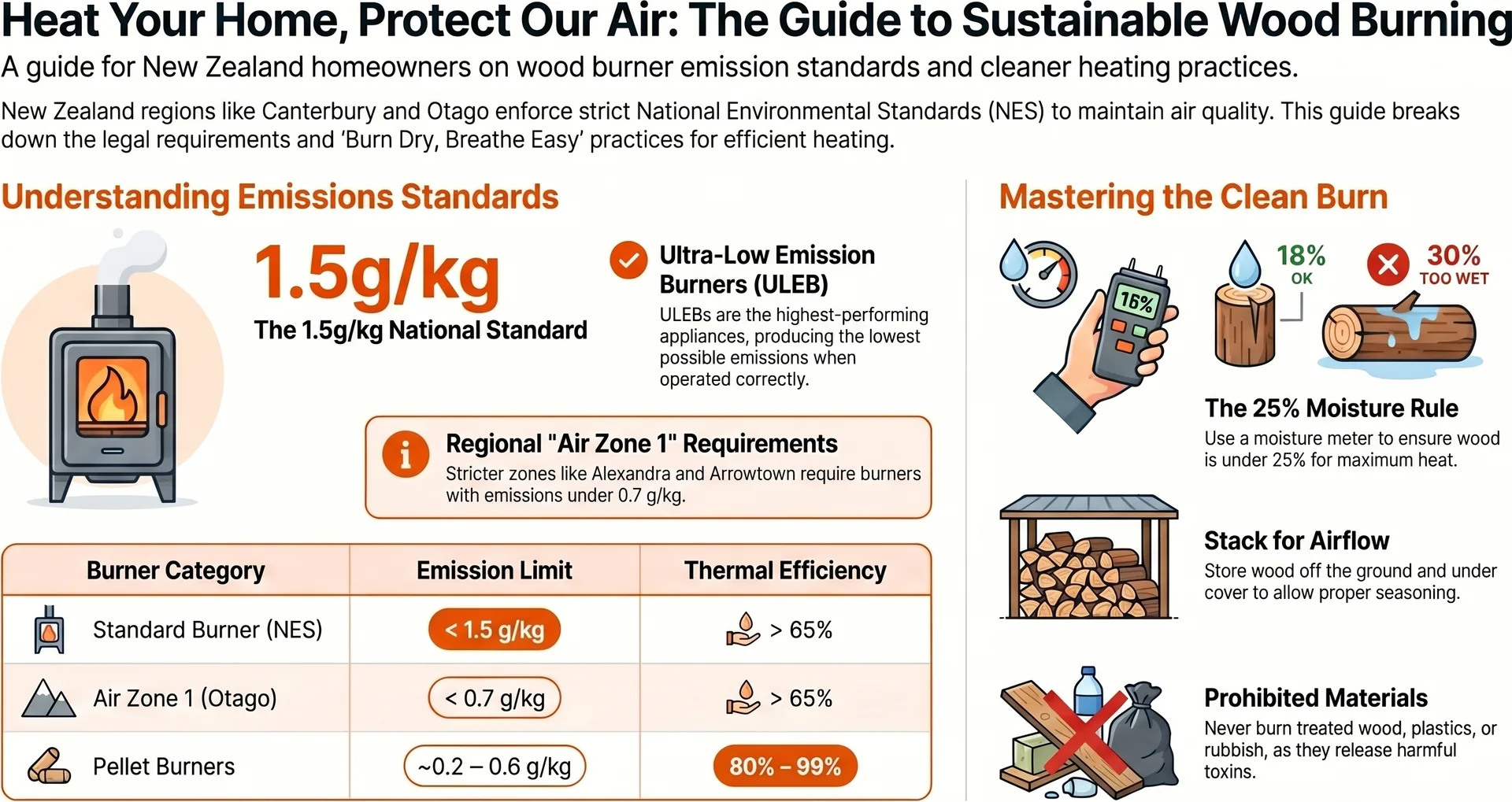
NZ has three national emission tiers: Ultra-Low Emission Burner (ULEB) under 0.4 g/kg PM10 (Canterbury mandatory), Low Emission Burner (LEB) under 1.0 g/kg, and Clean Air standard under 1.5 g/kg. The 2-hectare rule: properties 2 ha or larger can burn any approved wood burner regardless of regional plan. Canterbury's ECan Clean Air Zone is phasing out even LEBs in high-density areas — only ULEBs approved for new installs. Otago Air Zone 1 (Alexandra, Arrowtown, Clyde, Cromwell) caps at 0.7 g/kg. Support: Warmer Kiwi Homes covers 80% of insulation + 80% of approved heating capped at $3,000 per household.
Key Answers
- What are the three NZ wood burner emission tiers?
- Ultra-Low Emission Burner (ULEB): under 0.4 g/kg PM10 and combustion efficiency at the CM1 standard. This is mandatory for new installs in Canterbury's Clean Air Zone and strongly preferred by Auckland and Wellington councils. Low Emission Burner (LEB): under 1.0 g/kg PM10. Accepted for new installs in most NZ regions outside Canterbury's strictest zones. Clean Air standard: under 1.5 g/kg. Minimum for any new NZ install since 2005 via the National Environmental Standards (NES). All three are measured under AS/NZS 4012 and 4013 test conditions.
- What is the 2-hectare rule and does it apply to me?
- Properties of 2 hectares or larger can install and operate most approved wood burners regardless of regional plan restrictions. This is a national rule embedded in the NES for Air Quality (2004). If your section is smaller than 2 ha and you are in an urban or semi-urban zone, regional council Clean Air rules apply. The 2 ha boundary is measured from the title, not the house footprint. Rural lifestyle blocks on the city fringe frequently use this exemption — confirm your section area with a land title search before assuming you qualify.
- What does Canterbury's Clean Air Zone actually prohibit?
- Environment Canterbury (ECan) runs the strictest air quality rules in NZ. In the Canterbury Clean Air Zone (which covers greater Christchurch plus Selwyn and Waimakariri districts), only ULEBs (under 0.4 g/kg) are approved for new installs. LEBs (1.0 g/kg tier) can remain in use where previously installed but cannot be replaced with another LEB — the replacement must be a ULEB. ECan's Burn Dry Breathe Easy programme provides enforcement (monitoring patrols in winter) and education. Phase-out deadlines for older coal burners in Christchurch city have already passed; only clean-air compliant solid fuel burners remain legal in the urban core.
- Which other regions have tighter rules than the national NES?
- Otago Regional Council's Air Zone 1 (Alexandra, Arrowtown, Clyde, Cromwell) caps new burners at 0.7 g/kg — tighter than the national 1.5 g/kg floor but not as strict as Canterbury ULEBs. Nelson-Marlborough: the Richmond airshed has seasonal restrictions on older open fires and multi-day burning. Hawke's Bay: Napier and Hastings restrict older coal burners in the Heretaunga Plains airshed. Auckland: not a formal Clean Air Zone but consent conditions for new installations in high-density zones increasingly require LEB or ULEB standard.
- What support is available to replace a non-compliant burner?
- Warmer Kiwi Homes (EECA): 80% subsidy on insulation + 80% on an approved heating device capped at $3,000 per household. Eligibility: Community Services Card holder OR live in a high-needs school zone OR home built before 2000. Cosy Homes Trust: provides additional wrap-around support for low-income households alongside government subsidies. Aukaha Better Homes (Otago/Southland): Te Ao Marama/Aukaha-run programme for Kaupapa Maori households, coordinating heating upgrades. Habitat for Humanity: $20,000 interest-free loan for broader home upgrades including heating for eligible households. ECan's own programme funds ULEB upgrades in Canterbury air zone at council level — contact ECan direct for current round. NZ home insurance policies contain a 'reasonable steps' clause — burning a non-consented, non-compliant appliance is treated as failure to take reasonable steps, and insurers can void fire claims on this basis.
- How do I know if my current burner is compliant?
- Check the EECA approved product register (eeca.govt.nz) — all compliant burners are listed with their g/kg PM10 rating. The burner's serial plate should reference the NES or AS/NZS 4012/4013 test. If you have a pre-2005 appliance with no compliance plate, it is almost certainly non-compliant under the 1.5 g/kg national standard. A registered chimney sweep can advise on visible compliance indicators; for formal confirmation, contact your regional council.
- What happens if I burn a non-compliant burner in a Clean Air Zone?
- In Canterbury: infringement notices under the ECan Air Plan — $300 per offence, up to $300,000 for serious persistent breaches under the Resource Management Act. ECan monitors with air quality patrols during winter inversions and can issue notice to remove. Nationwide: new non-compliant installations can trigger enforcement action from regional councils or building consent authorities. Insurance implications: if a chimney fire results from a non-consented, non-compliant installation, insurers can and do decline claims. NZ home insurance policies contain a 'reasonable steps' clause — burning a non-consented, non-compliant appliance is treated as failure to take reasonable steps, and insurers can void fire claims on this basis.
Key Takeaways
- Three NZ emission tiers: ULEB (under 0.4 g/kg), LEB (under 1.0 g/kg), Clean Air (under 1.5 g/kg) — measured under AS/NZS 4012/4013
- Canterbury is the strictest: only ULEBs for new installs in the ECan Clean Air Zone; LEBs can remain but not be replaced with another LEB
- Otago Air Zone 1 (Alexandra/Arrowtown/Clyde/Cromwell) caps at 0.7 g/kg — tighter than national floor
- 2-hectare rule: sections 2 ha+ can install most approved burners regardless of regional plan restrictions
- Warmer Kiwi Homes: 80% insulation + 80% heating subsidy capped at $3,000 — Community Services Card or pre-2000 home required
What is PM10 and why does it matter?
PM10 = particulate matter under 10 micrometers diameter.
PM10 = particulate matter under 10 micrometers diameter. Small enough to be inhaled into the lungs and cause respiratory damage. Wood smoke is rich in PM10 and PM2.5 (even smaller particles). NZ's emission limit is set on PM10 because it's both measurable in lab tests and tied to the most documented health harms.
How is the 1.5 g/kg limit measured?
Lab testing under AS/NZS 4012 and AS/NZS 4013.
Lab testing under AS/NZS 4012 and AS/NZS 4013. Burners are tested across multiple burn configurations using standardised dry wood loads. The reported emission is the average across the test cycle.
Does the limit apply to old burners?
Not automatically.
Not automatically. The NES-AQ applies to new installations from September 2005. However, regional councils can mandate replacement of pre-2005 burners on their own timelines — and most councils with airsheds have done so.
What's the difference between a ULEB and a low-emission burner?
All compliant burners post-2005 are 'low emission' (≤1.5 g/kg).
All compliant burners post-2005 are 'low emission' (≤1.5 g/kg). ULEBs are a stricter sub-category — ≤0.5 g/kg, designed for restricted airsheds. ULEB is a NZHHA-certified label, not a regulatory term.
Can I install a new burner anywhere in NZ?
Yes, but it must be compliant.
Yes, but it must be compliant. Outside airsheds, any post-2005 NES-AQ-compliant burner. Inside airsheds, only ULEB-approved or council-specifically-approved models. Always check council planning rules before purchase.
What happens if I bring a non-compliant burner from another country?
Imported burners must pass NZ-specific testing under AS/NZS 4012/4013 to be sold and installed legally in NZ.
Imported burners must pass NZ-specific testing under AS/NZS 4012/4013 to be sold and installed legally in NZ. Most international burners aren't tested. Council inspectors can require removal of unapproved imports, and insurance may not cover them.
| Regional Council | standard emission limit | restricted-airshed emission limit | ULEB requirement | pre-2005 phase-out timeline | subsidy amount | Source |
|---|---|---|---|---|---|---|
| Environment Canterbury | Not in source | LEBs (<1.0 g/kg) being phased out in most Clean Air Zones | 38 mg/MJ useful energy (CM1 test) and thermal efficiency \ge 65% | In Rangiora, Kaiapoi, Christchurch, and Ashburton: use until 20 years old; Timaru: use until 15 years old | Not in source | [1] |
| Otago Regional Council | <1.5 g/kg and \ge65% efficiency (Air Zones 2 and 3) | <0.7 g/kg and \ge65% efficiency (Air Zone 1: Alexandra, Arrowtown, Clyde, Cromwell) | Noted as most efficient; specific limit not defined beyond Air Zone 1 standard | Not in source | Warmer Kiwi Homes: 80-90% insulation cost, 80% heater cost (capped at $3,000) | [2] |
| Tasman District Council | <1.5 g/kg and >65% efficiency (for properties <2 hectares) | Not in source | Not in source | Applies to burners installed after 1 September 2005 | Not in source | [3] |
| Nelson City Council | Not in source | Must be replacement from authorised list under rule AQr.25 | Not in source | Not in source | Not in source | [3] |
Data compiled from research by Chimney Guys
Frequently Asked Questions
Can I still use my old burner that was installed before 2005?
In most NZ regions, existing pre-2005 burners can remain in use until they need replacing. Canterbury is the exception — ECan has phase-out timelines for older coal burners in Christchurch city (already passed). When an older burner needs replacing, replacement must meet current standards for that region (ULEB in Canterbury, LEB or better elsewhere). Do not assume "grandfathered" status is permanent — check your regional council's air plan.
Does my open fire need to comply with emission limits?
Open fires are treated differently to enclosed wood burners. New open fires have been banned in urban areas under NES restrictions since 2005. Most existing open fires in urban NZ are technically non-consented for ongoing use in Clean Air Zones. A registered sweep can inspect and advise. Converting to an enclosed ULEB-rated insert is the most common upgrade path — often subsidy-eligible under Warmer Kiwi Homes.
I bought a house with a wood burner — how do I check if it's compliant?
Request the building consent and code compliance certificate for the heating install from your council (LIM report covers this). Then check the EECA approved product register. If the appliance was installed post-2005 and has a consent, it passed the NES standard applicable at time of install. If no consent exists, it may need a retrospective assessment — talk to your regional council.
My Warmer Kiwi Homes application was declined — what else is available?
Cosy Homes Trust works alongside EECA and can sometimes bridge households that fall just outside EECA eligibility. ECan has its own Canterbury-specific programme with different eligibility thresholds. Habitat for Humanity's interest-free loan covers households not eligible for direct subsidy. Te Puni Kōkiri manages separate funding for Māori homeownership that includes heating upgrades.
Is Canterbury's ULEB requirement new?
No — ECan's ULEB requirement for new installs in the main Christchurch airshed has been in place since 2014. The ongoing tightening is in the phase-out timeline for LEBs already installed. Check the current ECan Air Plan (available on ecan.govt.nz) for the most current phase-out schedule, as it is updated through annual plan rounds.
Think You've Got It?
10 questions to test your understanding — instant feedback on every answer
Question 1 of 10
Under the National Environmental Standards (NES) for Air Quality, what is the maximum particulate discharge allowed for a wood burner on a property smaller than two hectares?
Question 2 of 10
According to the Canterbury Method 1 (CM1), which specific emissions and efficiency standards must an Ultra-low Emission wood Burner (ULEB) meet?
Question 3 of 10
In Otago's Air Zone 1, which includes Alexandra and Arrowtown, what is the maximum permitted emission rate for a domestic burner?
Question 4 of 10
Why are pellet burners generally excluded from the specific testing method defined in the National Environmental Standard (NES) for Air Quality?
Question 5 of 10
What is the maximum recommended moisture content for firewood to ensure efficient combustion and minimal smoke production?
Question 6 of 10
Under the EECA 'Warmer Kiwi Homes' programme, what percentage of the cost is typically covered for the installation of a new heating appliance?
Question 7 of 10
Which burner classification applies to fireplaces that often exceed 1.5 g/kg in emissions and are typically only permitted on properties larger than two hectares?
Question 8 of 10
What happens to the compliance status of an authorised burner if unapproved modifications are made to the appliance?
Question 9 of 10
Which sounds and visual cues indicate that firewood is dry enough to be burned efficiently?
Question 10 of 10
In Canterbury, what determines the replacement date for an existing solid fuel burner according to the Regional Air Plan?
Need a chimney sweep?
Tell us where you are and what you need. We'll match you with a verified local sweep and have them in touch within one business day.