What Happens During a Chimney Sweep — NZ 2026
A professional NZ chimney sweep is a methodical 30–60 minute, seven-step service: floor protection, inspection, mechanical brushing, HEPA vacuum capture, optional CCTV, draught test, and certificate. This guide walks through each step, the tools used, and what to expect from your safety report.
Quick Answer
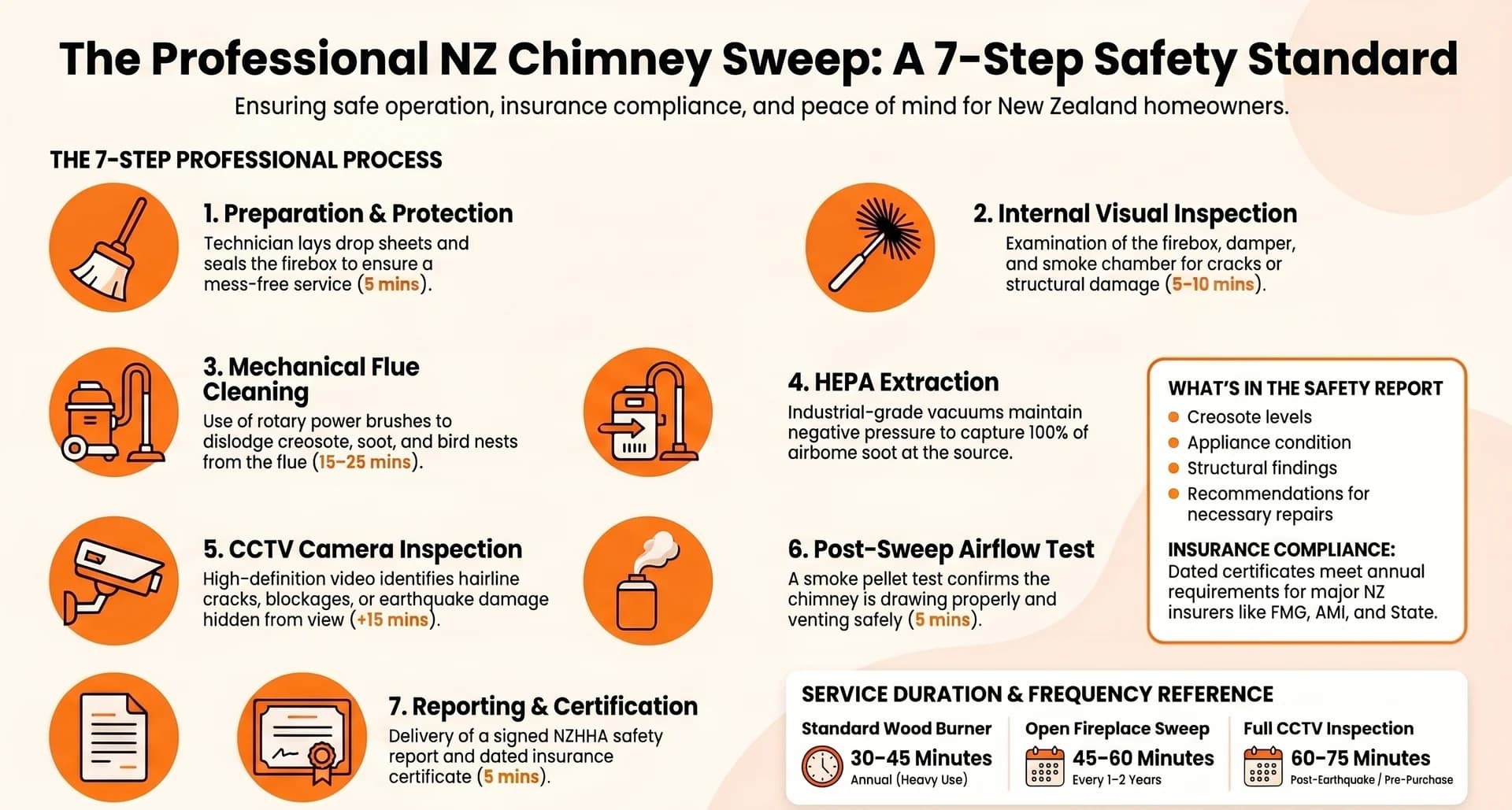
A professional NZ chimney sweep takes 30–60 minutes and follows a fixed sequence: floor protection, firebox and flue inspection, mechanical brushing (top-down or bottom-up) with HEPA vacuum capture, optional CCTV inspection, post-sweep airflow test, and a written safety report and dated certificate. NZHHA-certified sweeps follow AS/NZS 2918 and provide certificates accepted by all major NZ insurers.
Key Answers
- What does a professional chimney sweep actually do?
- A professional chimney sweep removes creosote, soot, ash, and obstructions from your flue using rotating brushes and a high-suction HEPA vacuum, then inspects the firebox, damper, smoke chamber, and chimney exterior for damage, completing with a written safety report and insurance certificate.
- How long does a professional chimney sweep take in NZ?
- Most residential chimney sweeps take 30–60 minutes. Add 15–20 minutes for a CCTV camera inspection. Roof-access jobs, decommissioning, or bird-nest removal can push the visit to 90–120 minutes.
- Will my house get dirty during a chimney sweep?
- No — modern NZ chimney sweeps use sealed dust sheets, HEPA-filtered vacuums, and negative-pressure systems that capture soot at the source. A correctly performed sweep leaves no visible mess in the room.
- Do I need to be home during the chimney sweep?
- Yes for the start and end of the visit. The middle 20–30 minutes does not require supervision; the technician needs you for the firebox walk-through at the start and the safety report at the end.
- What do I get at the end of the visit?
- A written safety report describing the chimney's condition, photographs or CCTV stills of any concerns, recommendations for repairs, and a dated NZHHA-format certificate that NZ insurers accept as proof of annual maintenance.
Key Takeaways
- A standard NZ residential chimney sweep takes 30–60 minutes and follows a seven-step process from preparation to certificate
- Modern sweeps use HEPA-filtered vacuums and sealed dust sheets — a correctly performed sweep leaves no mess in the room
- Bottom-up sweeping is the NZ default; top-down (roof-access) sweeping adds $30–$50 and is reserved for specific chimney types
- CCTV camera inspections are an $80–$150 add-on that detects hairline cracks, hidden creosote, and earthquake damage no torch inspection can find
- NZHHA-format certificates are accepted by all major NZ insurers including FMG, AMI, AA, Tower, and State as proof of annual maintenance
- Keep at least the last six years of chimney sweep certificates filed with your insurance documents
Should you stay home or leave during the sweep?
Be home for the first 5–10 minutes (firebox walk-through) and the final 5–10 minutes (report walk-through). The middle 20–30 minutes does not need supervision.
At the start: show the technician to the fireplace, mention concerns, confirm appliance details. During the sweep: stay nearby but the technician does not need supervision. At the end: walk through the report, confirm recommendations, receive the certificate, and pay. Most NZ sweeps accept card, EFTPOS, or bank transfer; cash is less common in 2026.
What happens during a professional chimney sweep?
A professional NZ chimney sweep follows a defined seven-step process: floor protection, inspection, brushing, HEPA vacuum capture, optional CCTV, draught test, and written certificate.
The technician removes creosote, loose soot, fine ash, fly-ash from the smoke shelf, and any bird nests or debris. NZHHA-certified sweeps follow the AS/NZS 2918 servicing standard. A standard residential job runs 30–60 minutes; the seven-step structure is consistent across NZ practitioners.
How does the chimney sweep prepare your home before starting?
Preparation takes about five minutes: drop sheets across the hearth, sealed firebox curtain, HEPA vacuum hose connected, and any decorative screens or ash pans removed.
The technician seals the firebox with a heavy-duty plastic curtain or magnetic shield, opens the damper, and positions a HEPA vacuum hose through a gasketed port. Homeowners help by not lighting a fire for 24 hours before the visit, removing mantelpiece ornaments, and clearing a 2-metre access path. Pets and small children should stay in another room while soot extraction is active.
What does the initial chimney inspection cover?
A 5–10 minute visual inspection of the firebox, damper, smoke chamber, flue liner, mortar joints, and (if access allows) the roof-side termination — looking for cracks, debris, and earthquake damage.
Findings shape how the brushing is performed. A cracked liner means softer brushes. Heavy Stage 3 glazed creosote may need chemical pre-treatment. The inspection is particularly important in seismic regions — Wellington, Canterbury, Hawke's Bay, and Gisborne — where flue damage from past earthquakes is common but invisible from inside the house.
Top-down vs bottom-up chimney sweeping — what's the difference?
Bottom-up sweeping starts from the firebox; top-down starts from the chimney pot on the roof. Both clean the same surfaces. Bottom-up is the NZ default; top-down adds $30–$50 and requires safe roof access.
Bottom-up sweeping avoids working at height, complies with WorkSafe height-safety rules without scaffolding, and works for the typical NZ wood burner with a straight stainless steel flue. Top-down is preferred for older masonry chimneys with multiple offsets, bird-nest removal, or any chimney where the upper section has heavier deposits than the lower flue.
What tools and brushes do professional chimney sweeps use?
Polypropylene rotary brushes for stainless flues, steel wire brushes for masonry, sectional fibreglass rods, HEPA-filtered vacuum, and pole-mounted CCTV camera. Power drills drive the brushes at 200–500 rpm.
Polypropylene bristles flex around bends without scoring liners. Steel wire brushes are reserved for masonry chimneys or heavily glazed creosote. Power-sweep rotary chains handle Stage 3 glazed deposits but require post-sweep CCTV verification. The HEPA vacuum maintains negative pressure at the firebox seal so soot moves toward the filter rather than into the room.
How does a CCTV chimney inspection work?
A high-definition camera mounted on flexible rods records the entire flue interior, smoke chamber, and firebox. The technician views the live feed and saves stills or video for the homeowner's records.
CCTV detects issues invisible to a torch-and-mirror check: hairline cracks, mortar joint failure, hidden creosote pockets, earthquake damage to upper sections, bird nests out of sight, and liner separation at joints where flue gases could escape into the home. NZ pricing: $80–$150 add-on. NZ insurers will accept CCTV stills as supporting evidence in fire claims.
How long does a professional chimney sweep take?
Standard residential wood burner: 30–45 minutes. Open fireplace: 45–60 minutes. With CCTV: 60–75 minutes. Top-down with roof access: 60–90 minutes. Bird-nest removal or pre-purchase inspection: 90–120 minutes.
A first sweep on a chimney that has been neglected for several years sits at the upper end of the range — heavier creosote means more brushing time and additional care to avoid liner damage. Annual sweeps on a well-maintained chimney sit comfortably at 30–35 minutes.
What does the post-sweep airflow check involve?
A 5-minute draught test using a smoke pellet, lit match, or combustion analyser to confirm the chimney is drawing properly and the firebox is clear of obstructions.
If the test reveals continued spillage or weak draw, the technician investigates causes that brushing alone cannot fix: cold flue, negative house pressure from extractor fans, insufficient air supply in airtight modern homes, chimney height failing NZ Building Code clearances, or cap and cowl restrictions. These structural issues are documented in the report and may require follow-up by an installer or builder.
What is in the chimney sweep safety report?
Property and appliance details, pre-sweep condition (creosote stage, debris, structural concerns), work completed, post-sweep condition with draught test result, recommendations, and photographs of any concerns.
A typical NZ sweep report is one or two pages and is included in the standard service — there should be no extra charge. If the sweep recommends repairs, the report should describe the issue plainly enough that you can show it to a builder, chimney repair specialist, or insurer without needing the original technician to translate.
What does the certificate include for insurance purposes?
Date, property address, technician name and NZHHA membership number, appliance type and serial, flue type and material, statement of work, pass/fail status, and signature.
The certificate is separate from the safety report and serves a single purpose: dated, signed proof that the chimney was professionally maintained. Keep certificates filed with your insurance documents. NZ insurers including FMG, AMI, AA Insurance, Tower, and State all accept NZHHA-format certificates as evidence of due maintenance.
What is the bottom line?
A professional NZ chimney sweep is a 30–60 minute methodical service that protects your home, satisfies your insurer, and gives you a written record of the chimney's condition.
The visible part of the visit is the brushing. The valuable part is the inspection that catches earthquake damage, the CCTV that documents hidden creosote, the airflow test that confirms safe combustion, and the certificate that protects a future fire claim. Book in spring or early autumn, set aside an hour, prepare the room, and file the certificate. Repeat annually.
| Job Type | Typical Duration | What's Included | Indicative NZ Price Range | Source |
|---|---|---|---|---|
| Standard residential wood burner sweep | 30–45 minutes | Floor and hearth protection, firebox and flue inspection, mechanical brushing, HEPA vacuuming, post-sweep airflow test, written safety report, and insurance certificate. | $130 - $150 + GST | [1, 2] |
| Open fireplace sweep | 45–60 minutes | Hearth protection, visual inspection of damper and smoke chamber, mechanical brushing, soot removal via HEPA vacuum, draught test, safety report, and insurance certificate. | $130 - $180 + GST | [2, 3] |
| Sweep with CCTV inspection add-on | 60–75 minutes | Standard sweep (brushing and vacuuming) plus HD video recording of flue interior, pan-and-tilt inspection of mortar joints/seams, and digital stills for insurance evidence. | $210 - $300 + GST | [2] |
| Top-down sweep with roof access | 60–90 minutes | Roof-side termination inspection, brush lowered from chimney top using rods or weighted cables, HEPA vacuuming from base, and safety certification. | $160 - $200 + GST | [2] |
| Sweep with bird-nest or obstruction removal | 90–120 minutes | Removal of nesting material/debris, specialized brushing, CCTV verification of clear flue, and post-removal airflow diagnostics. | $130 - $150 + GST (Base price + hourly add-on) | [2-4] |
| Decommissioning sweep | 90–120 minutes | Thorough flue cleaning to remove all combustible residues, blocking and sealing of the chimney to prevent airflow and moisture entry. | $130 - $150 + GST (Starting base price) | [2] |
| Pre-purchase inspection sweep with full CCTV report | 90–120 minutes | Full mechanical sweep, HD CCTV camera survey of flue/structure, compliance check against AS/NZS 2918, earthquake damage assessment, and full written report with video/stills. | $210 - $300 + GST | [2] |
Data compiled from research by Chimney Guys
Frequently Asked Questions
Why does the fire need to be out for 24 hours before a sweep?
Hot bricks, residual embers, and warm flue surfaces release acrid fumes when disturbed by the brush, can damage rotary equipment, and create a burn risk for the technician. NZ chimney sweeps will refuse to start a sweep if the firebox is still warm — this is an industry-wide safety rule.
Is top-down sweeping more thorough than bottom-up?
No — both methods clean the same surfaces. The brush makes contact with the entire flue interior in either direction. The choice is operational (access, chimney shape, weather) rather than quality-related.
Can a chimney sweep work in the rain?
Bottom-up sweeps proceed in any weather. Top-down sweeps require dry roof conditions for WorkSafe compliance — wet metal roofs are a fall risk. Most NZ sweeps will reschedule top-down jobs in heavy rain or high wind.
Do I need a CCTV inspection every year?
No. An annual CCTV inspection is overkill for most NZ homes. Schedule a CCTV inspection in three scenarios: when buying a property, after any earthquake of magnitude 5.0 or greater within 50 km, or when your annual sweep finds anything unusual.
How long should I keep my chimney sweep certificates?
Keep at least the last six years of certificates. NZ insurance claims can reach back several years if the cause of fire is disputed, and a continuous maintenance record is the strongest defence against a claim being declined.
Will a chimney sweep certificate from a non-NZHHA technician be accepted?
Most NZ insurers accept any clearly documented certificate showing date, technician details, and work performed. NZHHA certificates carry more weight because the certification itself confirms training and competency. If your sweep is not NZHHA-certified, ask whether they meet AS/NZS 2918 servicing standards before booking.
Think You've Got It?
10 questions to test your understanding — instant feedback on every answer
Question 1 of 10
Why is it considered essential to use a CCTV camera after attempting to remove a bird's nest from a chimney?
Question 2 of 10
According to the New Zealand industry guidelines, why must a fire be extinguished at least 24 hours before a professional sweep arrives?
Question 3 of 10
What is the primary difference between 'bottom-up' and 'top-down' chimney sweeping methods?
Question 4 of 10
In coastal regions like Lyall Bay or Porirua, why might a chimney require more frequent servicing than a standard inland installation?
Question 5 of 10
Which substance is described as a highly combustible tar-like byproduct of incomplete wood combustion that can ignite at 370° C?
Question 6 of 10
What is the primary function of a post-sweep airflow or draught test?
Question 7 of 10
What should a landlord in New Zealand provide as proof of annual chimney maintenance to comply with legal and insurance obligations?
Question 8 of 10
Which tool is specifically mentioned as being used to capture fine particles and prevent mess during a modern chimney sweep?
Question 9 of 10
True or False: A standard CCTV inspection is a mandatory requirement for every annual chimney sweep in New Zealand.
Question 10 of 10
What is the recommended frequency for sweeping a chimney that is used daily throughout the winter months?
Need a chimney sweep?
Tell us where you are and what you need. We'll match you with a verified local sweep and have them in touch within one business day.