How to Season Firewood NZ — Step-by-Step Guide
How long firewood actually takes to season in NZ — by species, climate zone, and stacking method. Target under 20% moisture. Manuka needs 3-5 years; Blue Gum 5-6 years; Oak 18-24 months; Pine 6-12 months. Properly seasoned wood delivers 40-60% more usable heat than green. Includes the four-test verification method NZ sweeps actually use on-site.
Quick Answer
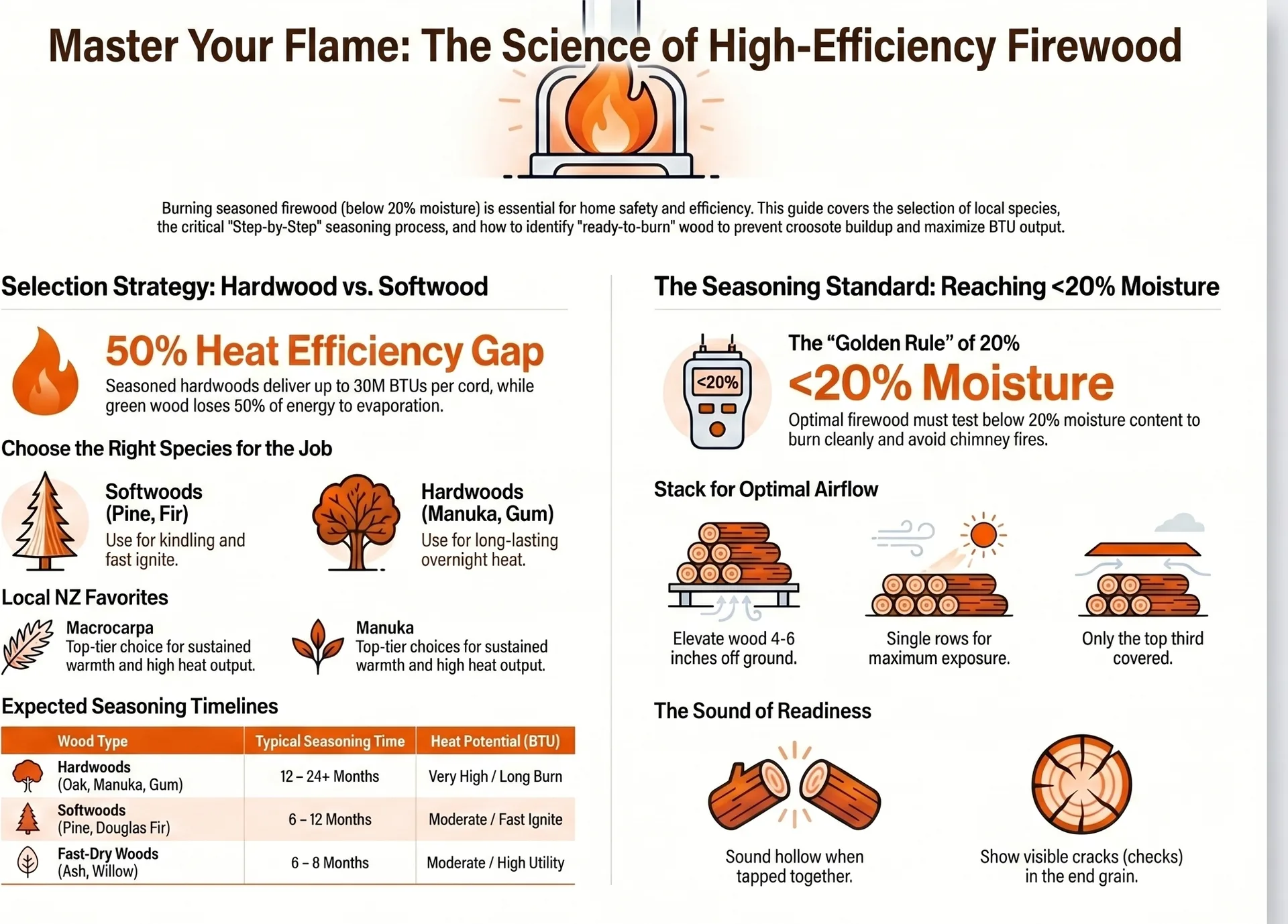
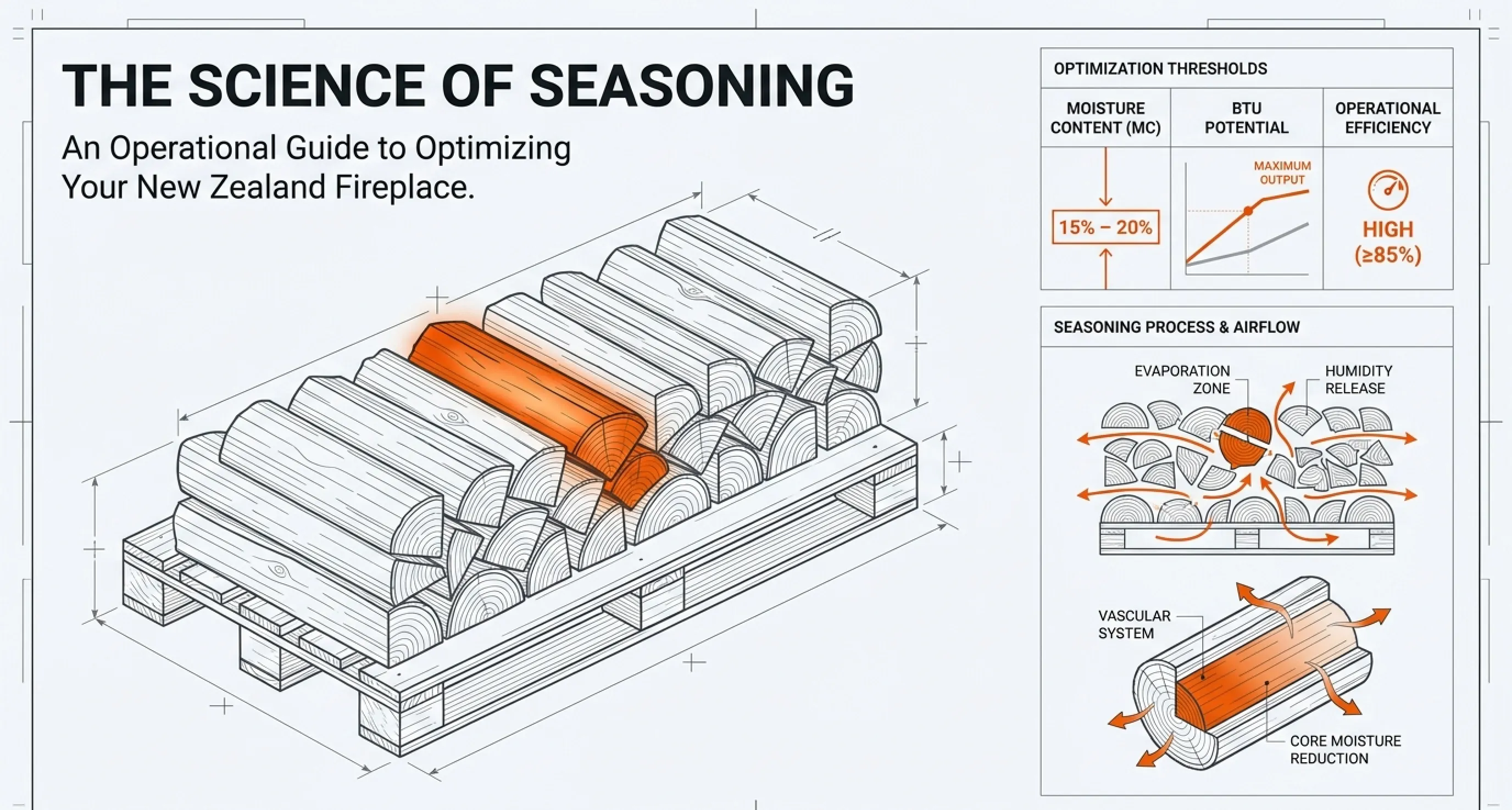
Target under 20% moisture — that is the point at which wood burns efficiently, produces the least creosote, and releases 40-60% more usable heat than green wood. NZ species seasoning times: Pine 6-12 months (fastest), Oak 18-24 months, Manuka 3-5 years (dense, slow), Blue Gum 5-6 years (densest common NZ species). Stack split wood bark-down off the ground, cover only the top third with a breathable cover (not plastic wrap — traps moisture), and use the three-year rotation method (years 1, 2, 3 stacks in sequence). Check with a pin-style moisture meter pressed across the grain on a freshly-split face — not on the bark.
Key Answers
- What moisture content should firewood reach before I burn it?
- Under 20% moisture by weight is the industry standard for clean, efficient burning. Under 15% is ideal for maximum heat output. Above 25% is the danger zone — wet wood produces 3x more creosote, half the usable heat, and is the leading cause of NZ chimney fires. Fresh green logs are 35-60% moisture. "Seasoned" wood purchased from a supplier should be under 25% at minimum, but always verify — suppliers vary significantly and NZ outdoor storage in winter can re-wet stacks.
- How long does each NZ species actually take to season?
- Pine (macrocarpa, radiata): 6-12 months — fastest to season, high resin content means the first 6 months should ideally be avoided. Oak: 18-24 months — dense hardwood, reliable heat output once seasoned, commonly available in Nelson, Hawke's Bay, Canterbury. Manuka: 3-5 years — one of the densest NZ native timbers, exceptional heat output but extremely long seasoning time. Blue Gum (eucalyptus): 5-6 years — the densest common NZ firewood species, outstanding burn time but requires patience. Willow and poplar: near-immediate (6-8 weeks if split and stacked) — low density, burns hot-fast, good summer-drying kindling. Avoid treating any of these as interchangeable in seasoning time.
- What is the correct way to stack firewood for fast seasoning?
- Three proven NZ-compatible methods. Parallel stacks: single-row, bark facing down (bark slows moisture escape if bark-up), elevated off ground by 10-15 cm minimum (pallets or rails — direct ground contact causes bottom-row decay in NZ humidity). Cover only the top third of the stack with a breathable cover (tin roofing, corrugated iron, shade cloth) — never plastic wrap, which traps moisture and creates condensation against the wood. Criss-cross stacking: alternating log directions at ends for structural stability — useful for unsupported stacks over 1.2 m tall. Holzhausen (round wood pile): circular beehive stack with central air chimney — aesthetically appealing but requires level ground and works best for smaller mixed-species quantities.
- What is the three-year rotation method?
- Cut and split in Year 1, stack in Year 1 stack area. In Year 2, repeat in an adjacent Year 2 area. In Year 3, burn from Year 1 (fully seasoned by now for most species), split for Year 3 area, and so on. By Year 3 you are always burning 2-3 year-old wood and never running short mid-winter. Most NZ homeowners who complain about wet firewood are buying or cutting too late (March-May) for that winter — the wood has not had a full summer to dry.
- How do I verify my firewood is ready to burn?
- Four tests NZ sweeps use on-site. (1) Moisture meter: pin-style meter, freshly-split face, pins pressed across the grain, three readings averaged — target under 20%. (2) Visual: properly seasoned wood turns grey-dull (not bright white), end grain shows radial cracks. (3) Sound: split two pieces and knock them together — dry wood produces a sharp clack; wet wood a dull thud. (4) Ember test: lit dry wood produces glowing embers with minimal smoke after the initial ignition; wet wood smoulders, smokes heavily, and produces little flame.
- What wood should I never burn?
- Four categories. Treated timber (H3, H4, H5 CCA, LOSP): burning releases arsenic, chromium, and other preservative toxins — illegal to burn under NZ waste regulations and highly toxic. Old Man Pine (Pinus radiata near saltwater): heavy resin content even when seasoned — dangerous creosote accumulation. Driftwood: concentrated salt deposits corrode metal flue liners and produce toxic chlorine gas compounds. Household rubbish and painted timber: untested combustion products, toxic fume risk, and voids chimney insurance. If in doubt about the timber source, do not burn it.
Key Takeaways
- Target under 20% moisture — above 25% produces 3x more creosote and half the heat output
- NZ species times: Pine 6-12mo, Oak 18-24mo, Manuka 3-5yr, Blue Gum 5-6yr, Willow 6-8 weeks
- Stack bark-down, elevated off ground, cover top third only with breathable material — never plastic wrap
- Three-year rotation: cut/split Year 1, burn from Year 1 in Year 3 — never run short mid-winter
- Never burn treated timber, Old Man Pine, driftwood, or household rubbish — toxic and insurance-voiding
What's the difference between seasoning and kiln-drying?
Seasoning is air-drying over months/years.
Seasoning is air-drying over months/years. Kiln-drying is forced drying in a kiln over hours/days at 60-90°C. Kiln-dried wood is faster but more expensive ($300-$450/cord vs $200-$350 seasoned). Both work — kiln-dried is just paying for time saved.
Can I season wood faster?
Marginally.
Marginally. Splitting smaller (10-12cm) speeds drying ~20%. Stacking in a windier, sunnier spot speeds drying ~15%. Mid-season re-stacking speeds drying ~10%. Combined, you can shave 3-6 months off typical seasoning times. But you cannot turn 24-month manuka into 6-month wood.
What if my wood develops fungus during seasoning?
White or grey fungal patches on the bark are normal — they don't affect burning quality.
White or grey fungal patches on the bark are normal — they don't affect burning quality. Black mould or soft punky wood IS a problem — usually means the bottom row got damp or the stack was wrapped. Discard punky logs; the rest of the stack is usually salvageable.
How do I know if my wood is seasoned without a meter?
Visual checks are unreliable.
Visual checks are unreliable. Look for: greyish/silvery weathered ends (not bright/orange — that's fresh), cracks radiating from the centre, lighter-than-expected weight when picked up, hollow sound when knocked together. But these only suggest dryness — only a moisture meter confirms it.
Should I season the bark on or off?
Bark on.
Bark on. Bark protects against rain while the cut faces dry. Stripping bark exposes too much moisture-absorbing surface area and accelerates fungal damage on the outside.
What if I run out of seasoned wood mid-winter?
Buy kiln-dried at $300-$450/cord — expensive but available year-round.
Buy kiln-dried at $300-$450/cord — expensive but available year-round. Or mix the wettest of your stack 1:3 with the driest. Or buy partially-seasoned (~30% moisture) and burn small loads with active draft. Don't smoulder wet wood — that's how chimney fires start.
| species | starting moisture content | target moisture content | seasoning time months | Wood Type (Hardwood/Softwood) | Energy Output (BTUs) | Source |
|---|---|---|---|---|---|---|
| pine (plantation) | 45-100% | 15-20% | 12-24 | Softwood | Not in source | [1] |
| macrocarpa | Not in source | 15-20% | 36-60 | Softwood | 21 Million BTU per cord | [1, 2] |
| larch (Douglas Fir) | Not in source | 15-20% | 12-24 | Softwood | 20 Million BTU per cord | [1, 2] |
| eucalyptus (Blue Gum) | Not in source | 15-20% | 60-72 | Hardwood | 34.5 Million BTU per cord | [1, 2] |
| manuka (Tea Tree) | Not in source | 15-20% | 36-60 | Hardwood | Not in source | [1] |
| old-man pine | Not in source | 15-20% | 24-36 | Softwood | Not in source | [1] |
| kanuka | Not in source | Not in source | Not in source | Hardwood | Not in source | [3] |
| puriri | Not in source | Not in source | Not in source | Hardwood | Not in source | [3] |
Data compiled from research by Chimney Guys
Frequently Asked Questions
I bought "seasoned" firewood but it's still smoking — what went wrong?
Three likely causes. (1) It was not actually seasoned — many NZ firewood suppliers sell wood cut to order rather than pre-seasoned; ask specifically "what is the moisture content and when was it cut?" (2) It was seasoned but re-wet in storage or delivery — wet NZ winters can push a 20% stack back above 30% in a few weeks if not correctly covered. (3) The stack at the bottom (near ground or wall) absorbed ground moisture even though the top was fine. Always test the specific logs you are about to burn, not just the stack surface.
Does pine cause creosote problems even when dry?
Dry pine below 20% moisture burns cleanly and does not cause more creosote than dry hardwood. The "pine causes creosote" belief comes from burning green or partially-seasoned pine — resin in wet pine does cause heavy tar deposits. Dry pine is fine for occasional use; it burns hot and fast. For sustained winter burning, dense hardwoods (Oak, Manuka, Blue Gum) give longer burn times per load. Avoid fresh macrocarpa — the resin is especially high and takes the full 12-month minimum.
Can I speed up seasoning?
Yes — two practical methods. (1) Split to smaller pieces: the larger the diameter, the longer the core takes to dry. Splitting to pieces under 15 cm diameter doubles the drying surface. (2) Maximise airflow: a south-facing stack in direct wind dries faster than a sheltered north-facing one in NZ conditions (southerly winds are dry; northerlies bring humidity in many regions). Kiln-drying (available from some NZ suppliers) achieves under 12% moisture rapidly but costs more — useful if you are stocking up late.
What is the best time of year to buy or cut firewood in NZ?
November-March (summer) for the year-after winter. Wood cut or bought in November gives a full summer to dry before the following June. Buying in April-May for the same winter is almost always a mistake — the wood has had no summer drying time and will burn poorly regardless of what the supplier claims. Three-year rotation buyers who cut their own are immune to this timing problem.
My chimney sweep told me my firewood is too wet — how do I fix it mid-winter?
Short-term: bring a week's supply inside near (not touching) the wood burner to dry at room temperature. Even 2-3 days inside reduces moisture by 3-5% in a 15 cm diameter piece. Split any pieces over 15 cm in half — this dramatically speeds internal drying. Long-term: buy a separate load of kiln-dried wood for the rest of the season and start a proper seasoning stack for next year. Do not burn wet wood through the winter — one season of wet burning can produce a Chimney fire from creosote build-up. NZHHA-registered sweeps report that wet firewood is the single most common avoidable cause of chimney fires — do not burn through the rest of the season hoping it will improve.
Should I store wood inside a garage or outside?
Outside under a proper cover is better for the main stack — garages lack the airflow needed for seasoning and tend to be humid. The exception: a small working stack (1-2 weeks' worth) stored just inside a garage door or in an open-sided lean-to is fine and stays dry from rain. Never store large quantities of wood inside the house — fire risk and timber borer (a common NZ wood-boring beetle that thrives in stored firewood) infestation.
Think You've Got It?
15 questions to test your understanding — instant feedback on every answer
Question 1 of 15
According to expert recommendations, what is the ideal moisture content range for firewood to achieve maximum heat output and efficiency?
Question 2 of 15
Why is it recommended to stack firewood in a single row rather than multiple rows deep?
Question 3 of 15
When using a moisture meter to check if firewood is seasoned, where should the probes be inserted for the most accurate reading?
Question 4 of 15
What is a common consequence of 'mummifying' a firewood stack by completely wrapping it in plastic or tarps?
Question 5 of 15
Which of these New Zealand wood species is known for its fast seasoning time, often being ready to burn in as little as 6-8 months?
Question 6 of 15
How does burning wet or green wood increase the risk of chimney fires?
Question 7 of 15
What is the primary reason for elevating a firewood stack at least 4-6 inches off the ground?
Question 8 of 15
In the context of 'Wellington Fireplaces,' why is Macrocarpa typically avoided for open fires, despite its high heat output?
Question 9 of 15
True or False: Driftwood collected from the beach is an excellent, sustainable firewood source for home woodburners.
Question 10 of 15
What does the 'sound test' indicate when two pieces of firewood are knocked together?
Question 11 of 15
When splitting wood for optimal seasoning, what is the recommended diameter for individual pieces?
Question 12 of 15
What is the best way to use Plantation Pine in a wood-burning strategy?
Question 13 of 15
Why is 'Old Man Pine' often listed as a wood to avoid or use with caution?
Question 14 of 15
What visual indicator on the cut end of a log suggests that the wood has released its moisture?
Question 15 of 15
Which hardwood is often referred to as the 'King of Firewood' but requires at least 2 years of seasoning?
Need a chimney sweep?
Tell us where you are and what you need. We'll match you with a verified local sweep and have them in touch within one business day.