Landlord Chimney Maintenance NZ — 2026 Guide
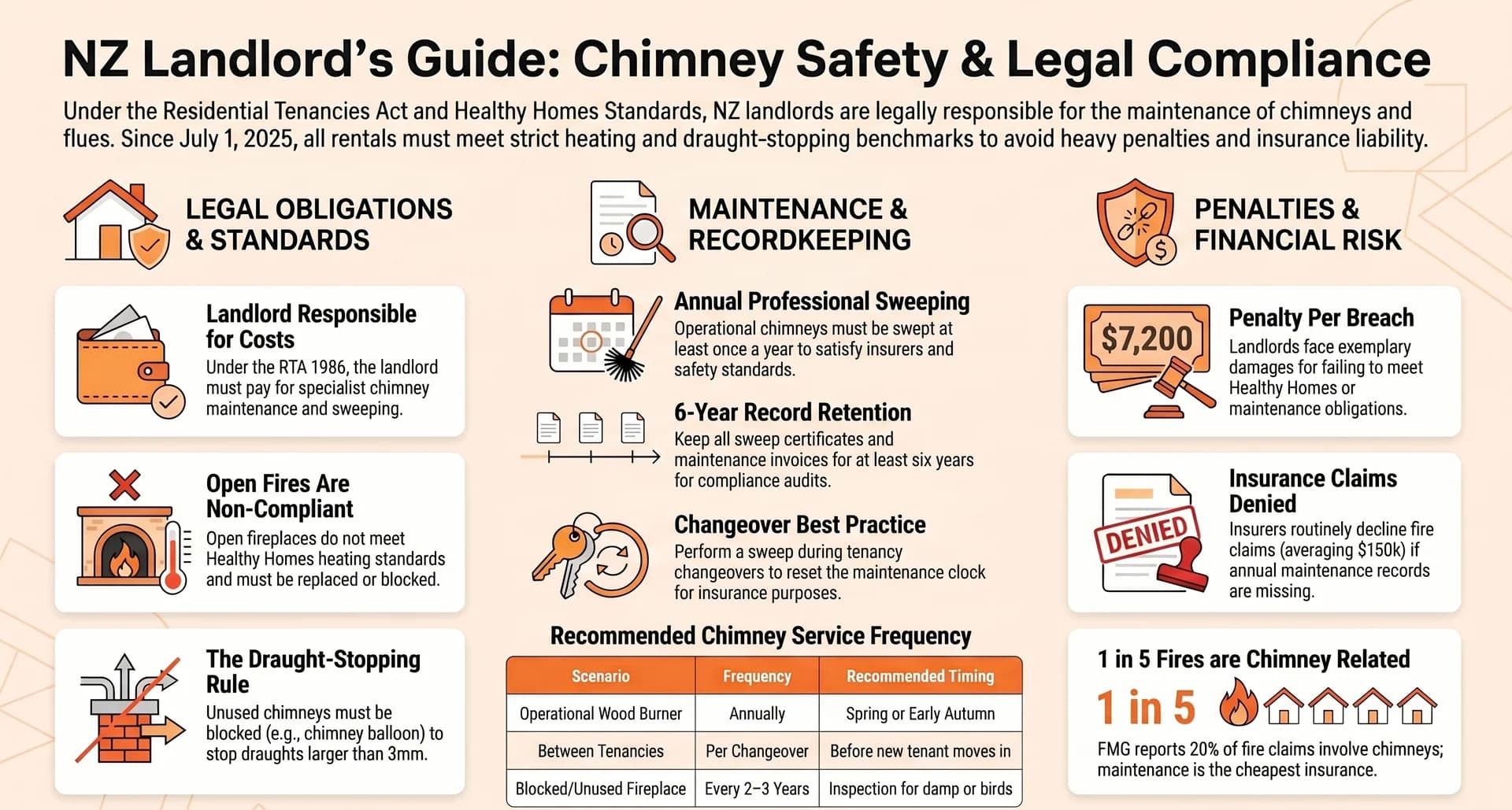
NZ landlords are legally required to maintain chimneys and fireplaces in rental properties under both the Residential Tenancies Act and the Healthy Homes Standards. Open fireplaces don't meet the heating standard — they must be replaced with a compliant heater or blocked off. Non-compliance carries penalties of up to $7,200 per breach.
Quick Answer
NZ landlords are legally required to maintain chimneys and fireplaces in rental properties under both the Residential Tenancies Act and the Healthy Homes Standards. Open fireplaces don't meet the heating standard — they must be replaced with a compliant heater or blocked off. Non-compliance carries penalties of up to $7,200 per breach. Annual chimney sweeping, documented maintenance records, and understanding which heating systems qualify are essential for every NZ landlord with a chimney in their rental.
Key Answers
- Are landlords required to sweep chimneys in rental properties?
- Yes. The Residential Tenancies Act 1986 requires landlords to maintain rental properties in a reasonable state of repair, which includes chimney and flue maintenance for any operational solid fuel appliance. Most NZ insurers also require proof of annual chimney sweeping before paying fire-related claims on rental properties.
- Do open fireplaces meet the Healthy Homes heating standard?
- No. Open fireplaces are explicitly excluded from the Healthy Homes Standards as a qualifying heating source. The heating standard requires a fixed heater with at least 1.5 kW capacity that can heat the main living room to 18°C. Landlords must either install a compliant heater (heat pump, wood burner, pellet burner, or flued gas heater) or block off the fireplace to prevent draughts.
- What happens if a landlord doesn't maintain the chimney?
- Landlords who breach their Healthy Homes obligations face exemplary damages of up to $7,200 per breach under the Residential Tenancies Act. Beyond fines, a fire in an unmaintained chimney can result in declined insurance claims, personal liability, and potential criminal negligence charges if tenants are harmed.
- Can a tenant use an open fireplace in a rental?
- A tenant can request that an unused open fireplace be made available for use. However, the open fireplace still won't count towards the Healthy Homes heating standard — the landlord must provide a separate compliant heater regardless. If the fireplace is operational, the landlord must maintain it in good working order and free of gaps.
- Who pays for chimney sweeping — landlord or tenant?
- The landlord pays. Chimney sweeping is maintenance, and under the Residential Tenancies Act 1986, the landlord is responsible for maintenance and repairs. The tenant is responsible for keeping the property reasonably clean and tidy, but chimney servicing is a specialist maintenance task that falls to the property owner.
Key Takeaways
- NZ landlords must maintain chimneys under the Residential Tenancies Act, Healthy Homes Standards, and NZ Building Code
- Open fireplaces are excluded from Healthy Homes compliance — install a heat pump or enclosed wood burner, or block the fireplace
- Non-compliance penalties reach $7,200 per breach, plus potential insurance claim denials worth $150,000+
- Sweep every operational rental chimney annually — the landlord pays, not the tenant
- Keep chimney sweep certificates and maintenance records for at least 6 years for Tenancy Tribunal and insurance protection
- Since 1 July 2025 all rentals must comply with Healthy Homes from day one of any new or renewed tenancy — no grace period
What are a landlord's chimney obligations in NZ?
NZ landlords have three distinct legal obligations relating to chimneys in rental properties: maintenance under the Residential Tenancies Act, compliance with the Healthy Homes Standards, and adherence to the NZ Building Code for any installed solid fuel appliance.
These obligations apply to all private rental properties in New Zealand. Since 1 July 2025, all rentals must fully comply with the Healthy Homes Standards from day one of any new or renewed tenancy — the previous 120-day grace period has ended.
What do the Healthy Homes Standards say about chimneys and heating?
The Healthy Homes Standards impose two requirements directly relevant to chimneys: a minimum heating capacity standard and a draught-stopping standard that covers open fireplace flues.
Every rental must have at least one fixed heater that can directly heat the main living room. The heater must have a minimum capacity of 1.5 kW and be capable of heating the main living room to at least 18°C within 2 hours. Acceptable types include heat pumps, wood burners, pellet burners, and flued gas heaters. Open fires, unflued combustion heaters, and plug-in electric heaters are not acceptable. All unused open fireplaces and chimney flues must be closed off or blocked to prevent draughts. However, tenants can request that an open fireplace be made available for use.
Why don't open fireplaces meet the heating standard?
Open fireplaces are explicitly excluded from the Healthy Homes Standards as a qualifying heating source because they are thermally inefficient and create net heat loss in most NZ homes.
An open fireplace operates at roughly 15–20% thermal efficiency — meaning 80–85% of the heat goes straight up the chimney. By contrast, a modern enclosed wood burner operates at 65–80% efficiency, and a heat pump at 300–600% efficiency (COP of 3–6). When the fire is not lit, an unblocked open fireplace acts as a ventilation shaft, drawing warm air out of the living room and replacing it with cold outside air. If a rental property has an open fireplace as its only heat source, the landlord must install a compliant fixed heater to meet the heating standard.
What heating systems qualify under Healthy Homes?
The Healthy Homes Standards specify which heating types qualify and which are excluded. Understanding this is critical for landlords deciding how to bring a rental property into compliance.
Heat pumps, enclosed wood burners (NES-compliant, ULEB where required), pellet burners, and flued gas heaters all qualify. Fixed electric heaters qualify only if the room heating requirement is less than 2.4 kW. Open fireplaces, portable LPG heaters, and plug-in electric heaters do not qualify. For landlords with existing chimneys, the two most common compliance pathways are: install a heat pump ($2,500–$5,000) and block off the unused fireplace, or install an enclosed wood burner into the existing fireplace opening ($4,500–$8,000 including consent and installation).
What should landlords do with unused fireplaces?
If a fireplace is not being used as a heat source, the Healthy Homes draught-stopping standard requires landlords to close it off or block the chimney to prevent heat loss.
Options include a chimney balloon or inflatable plug ($40–$80, fully reversible), a rigid foam board insert ($20–$50 DIY, reversible), a permanent cap with damper ($150–$350 installed), or bricking up the opening ($300–$800, not easily reversible). If a tenant requests that the fireplace be made available for use, the landlord must comply — but the fireplace must then be maintained in good working order and free of any gaps. A chimney balloon is the recommended option for most rental properties — cheap, effective, and fully reversible.
How often should rental property chimneys be swept?
Every operational chimney in a rental property should be professionally swept at least once per year. This aligns with FENZ recommendations, NZHHA standards, and the maintenance expectations of NZ insurance providers.
Moderate-use wood burners should be swept annually (spring or early autumn). Heavy daily use warrants twice per year (pre-season and mid-season). Between tenancies, sweep before the new tenant moves in. Blocked or unused fireplaces need inspection only every 2–3 years. A chimney sweep during tenancy changeover is best practice — it confirms safety for the incoming tenant, resets the maintenance clock for insurance, and identifies any damage from the outgoing tenant's use.
What chimney maintenance records should landlords keep?
Documented chimney maintenance records protect landlords in three situations: Tenancy Tribunal disputes, insurance claims, and Healthy Homes compliance audits. Keep records for at least 6 years (the limitation period for residential tenancy claims).
Essential records include chimney sweep certificates, inspection reports, repair invoices, building consent documentation, Code Compliance Certificates, Healthy Homes compliance statements, and tenant communications regarding chimney issues. Professional sweep certificates should include the date of service, technician name and qualifications, condition of the flue, work completed, recommendations for follow-up, and next recommended service date.
What are the penalties for non-compliance?
Landlords who fail to meet their chimney maintenance and Healthy Homes obligations face financial penalties, insurance consequences, and potential personal liability.
The Tenancy Tribunal can impose exemplary damages of up to $7,200 per breach for failing to meet Healthy Homes Standards and can order landlords to carry out specific work. Most NZ insurers will decline fire-related claims if the landlord cannot provide evidence of annual chimney maintenance. Using an unconsented or non-compliant wood burner can void the property's fire insurance entirely. If a tenant is injured or killed in a fire caused by a landlord's failure to maintain the chimney, the landlord may face criminal negligence charges. An annual chimney sweep costs $100–$170. Penalties for non-compliance start at $7,200. A house fire claim averages $150,000. Maintenance is always the cheapest option.
What are the insurance implications for landlords?
Rental property insurance carries specific chimney-related requirements that landlords must understand. A failure of maintenance that causes fire can result in both the claim being declined and the policy being voided.
NZ insurers require annual chimney sweeping documented with professional certificates, building consent and Code Compliance Certificate for any installed wood burner, NES-compliant or ULEB-compliant burner (depending on regional requirements), and evidence of responsive maintenance when issues are identified. When switching between tenants, have the chimney swept and inspected before the new tenant moves in. This creates a documented baseline for the new tenancy and resets the clock on your insurance maintenance record.
What about multi-property portfolios?
Landlords and property managers with multiple rental properties can systematise chimney maintenance to reduce cost, ensure compliance, and minimise administrative overhead.
Audit all properties to identify operational chimneys, blocked fireplaces, and properties needing heating upgrades. Schedule annual sweeps for all properties in the same period to get bulk pricing. Most NZ chimney sweeps offer 10–20% discounts for portfolios of 5+ properties. Property managers who are contracted to maintain rental properties share responsibility for compliance — if a property manager fails to arrange required chimney maintenance and a fire occurs, both the landlord and the property manager may face liability.
What if a tenant reports a chimney problem?
When a tenant reports a chimney issue, the landlord must respond promptly. Chimney problems that affect safety — smoke entering the living space, suspected blockages, structural cracking — require urgent attention.
Smoke entering the room is an urgent safety risk — instruct the tenant to stop using the fire immediately and arrange professional inspection within 48 hours. A suspected chimney fire is an emergency — tenant calls 111 and evacuates. Reduced performance or poor draw should be addressed within 14 days. Bird nesting sounds also within 14 days. Visible cracks in chimney brickwork require immediate cessation of use and structural assessment. Record every tenant chimney complaint and your response — date received, action taken, professional engaged, outcome. The Residential Tenancies Act requires landlords to carry out repairs as soon as possible after being notified.
What is the bottom line?
NZ landlords are legally required to maintain chimneys in rental properties, provide Healthy Homes-compliant heating (open fireplaces don't qualify), and block unused fireplaces to prevent draughts.
Non-compliance carries penalties of up to $7,200 per breach, potential insurance claim denials worth $150,000+, and personal liability if tenants are harmed. The compliance formula for landlords: sweep every operational chimney annually, install a qualifying heater if you haven't already, block unused fireplaces with a chimney balloon, keep all maintenance certificates for at least 6 years, and include heating details in your Healthy Homes compliance statement. The total annual cost is under $200 per property — a fraction of the penalties and liability exposure from non-compliance.
| type | compliant with Healthy Homes (yes/no) | typical cost to install | heating capacity | pros and cons for rental properties | Source |
|---|---|---|---|---|---|
| Heat pumps | yes | Not in source | Must be at least 1.5 kW; exact capacity depends on room size calculation. | Pros: Acceptable for HHS, efficient, must have a thermostat. Cons: Professional installation required. | [1-4] |
| Wood burners | yes | Not in source | Must be at least 1.5 kW. | Pros: Acceptable for HHS. Cons: Maintenance requirement (landlord must ensure chimney is swept regularly). | [1, 3-5] |
| Pellet burners | yes | Not in source | Must be at least 1.5 kW. | Pros: Acceptable for HHS. | [1-3, 6] |
| Flued gas heaters | yes | Not in source | Must be at least 1.5 kW. | Pros: Acceptable for HHS. Cons: Must be flued (vented to outside). | [1-4] |
| Fixed electric heaters | yes | Not in source | Must be at least 1.5 kW; only acceptable in smaller rooms/apartments where calculated requirement is low. | Pros: Cheaper upfront, acceptable in specific small contexts. Cons: Must have a thermostat, not acceptable for large rooms where required capacity exceeds 2.4 kW. | [1, 2, 4, 5] |
| Geothermal heating | yes | Not in source | Must meet specific standards. | Pros: Acceptable primarily in specific areas like Rotorua. | [1, 3, 5, 6] |
| Open fires | no | Not in source | Not applicable | Pros: Tenants can request use if in good order. Cons: Not compliant for HHS; unused ones must be blocked to prevent draughts. | [1, 2, 4, 5] |
| Portable LPG bottle heaters | no | Not in source | Not applicable | Cons: Do not meet HHS requirements; health and safety risk (unflued). | [1, 2, 4, 5] |
| Plug-in / Portable electric heaters | no | Not in source | Not applicable | Cons: Not compliant for HHS as they are not fixed heaters. | [1-3, 6] |
Data compiled from research by Chimney Guys
Frequently Asked Questions
Do these obligations apply to boarding houses and social housing?
Yes. The Healthy Homes Standards apply to all residential rental properties, including boarding houses, social housing, and Housing New Zealand properties. Boarding houses must meet the standards from the beginning of any new tenancy.
Can I convert the open fireplace to a wood burner to meet the standard?
Yes. Converting an open fireplace to an enclosed wood burner is one of the most common compliance pathways for NZ landlords. Costs range from $3,000–$7,000+ depending on the burner model, flue requirements, and building consent fees. The burner must be NES-compliant (or ULEB where required by regional council rules), and building consent is mandatory.
Is a gas fire insert an option?
A flued gas fire insert can meet the Healthy Homes heating standard if it has sufficient capacity for the room size. Unflued gas heaters do not qualify. Gas fire inserts slot into existing fireplace openings, making them a practical option for character homes where the homeowner wants to preserve the fireplace surround.
Can a landlord require the tenant to arrange their own chimney sweep?
The landlord can include chimney sweeping in the tenancy agreement as a shared responsibility, but the cost of maintenance remains the landlord's obligation under the Residential Tenancies Act. In practice, most landlords either arrange sweeping directly or reimburse the tenant for a professional sweep. Including a sweep clause in the tenancy agreement ensures it happens on schedule.
Can a tenant withhold rent because of a chimney problem?
No. Under the Residential Tenancies Act, tenants cannot withhold rent for any reason. However, if a landlord fails to address a chimney maintenance issue, the tenant can apply to the Tenancy Tribunal for an order requiring the work to be done, plus compensation for any loss or inconvenience.
Think You've Got It?
12 questions to test your understanding — instant feedback on every answer
Question 1 of 12
As of the final deadline, by what date must all rental homes in New Zealand fully comply with the healthy homes standards?
Question 2 of 12
What is the minimum heating capacity required for a fixed heater installed in the main living room of a rental property?
Question 3 of 12
According to the ventilation standard, what is the minimum required size for opening windows, doors, or skylights in a habitable room?
Question 4 of 12
For draught stopping, landlords are generally required to block any unreasonable gaps or holes that are wider than which object?
Question 5 of 12
If an extractor fan is installed in a kitchen after 1 July 2019, what is the minimum required diameter for the fan and its ducting?
Question 6 of 12
What is the maximum amount of exemplary damages a landlord may be liable to pay per breach of the healthy homes standards?
Question 7 of 12
Which type of insulation is acceptable for use under the healthy homes standards?
Question 8 of 12
When is a ground moisture barrier required to be installed in a rental property?
Question 9 of 12
For how long must a landlord retain records and documents that prove compliance with the healthy homes standards?
Question 10 of 12
Starting from 25 September 2025, the healthy homes standards explicitly override specific requirements from which older set of regulations?
Question 11 of 12
What is the required ceiling insulation thickness for a new installation in Zone 3 (colder areas of the South Island and central North Island)?
Question 12 of 12
Which of the following is an acceptable primary heating source for the main living room under the standards?
Need a chimney sweep?
Tell us where you are and what you need. We'll match you with a verified local sweep and have them in touch within one business day.