Installing a Wood Burner in NZ — Permits, Costs, Timeline
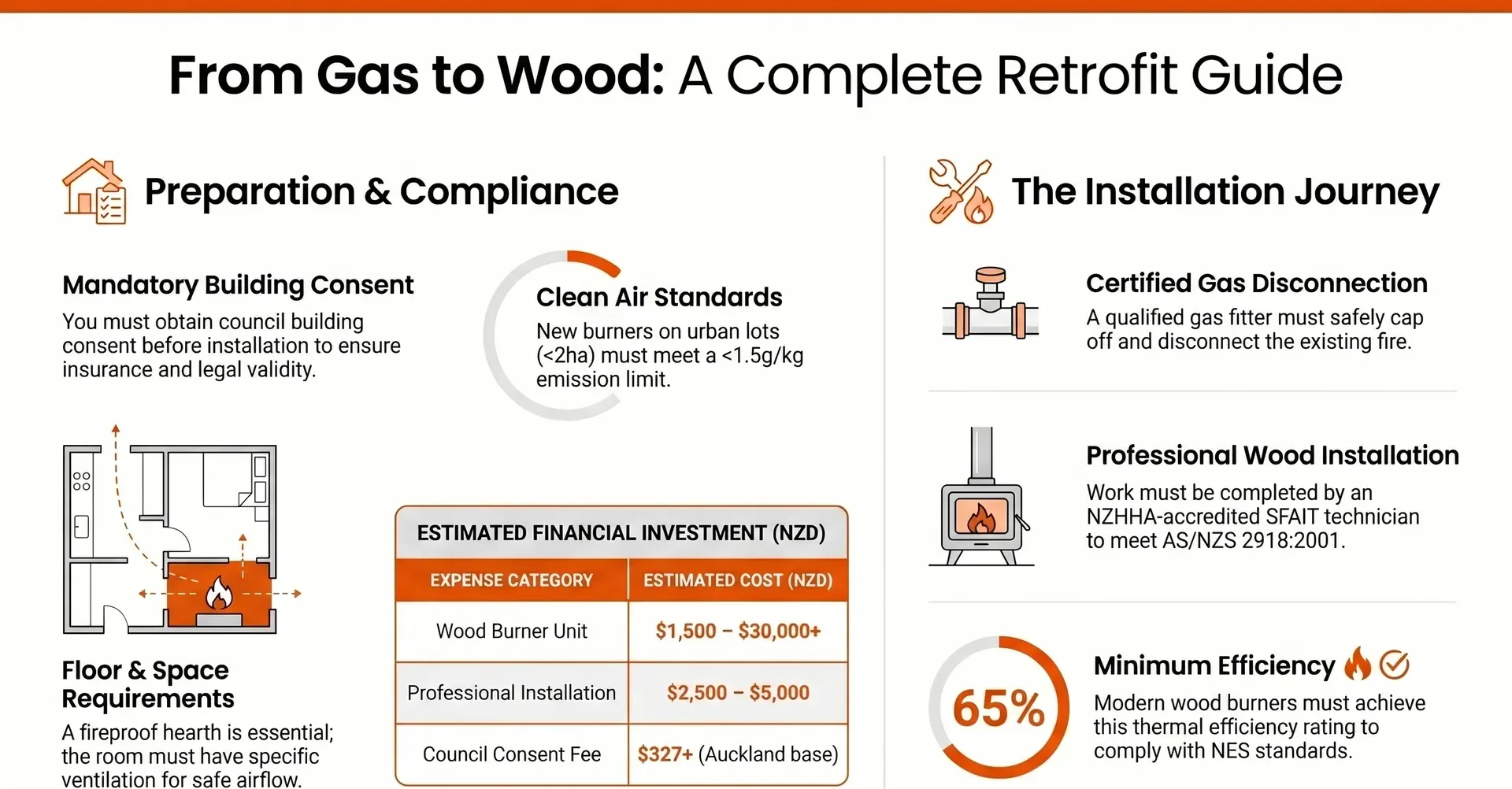
Installing a wood burner in NZ requires building consent — no exceptions. This guide covers what the consent covers, why gas-to-wood installs need a specific three-trade sequence, what the National Environmental Standards (NES) appliance requirements are, and the real cost breakdown: $1,500-$30,000+ appliance plus $2,500-$5,000 labour plus council fees.
Quick Answer
Building consent is mandatory for all NZ wood burner installs — it is Restricted Building Work. The installer must hold a Solid Fuel Appliance Installation Technician (SFAIT) certification with a 2-year refresher requirement. NES appliance standard: under 1.5 g/kg PM10 and at least 65% efficiency (tested under AS/NZS 4012/4013). Auckland fixed consent fee: $327 processing + $195 per inspection. Appliance cost: $1,500 (budget freestanding) to $30,000+ (high-end inbuilt). Labour: $2,500-$5,000 for a standard single-storey install. Gas-to-wood: gas fitter must cap the gas line first, then SFAIT installs, then certifying plumber signs off the wetback (if fitted).
Key Answers
- Do I need building consent to install a wood burner in NZ?
- Yes — always. Wood burner installation is Restricted Building Work under the Building Act 2004, meaning it must be done by a Licensed Building Practitioner (LBP) holding the Solid Fuel Appliance Installation Technician (SFAIT) designation. No consent means no Code Compliance Certificate (CCC), which means the work is unlawful and will appear on any LIM report. Insurers can decline fire claims on unconsented heating installs. The council issues consent before install and a CCC after inspection.
- What does the building consent actually check?
- The consent confirms: (1) the appliance is on the EECA approved register and meets NES air quality requirements for your zone (under 1.5 g/kg nationally, stricter in Canterbury, Otago, and other zones). (2) the flue installation meets NZS 7634 — clearances, height above roof, liner specification, and termination cap. (3) B2 Durability — 5 years for freestanding appliances (seals, gaskets, moving parts), 15 years for inbuilt/flue/hearth. (4) C/AS1 fire protection — non-combustible hearth, clearances to combustible materials. Council inspection happens after install before CCC is issued.
- What is SFAIT and why does it matter?
- SFAIT stands for Solid Fuel Appliance Installation Technician — the LBP licence class required for all wood burner and pellet fire installs in NZ. SFAIT holders must complete a 2-year refresher to remain current. Only a current SFAIT can lodge building consent for a wood fire install and take responsibility for the restricted building work. SFAST (Solid Fuel Appliance Service Technician) is the service/maintenance credential — different from SFAIT. When getting quotes, ask: "Are you a current SFAIT with your refresher up to date?"
- What are the NES emission and efficiency requirements for the appliance?
- National Environmental Standards for Air Quality (NES, in force from September 2005): any new wood burner installed in an urban area must produce under 1.5 g/kg PM10 and achieve at least 65% combustion efficiency — both tested under AS/NZS 4012 and 4013. Regional councils can impose stricter limits — Canterbury requires ULEB (under 0.4 g/kg) for all new installs in the ECan Clean Air Zone. The EECA approved product register lists every compliant appliance with its tested rating.
- How does a gas-to-wood conversion work — what is the correct sequence?
- Three trades in strict order: (1) Gas fitter caps the gas line and removes the existing gas appliance — gas work must be done first, before any new heating appliance enters the flue. (2) SFAIT installer fits the wood burner, builds the hearth, and installs the flue. (3) If a wetback (hot water heat exchanger) is fitted to the wood burner, a certifying plumber must test and sign off the wetback connection to the cylinder. Skipping or reversing this sequence creates both safety and consent issues — the gas fitter cannot certify around an installed wood burner.
- What does a NZ wood burner install actually cost?
- Appliance: $1,500-$4,000 (budget freestanding, e.g. Jayline Classic, Firenzo), $4,000-$10,000 (mid-range inbuilt or Pyroclassic), $10,000-$30,000+ (high-spec European brands, wetback system, complex custom flue). Labour: $2,500-$5,000 for a straightforward single-storey install with a standard brick or steel flue. Complex installs (multi-storey, masonry rebuild, long horizontal flue run, wetback): $5,000-$15,000+. Council fees: Auckland $327 fixed fee + $195 per inspection; other councils vary, typically $200-$500 total. Total for a mid-range install: $8,000-$18,000 all-in.
- What is B2 Durability and why does it affect my install?
- Building Code Clause B2 requires buildings to be durable for the specified design life. For wood burner installs: freestanding appliances and their moving parts (door, damper, baffle clips) must be designed to last 5 years. Inbuilt appliances and fixed components — flue liner, hearth, chimney breast masonry — must be designed to last 15 years. This affects material choice (no flimsy liner), gasket quality, and the contractor's obligation to use compliant components. Cheap thin liners that corrode within 5 years can trigger enforcement action for non-compliance with B2.
Key Takeaways
- Building consent is mandatory — wood burner install is Restricted Building Work requiring a current SFAIT (LBP) with 2-year refresher
- NES appliance standard: under 1.5 g/kg PM10 and at least 65% efficiency; Canterbury requires ULEB (under 0.4 g/kg)
- Gas-to-wood sequence: gas fitter caps first → SFAIT installs → certifying plumber signs off wetback
- B2 Durability: 5yr for freestanding appliances, 15yr for inbuilt/flue/hearth — affects liner spec and material choice
- Full install cost: $8,000-$18,000 all-in for a mid-range NZ residential install; Auckland consent fees $327 + $195 per inspection
What's the difference between Building Consent and CCC?
Building Consent is the council's pre-approval to do the work — issued before installation.
Building Consent is the council's pre-approval to do the work — issued before installation. Code Compliance Certificate (CCC) is the council's post-installation verification that the work was done to consented spec — issued after the inspection passes. Both are required for a fully-legal wood burner installation.
What is an NZHHA-accredited installer?
A Licensed Building Practitioner who has completed the NZ Home Heating Association's wood burner installation certification.
A Licensed Building Practitioner who has completed the NZ Home Heating Association's wood burner installation certification. They understand NZ Building Code clause C/AS1, fire-clearance requirements, hearth construction, and council consent processes. Always verify accreditation before signing a quote.
Can I replace my old burner with the same model without consent?
Some councils allow this as exempt work (like-for-like replacement using the existing flue and hearth).
Some councils allow this as exempt work (like-for-like replacement using the existing flue and hearth). Others require fresh consent. Always call your council's building consent team before starting — getting it wrong means an order to remove the new burner.
What happens if I install without a consent?
Council inspectors find non-consented burners during routine inspections, property sale checks, or after fire incidents.
Council inspectors find non-consented burners during routine inspections, property sale checks, or after fire incidents. Penalty: order to remove burner, repair structure, and reapply for consent. Added cost: typically $3,000-$8,000 of unnecessary work plus possible RMA fines.
How do council subsidies work?
Most councils with restricted airsheds run subsidies for replacing pre-2005 burners with ULEBs.
Most councils with restricted airsheds run subsidies for replacing pre-2005 burners with ULEBs. Subsidies are paid as direct grants or as installation discounts via approved installers. Most schemes are time-limited and budget-capped — check your council's current funding window before scheduling.
Can I install a burner in a heritage building?
Yes but expect added time and cost.
Yes but expect added time and cost. Listed buildings or homes in conservation areas may require custom flue routing, like-for-like materials, or heritage planning officer sign-off. Add 4-8 weeks to the timeline and $500-$2,000 to the cost.
| burner standard | burner ULEB | flue | hearth | installation labour | building consent | council inspection | total standard | total ULEB | subsidies by council | Source |
|---|---|---|---|---|---|---|---|---|---|---|
| $1,500.00 for basic models | $30,000+ for top-tier stoves | Not in source | Not in source | Not in source | Not in source | Not in source | Not in source | Not in source | Not in source | [1] |
| Not in source | Not in source | Not in source | Not in source | Not in source | $327 | $195 (deposit fee) | Not in source | Not in source | Not in source | [2] |
| Not in source | Not in source | Not in source | Not in source | Not in source | Not in source | Not in source | $2,500 to $5,000 (average NZ cost on top of appliance) | Not in source | Not in source | [3] |
Data compiled from research by Chimney Guys
Frequently Asked Questions
Can I install a wood burner myself?
No. Wood burner installation is Restricted Building Work under the Building Act 2004. Only a current SFAIT (Licensed Building Practitioner — Solid Fuel Appliance Installation Technician) can legally carry out the work and lodge consent. DIY installs are unlawful, uninsured, and will fail the LIM check on resale.
How long does the consent process take?
Most councils: 10-20 working days to process consent once lodged. Auckland Council can be faster for straightforward installs using their fixed-fee streamlined pathway. Add time for the post-install inspection and CCC issue — typically 2-3 more working days. Total wall-clock time from lodgement to CCC: 4-8 weeks. Good SFAIT contractors pre-lodge consent before the scheduled install date.
Is a second-hand wood burner legal to install?
Only if the council grants a specific waiver. Second-hand appliances are not on the EECA approved product register under the current serial number — they cannot be consented through the standard pathway. Some councils will issue a discretionary consent if the appliance can be shown to meet current emission/efficiency standards via a test certificate. In practice, most consent authorities decline second-hand installs. New appliance is almost always the only practical path.
What happens if I sell a house with an unconsented wood burner?
The unconsented work appears on the LIM and must be disclosed. Buyers can require remediation (consent retrospectively or removal) as a condition of sale. Retrospective consent for a wood burner install is possible but expensive and not guaranteed — the council may require removal if the installation cannot be brought to current standard. Getting consent at install time is always cheaper.
My installer said I don't need consent for a portable heater — is that right?
Portable free-standing electric or gas heaters do not need consent. But any wood burner or solid fuel appliance connected to a flue — including pellet fires — requires building consent. If someone is selling you a "no consent needed" wood burner install, they are either describing a non-solid-fuel heater or giving you incorrect advice. Do not accept this.
What does a SFAIT check during the install inspection?
Clearances to combustible materials (C/AS1), flue height above roofline (NZS 7634), liner integrity and join sealing, hearth non-combustibility, baffle and secondary burn tube condition, door seal integrity, and damper operation. They photograph the install at key stages for the CCC file. Any failure means the council will not issue the CCC and the work must be corrected before the install can be used.
Think You've Got It?
10 questions to test your understanding — instant feedback on every answer
Question 1 of 10
According to the Building Code Clause B2, what is the minimum durability requirement for most inbuilt solid fuel appliances and their flues?
Question 2 of 10
Under the National Environmental Standards for Air Quality (NES), what is the maximum particle emission limit for a new wood burner installed on a site of 2 ha or less?
Question 3 of 10
To maintain their NZHHA accreditation, how often must a Solid Fuel Appliance Installation Technician (SFAIT) complete a refresher course?
Question 4 of 10
Which New Zealand standard outlines the specific requirements for clearances, flue discharge positions, and floor protectors for solid fuel burners?
Question 5 of 10
When replacing a gas fire with a wood burner, what is the first critical step regarding the existing gas infrastructure?
Question 6 of 10
What is a common method used by councils to approve a building consent for a second-hand wood burner that may not meet modern durability requirements?
Question 7 of 10
In the context of the National Environmental Standards, a wood burner must achieve a minimum thermal efficiency of which percentage?
Question 8 of 10
True or False: A homeowner is legally permitted to install and sign off their own indoor wood fire if they follow the manufacturer's instructions exactly.
Question 9 of 10
Why is the Code Compliance Certificate (CCC) considered essential after a wood burner installation?
Question 10 of 10
Which of the following is a mandatory requirement if a 'wetback' system is being added to a solid fuel burner?
Need a chimney sweep?
Tell us where you are and what you need. We'll match you with a verified local sweep and have them in touch within one business day.