How to Test Firewood Moisture in NZ — Meter Guide
How to test firewood moisture properly in NZ — the correct pin-meter technique that matters more than the meter you buy. Split a fresh face, press pins across the grain in three spots, average the readings. Target under 20% for clean burns and minimum 25% for safety. NZ meters: $30-$50 from Trade Tested, BBQs Direct, STIHL Shop.
Quick Answer
Split a log fresh, press the pins across the grain (never along it) into the centre of the freshly-split face, take three readings from different spots, and average them. Target under 20% moisture for clean burns; under 25% as the absolute safety minimum. NZ pin-style meters cost $30-$50 (Trade Tested $39.90, STIHL Shop $45). Wood at room temperature; every ±10°C off introduces ~1% reading error. Surface measurements (bark or weathered face) read low — the freshly-split centre is the only reading that matters.
Key Answers
- What is the correct technique for testing firewood moisture?
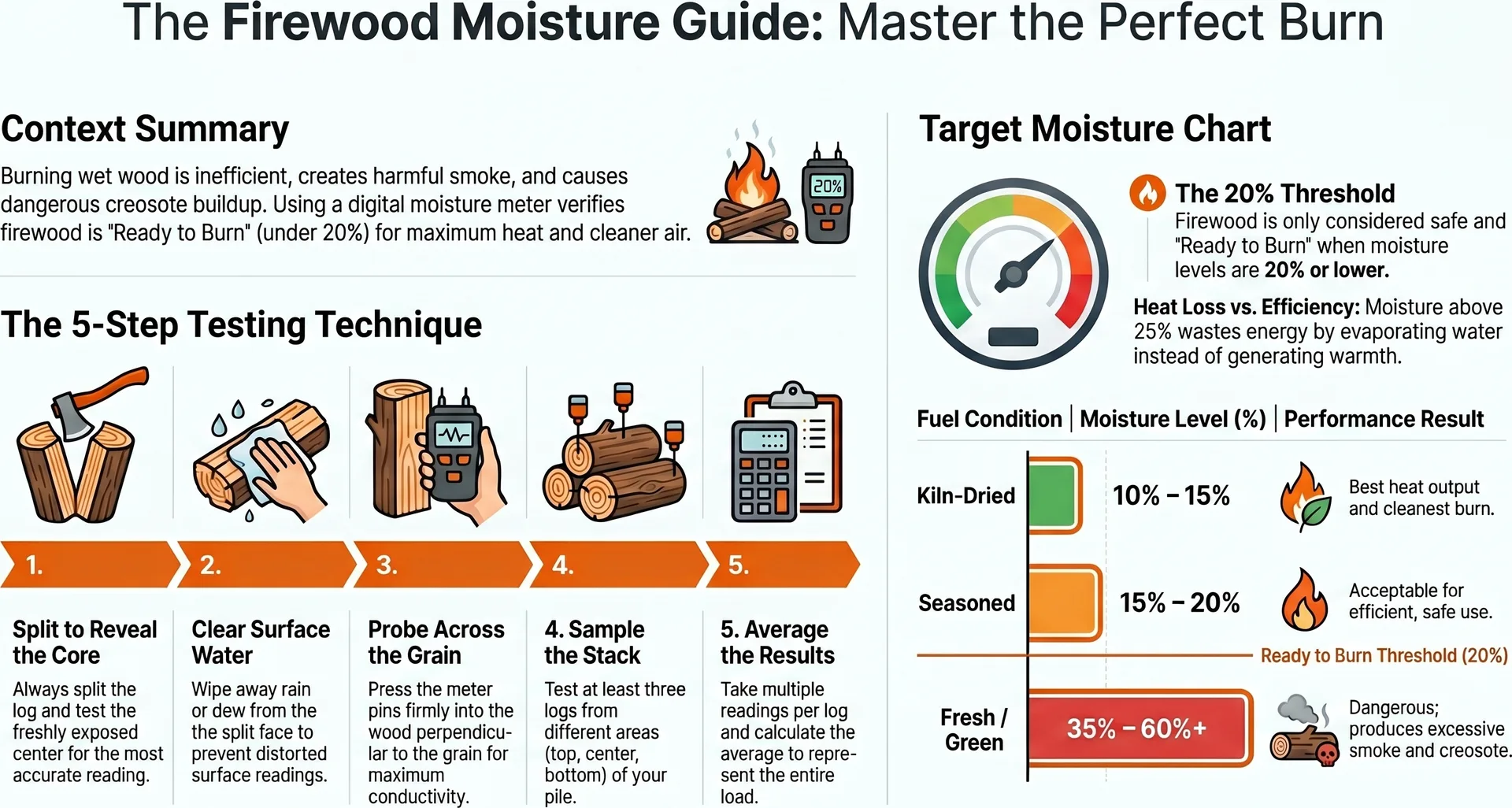
- Split a log immediately before testing to expose a fresh internal face. Press the pin probes firmly across the grain (not along it — conductivity is much higher across the grain). Take three readings from different spots: middle, near each end. Average the three. Wood must be at room temperature; ±10°C swing introduces ~1% reading error.
- Why does the technique matter more than the meter?
- Surface readings can be 10-15% lower than core readings on the same log. Bark and end-grain conduct differently than the wood centre. Pins inserted along the grain return inconsistent results. A $30 meter used correctly beats a $200 meter used incorrectly. The most common NZ moisture-meter mistake is testing the outside of an unsplit log and assuming the whole log is dry.
- What moisture content is safe to burn?
- Under 20% is the industry standard for clean efficient burns. Under 25% is the absolute safety minimum. Above 25%: wood produces 3x more creosote, halves the heat output, and is the leading cause of NZ chimney fires. Kiln-dried firewood is 10-15%; properly air-dried seasoned wood is 15-20%; fresh green logs are 35-60%.
- How much does a moisture meter cost in NZ?
- $30-$50 for a quality pin-style meter. Trade Tested $39.90 (Kent Digital), BBQs Direct around $45, STIHL Shop $45. Pinless meters cost $80-$200 but are less reliable for firewood than pin-style. Any meter under $20 is usually a novelty item with poor accuracy. A $30 meter pays for itself in one avoided chimney fire.
- When should I test — every burn or just the stack?
- Test the stack quarterly to track seasoning progress; test individual logs before each burn during winter. Even fully-seasoned wood can re-absorb moisture in heavy NZ winter rain or coastal humidity. The 30-second pre-burn test (split + 3 readings + average) catches re-wetted logs before they fuel creosote build-up.
Key Takeaways
- Split fresh, press pins across the grain, take 3 readings, average — the technique matters more than the meter
- Target under 20% moisture for clean burns; 25% is the absolute safety minimum (above 25% = 3x more creosote)
- NZ meter prices: $30-$50 for pin-style (Trade Tested, BBQs Direct, STIHL Shop) — pays for itself in one avoided chimney fire
- Temperature affects readings — every ±10°C off introduces ~1% error; wood must be at room temperature
- Surface and end-grain readings are wrong — only the freshly-split internal face gives the true moisture

Why does moisture matter more than species?
A 25%-moisture manuka log produces less heat than a 15%-moisture pine log.
A 25%-moisture manuka log produces less heat than a 15%-moisture pine log. Water absorbs heat as it evaporates instead of releasing it. Wet wood also creates 3x more creosote, which is the leading cause of NZ chimney fires.
Pin-style vs pinless moisture meter — which is better for firewood?
Pin-style.
Pin-style. Pinless meters use surface electromagnetic sensing which produces wildly inaccurate readings for irregular firewood surfaces. Pin meters measure conductivity between two probes driven into the wood — much more accurate for split firewood.
Where can I buy a moisture meter in NZ?
Mitre 10, Bunnings, Trade Tested, Trade Me, and Stihl dealers all stock pin-style meters.
Mitre 10, Bunnings, Trade Tested, Trade Me, and Stihl dealers all stock pin-style meters. Basic models cost $20-$40; pro-grade with temperature compensation $40-$80; commercial dual-pin $80-$150.
Should I test wood I just bought?
Yes.
Yes. Test before stacking, ideally in front of the seller. If the wood tests above 25%, raise it as a quality issue — most reputable NZ firewood suppliers will adjust price or replace if their stated moisture claim doesn't hold up to a meter.
What's the best time of year to test in NZ?
Autumn (March-May) before peak burning season.
Autumn (March-May) before peak burning season. Test the whole stack once, log new deliveries throughout autumn-winter, then re-test in early spring (Sept) to assess what carried over.
Can I test cold wood?
Yes but the reading will be ~3 percentage points lower than warm wood unless your meter has temperature compensation.
Yes but the reading will be ~3 percentage points lower than warm wood unless your meter has temperature compensation. Either use a compensating meter or bring logs inside for an hour before testing.
How does moisture testing affect insurance?
Moisture testing isn't formally required by NZ insurers, but FMG, AA, Tower, and IAG loss adjusters increasingly ask about it during chimney-related claim investigations.
Moisture testing isn't formally required by NZ insurers, but FMG, AA, Tower, and IAG loss adjusters increasingly ask about it during chimney-related claim investigations. Combined with annual sweep certificates, it's the strongest documented reasonable-maintenance you can show.
| meter type (pin vs pinless) | accuracy ranges | target moisture for burning (15-20% ideal, <25% acceptable) | test technique steps | NZ meter prices (-100) | brand options (STIHL, Kent, Hearth Country) | Source |
|---|---|---|---|---|---|---|
| Pin (two metal probes/pins) | Low 0.1% error margin; Senses up to 40% moisture content | Ideal: below 20%; Acceptable: less than 25% | 1. Select three logs from different pile sections. 2. Split logs down the center to expose fresh surface. 3. Wipe any surface moisture/dew. 4. Press pins firmly into the center of the split, across the grain. 5. Record multiple readings and calculate the average. | $39.90 | Kent | [1, 2] |
| Pin (supplied with 4 batteries) | Not in source | Ideal: 20% or less | 1. Split the wood. 2. Take a reading from the center of the split piece. 3. Hold meter parallel to the grain. 4. Push prongs in and hold until reading appears. 5. Test in multiple places. | $45.00 | STIHL | [3, 4] |
| Pinless (Invasive and non-invasive mentioned) | Not in source | Ideal: 15-20% (Seasoned air-dried); Acceptable: <20% (Certified Ready to Burn) | Not in source | Not in source | Hearth Country | [1, 2, 5] |
Data compiled from research by Chimney Guys
Frequently Asked Questions
Pin or pinless meter — which should I buy?
Pin-style for firewood. Pinless meters scan with a flat sensor pad and read the surface only — they miss the dry-outside / wet-inside profile that is typical of seasoning logs. Pin-style meters press 1/4 to 1/2 inch into a freshly-split face and read the actual core moisture you care about. NZ retailers stock both; pin-style is cheaper and more reliable for this use case.
My meter says 18% on the bark but 32% in the centre — which is right?
The 32% centre reading. Bark and exterior surfaces dry first; the wood core retains moisture for months longer. Always split immediately before testing and probe the freshly-exposed internal face. The 18% bark reading is the wood lying to you about being seasoned.
Do I need to wipe the wood before testing?
Yes if there is visible dew, rain, or condensation on the surface. Surface water inflates readings. Wipe the freshly-split face with a dry cloth then probe the underlying wood. Do not test wood that was rained on within the last 24 hours unless you split a fresh face deeper into the log.
Why does temperature matter?
Pin meters work by measuring electrical resistance — and electrical resistance changes with temperature. Every ±10°C from room temperature introduces ~1% reading error. Wood at 5°C reads about 1.5% lower than the actual moisture; wood at 30°C reads about 1.5% higher. Bring logs inside for 15-30 minutes before testing in winter.
How do I know if my meter is broken or just low battery?
Two checks: (1) replace the battery — low voltage is the #1 cause of inconsistent readings. (2) test on a known dry reference (a kiln-dried offcut should read 8-12%). If your meter drifts more than 2% from the reference even with fresh battery, the sensor is degrading and the unit is due for replacement.
Should I test every log before burning?
Habitual users build it into their wood-fetching routine — keep the meter on the wood-shed shelf, takes 30 seconds, prevents wet-wood fires. At minimum: test logs that look dark, wet, or recently re-stacked. Wood from the bottom of a stack near soil is the highest-risk log to skip-test.
Can wood be too dry?
Mostly no for NZ residential burning. Below 12% moisture wood can ignite faster and burn hotter than the burner is designed for, but most properly-seasoned NZ firewood plateaus at 15-18% moisture and never gets dangerously dry. Kiln-dried wood at 8-12% is fine for fast-start fires; just feed gradually.
How do I store wood to keep moisture low?
Single-row stack, off the ground (pallet or scoria base), top covered (corrugated iron) but sides open for airflow. Re-test seasoned wood quarterly — coastal humidity and winter rain can re-wet a stack. The full method is in our seasoning firewood guide.
Think You've Got It?
10 questions to test your understanding — instant feedback on every answer
Question 1 of 10
What is the maximum moisture content recommended for firewood to be considered safe and efficient for burning in a stove or fireplace?
Question 2 of 10
When using a pin-type moisture meter, why is it necessary to split the log before taking a reading?
Question 3 of 10
In which direction should the moisture meter pins be pressed into the wood for the most consistent results?
Question 4 of 10
How does ambient temperature affect the readings on a standard firewood moisture meter?
Question 5 of 10
Which of the following is a recommended practice to ensure a representative moisture reading for an entire log store?
Question 6 of 10
Why should you avoid taking moisture readings on wood that shows signs of fungal decay or rot?
Question 7 of 10
When measuring logs, why is it critical to ensure the firewood is not resting on a metal surface?
Question 8 of 10
According to the Woodsure guidelines, what should you do if you find moisture present on the surface of your split wood from rain or dew?
Question 9 of 10
Why is it important to check the moisture content of seasoned firewood even if it was dry when you first stored it?
Question 10 of 10
What is a primary consequence of burning 'wet' wood with a moisture content significantly higher than 20%?
Need a chimney sweep?
Tell us where you are and what you need. We'll match you with a verified local sweep and have them in touch within one business day.