How Often to Sweep a Chimney in NZ (2026)
Every NZ chimney should be swept at least once a year. FENZ, the NZHHA, and most insurance companies all agree. Heavy users need bi-annual sweeping. This guide covers frequency recommendations, insurance requirements, costs, and NZ-specific data.
Quick Answer
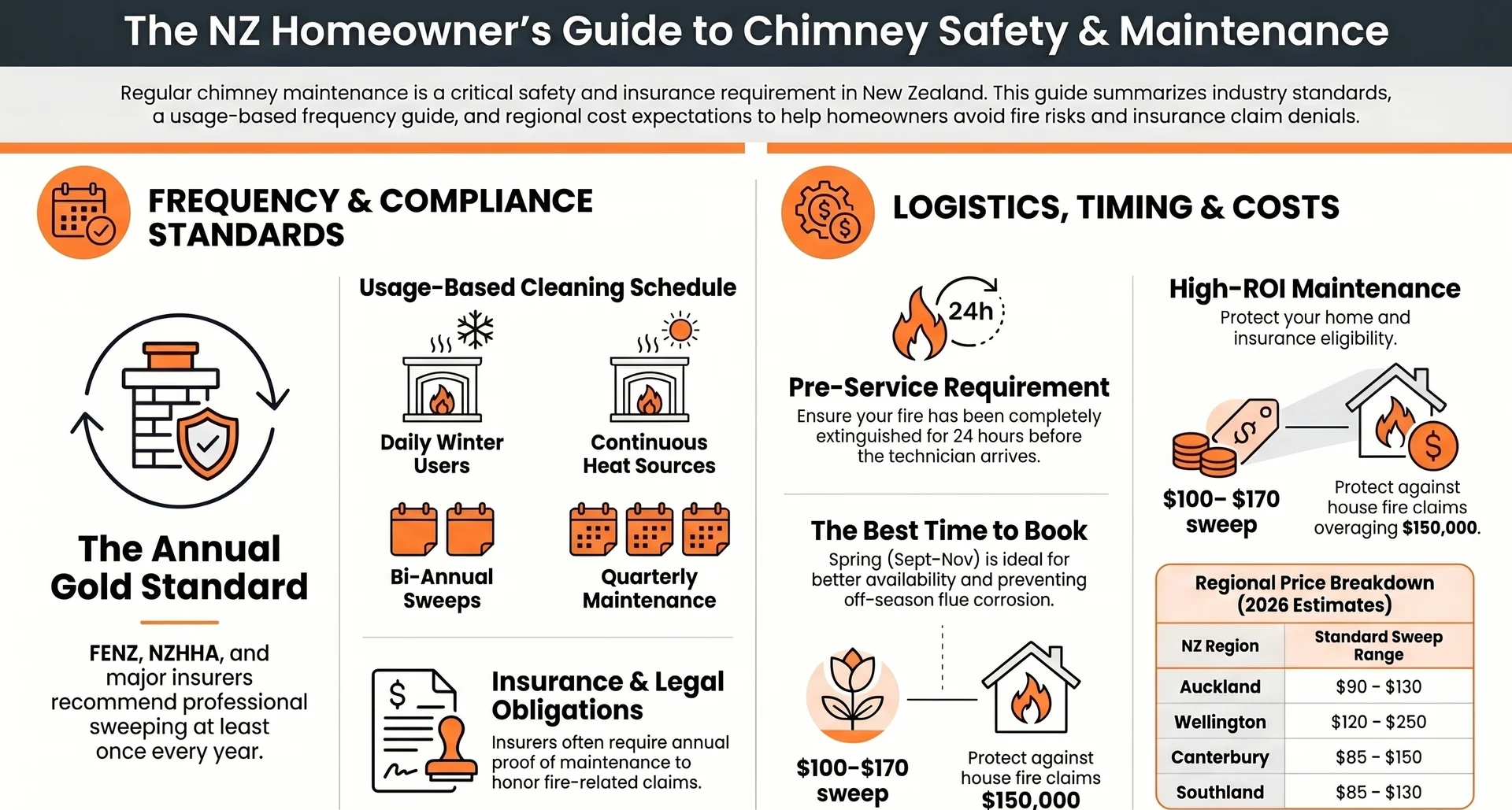
Every NZ chimney should be swept at least once a year — FENZ, the NZHHA, and most insurance companies all agree on this minimum. If you use your wood burner daily through winter, sweep twice a year. Skipping your annual sweep risks chimney fires, insurance claim denials, and creosote damage that costs far more than the $100–$170 a professional sweep costs.
Key Answers
- How often should I sweep my chimney in NZ?
- At minimum once a year. FENZ, the NZHHA, and NZ insurance companies all recommend annual chimney sweeping as the baseline for safe operation of any solid fuel appliance.
- Will my insurance cover a chimney fire if I haven't swept?
- Most NZ insurers require proof of annual chimney sweeping before paying fire-related claims. FMG reports that 20% of all their fire claims involve chimneys or fireplaces — and claims without maintenance records are routinely declined.
- Is chimney sweeping a legal requirement in NZ?
- No specific NZ law mandates chimney sweeping at a set frequency. However, the NZ Building Code, AS/NZS 2918, and insurance policy conditions create practical obligations that make annual sweeping effectively required.
- How much does a chimney sweep cost in NZ?
- A standard residential chimney sweep costs $100–$170 NZD in most of New Zealand. Auckland ranges from $90–$130, Wellington from $120–$250, and Canterbury from $85–$150.
- When is the best time to book a chimney sweep?
- Spring (September–November) is ideal — sweeps are less busy, and removing creosote promptly prevents off-season flue damage. Early autumn (March–April) is the second-best option.
Key Takeaways
- Sweep your chimney at least once a year — this is the FENZ, NZHHA, and insurance industry standard
- Daily wood burner users should sweep twice a year; continuous all-day users every 3 months
- Most NZ insurers will decline fire claims without proof of annual chimney maintenance
- A professional sweep costs $100–$170 — trivial against the $150,000 average house fire claim
- Book in spring (Sep–Nov) for best availability and pricing; avoid the May–July winter rush
- Burning dry seasoned wood (below 20% moisture) reduces creosote and extends time between sweeps
How often should you sweep your chimney in NZ?
Every NZ chimney should be professionally swept at least once per year. This is the consistent recommendation from FENZ, the NZHHA, and the majority of NZ insurance providers.
The frequency increases based on how heavily you use your fire. Light use (1–2 nights/week) requires an annual sweep. Moderate use (3–4 nights/week) calls for sweeping every 6–9 months. Heavy daily use as your primary heat source needs bi-annual sweeping. Continuous all-day use in cold regions like Dunedin or Central Otago warrants quarterly sweeping. Your firewood choice also affects frequency — burning pine or wet wood accelerates creosote buildup.
What do FENZ and the NZHHA recommend?
Both FENZ and the NZHHA recommend annual chimney sweeping as the minimum standard for all NZ homeowners using solid fuel appliances.
Fire and Emergency New Zealand responds to more chimney fires than any other household fire type during winter, with incidents peaking June–August. Their guidance emphasises annual sweeping alongside safe, dry firewood use. The NZ Home Heating Association recommends at least one sweep per year, with bi-annual cleaning for daily users. Using an NZHHA-certified sweep ensures the technician meets current training, code, and safety benchmarks.
Do NZ insurance companies require annual chimney sweeping?
Most NZ insurance companies require proof of annual chimney maintenance before paying fire-related claims. Without documented sweeping records, your claim may be declined.
FMG states that 20% of all their fire claims involve fireplaces or chimneys and explicitly advises annual flue sweeping. AMI reports a nearly 40% increase in house fires between summer and winter. Tower recommends annual sweeping by a qualified chimney sweep. AA Insurance requires homeowners to take all reasonable steps to prevent loss — annual sweeping is the accepted standard. The average NZ house fire claim costs approximately $150,000 (AMI data), with roughly 1 in 5 resulting in uninhabitable homes at over $265,000.
Is chimney sweeping a legal requirement in New Zealand?
No specific NZ law mandates chimney sweeping at a fixed frequency. However, the NZ Building Code, AS/NZS 2918, and insurance policy conditions create practical obligations that make annual sweeping effectively required.
The NZ Building Code Clauses C1–C6 require homeowners to maintain solid fuel appliances per AS/NZS 2918, which specifies annual servicing including a flue sweep. The Healthy Homes Standards require landlords to maintain usable fireplaces in safe condition or block the chimney. While no law will fine you for not sweeping, failing to maintain your chimney can void your insurance, breach Building Code obligations, and for landlords breach Healthy Homes Standards with penalties up to $7,200.
How often should heavy users sweep their chimney?
If your wood burner is your primary heat source and runs most of the day through winter, sweep at least twice per year — once in autumn before the season starts, and once mid-season or at season's end.
For homes where the wood burner runs continuously all day through the coldest months — common in Dunedin, Invercargill, Central Otago, and the West Coast — NZ chimney sweep professionals recommend quarterly sweeping. Several factors increase creosote buildup: burning pine or high-resin softwoods, burning green or damp firewood above 20% moisture content, running fires on low smouldering settings (the primary cause of dangerous Stage 2 and Stage 3 creosote), and coastal exposure where salt air accelerates flue corrosion.
What about holiday homes and baches?
Bach and holiday home chimneys should be swept at least once per year, even if the fire is only used for a few weeks. The primary risk is blockage from bird nests, not creosote buildup.
A chimney left unused from October to May is prime nesting habitat for starlings, sparrows, and mynas. An unswept, nest-blocked flue with dried debris is a severe fire hazard the moment you light the first fire of the season. Sweep in late autumn (April–May) just before bach season starts. Moisture ingress during long idle periods also causes flue liner deterioration, and acidic creosote from the previous season breaks down and damages the chimney structure over months of disuse.
What are the signs your chimney needs sweeping?
Warning signs include a tar-like smell near the fireplace, smoke backing up into the room, excessive soot accumulation, reduced heat output, and scratching noises from nesting birds.
Smell-based signs include a sharp chemical or tar-like smell (dangerous creosote levels), musty campfire odour when not in use (moisture combining with creosote), and smoke entering the living space. Visual signs include black tar-like deposits in the firebox, excessive soot on furniture, and oily shiny black residue on interior walls. Performance signs include smoke backing up, difficulty starting fires, reduced heat output, and glass blackening quickly. Noise signs include scratching or chirping from birds and debris dropping into the firebox. If you notice any of these, stop using the fire and book a sweep immediately.
What is creosote and why does it matter?
Creosote is the byproduct of incomplete wood combustion that condenses on chimney walls. It progresses through three stages — from harmless soot to glazed tar that ignites at lower temperatures and burns at over 1,100°C.
Stage 1 is dry dusty soot removed by a standard brush. Stage 2 is shiny black hard flakes that restrict the flue and require rotary power cleaning. Stage 3 is thick glazed tar-like coating that is extremely dangerous — a single flue can hold over 45 kg of deposits, and once ignited a chimney fire can reach temperatures exceeding 1,100°C, enough to crack masonry and spread fire to the roof structure. Stage 3 requires chemical treatment over multiple burns followed by specialist chain whip cleaning. Prevention: burn dry seasoned hardwood at adequate temperatures and sweep annually.
How much does a chimney sweep cost across NZ?
A standard residential chimney sweep costs $100–$170 NZD in 2026. Auckland ranges from $90–$130, Wellington from $120–$250, Canterbury from $85–$150, and Southland from $85–$130.
Factors that increase cost include roof access required (harness and safety equipment), heavy creosote buildup (additional labour), bird nest removal (~$160+ GST), multi-storey homes, and minor repairs identified during the sweep. Multi-flue chimneys add approximately $70 per additional flue. Off-season booking (August–February) can get discounted rates. Grey Power and Gold Card holder discounts are available at select operators. Compare the cost of a $100–$170 sweep against the average NZ house fire claim of $150,000.
When is the best time of year to book a chimney sweep?
Spring (September–November) is the best time to book a chimney sweep in NZ. Sweeps are least busy, and removing creosote promptly prevents off-season flue damage.
Early autumn (March–April) is the second-best option — still early enough to book comfortably and ensures the system is ready before the first fire of winter. Late autumn (May) sees limited availability as demand surges. Winter (June–August) is peak season with sweeps booked out 2–4 weeks in advance. Removing creosote in spring prevents it from sitting in the flue over summer, where its acidity corrodes the chimney lining. Any issues identified can be repaired over summer. Environment Canterbury actively campaigns to encourage pre-winter booking to prevent homeowners entering winter with unswept chimneys.
Can you sweep your own chimney in NZ?
You can technically sweep your own chimney, but for most NZ homeowners it's not worth the risk. The cost saving is marginal ($40–$70) and some insurers may decline claims if maintenance wasn't done by a qualified professional.
DIY can remove Stage 1 soot from a straight, accessible flue using a $60–$100 kit from NZ hardware stores. However, DIY cannot identify Stage 2 or Stage 3 creosote, detect cracked flue liners or structural damage, inspect areas requiring camera access, or provide the documented maintenance certificate many NZ insurers now require. Some insurance policies specify that maintenance must be carried out by a qualified or approved operator. If you DIY sweep and later make a fire-related claim, your insurer may decline it. DIY should supplement, not replace, annual professional sweeping.
What happens during a professional chimney sweep?
A standard professional chimney sweep takes 30–60 minutes and includes initial inspection, room protection, full flue cleaning with rod or rotary brushes, component checks, airflow testing, and a condition report.
The fire must be out for 24 hours beforehand. The technician visually inspects the firebox and flue for blockages, damage, nests, and creosote level. Dust sheets and a HEPA-filter vacuum system protect the room. Rod-based or rotary power brushes clean the full length of the flue. Component checks cover baffles, door seals, latches, and hinges depending on service level. After cleaning, airflow is confirmed and a written or verbal report covers chimney condition with recommendations. A full fire service including baffle removal takes 45–90 minutes. Complex appliances like Pyroclassic or Masport catalytic models may take longer.
Frequently Asked Questions
Does the type of fire affect how often I need to sweep?
Yes. Enclosed wood burners produce more creosote than open fireplaces because they operate at lower flue temperatures. If you run a modern enclosed burner as your primary heat source, bi-annual sweeping is recommended.
Do pellet fires need chimney sweeping?
Yes, but less frequently. Pellet fires burn cleaner than wood burners but the flue still accumulates ash and fine particulate. An annual service is the minimum.
Do I need a chimney sweep certificate for insurance?
Many NZ insurers now request documented proof of maintenance when processing fire-related claims. A professional sweep certificate showing the date, condition found, and work completed is the simplest way to protect your claim.
Will DIY sweeping satisfy my insurer?
Possibly not. Some NZ insurance policies specify that maintenance must be carried out by a qualified or approved operator. Check your specific policy wording before relying on DIY sweeping alone.
Is pine safe to burn in a wood burner?
Pine is safe to burn but produces more creosote than hardwoods due to its resin content. Use the hot mix approach — a 50/50 blend of pine and hardwood — to reduce creosote production while keeping ignition easy.
How do I know if my firewood is dry enough?
Firewood should have a moisture content below 20%. Test with a $30 moisture meter from Bunnings or Mitre 10. Properly seasoned wood has visible end-grain cracks, feels light, and makes a hollow clunk when two pieces are knocked together.
Can I just sweep once mid-season instead of at the start?
A mid-season sweep is better than nothing, but sweeping before the first fire of winter is critical. Creosote sitting in the flue over summer is acidic and damages the chimney lining.
Need a chimney sweep?
Tell us where you are and what you need. We'll match you with a verified local sweep and have them in touch within one business day.