Heritage Property Chimney NZ — Listed Building Maintenance
Heritage property chimneys in NZ — what makes them different, when you need consent for repairs and removals, how earthquake risk changes the calculation in Wellington, and why the "replica chimney" solution exists. Includes the FENZ fire risk reality, insurance obligations, and NZHHA-approved approach to making an old chimney safe without gutting the character of a pre-1920 home.
Quick Answer
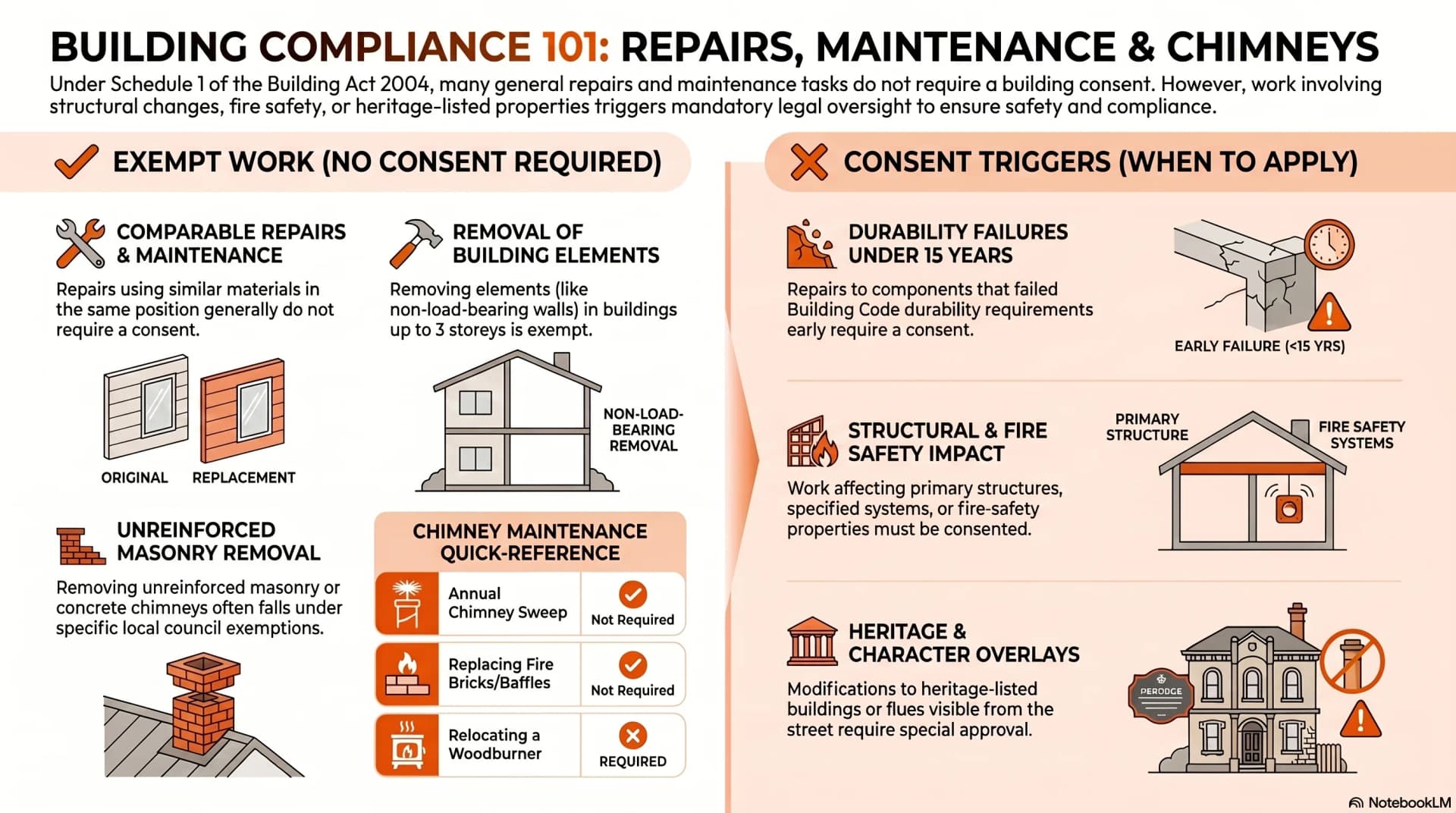
Heritage chimneys in NZ pre-1920 villas and bungalows have three layers of complexity: (1) Building Code — sweeping/repairs using comparable materials are consent-exempt (Schedule 1 Exemption 1); full removal is also often exempt (Exemption 31) but only if the chimney is not load-bearing. (2) Heritage overlay — Auckland (Ponsonby, Grey Lynn) and Wellington (Thorndon, Kelburn) often require the above-roof portion to be replaced with a replica even if the internal breast is removed, to preserve the heritage skyline. (3) Seismic risk — Wellington's unreinforced brick chimneys are the #1 earthquake hazard in older homes. The replica solution uses a lightweight steel or timber frame in the attic clad with original brickslips: earthquake-safe, council-approved, visually authentic. FENZ data: chimney fires are the most common household fire type in NZ — the annual sweep is non-negotiable.
Key Answers
- Does heritage status mean I cannot touch my old chimney?
- No — but it adds a layer to the process. Under Schedule 1 of the Building Act 2004, routine maintenance, repair, and replacement using comparable materials does not require building consent (Exemption 1). An annual sweep, relining the flue with a comparable liner, and repointing mortar are all typically exempt. Where heritage rules bite: if your property is in a heritage overlay (Auckland Ponsonby/Grey Lynn, Wellington Thorndon/Kelburn), modifications visible from the street — including removing the above-roof chimney portion — may require resource consent from the council in addition to or instead of building consent. The rule of thumb is: if a neighbour standing on the footpath could see the change, call your council before starting.
- Can I remove an old chimney from a heritage home without consent?
- Often yes for the internal breast — Schedule 1 Exemption 31 allows removal of a building element without consent, provided the removal does not affect the primary structure, any specified fire-safety system, or any fire separation. The critical question: is the chimney load-bearing? In pre-1940 NZ construction, chimney stacks commonly support roof rafters or ceiling joists. If it is load-bearing, removal requires a building consent and structural assessment. If it is not load-bearing, internal removal is usually exempt. The above-roof portion in heritage overlays (Auckland, Wellington inner suburbs) typically cannot simply disappear — councils often require a replica to maintain the heritage roofline. Get a LBP assessment before breaking anything.
- What is the earthquake risk with old brick chimneys in Wellington?
- Significant. Unreinforced brick chimneys are among the most hazardous residential elements in Wellington earthquake scenarios — they act as unanchored vertical masses that topple outward at relatively modest shaking levels. Wellington City Council allows up to 25 working days for building consent, so planning removals before winter is important. Professional removal in Wellington uses scaffolding (ladders are not permitted as work platforms under WorkSafe regulations) and deconstructs bricks down to the roofline or further. A single-level chimney removed to below roof costs approximately $5,000; full removal to ground level $10,000-$12,000; double-storey $15,000-$25,000. In Wellington, the earthquake risk case for removal is strong even when the chimney appears serviceable.
- What is a replica chimney and why does Auckland and Wellington councils approve them?
- A replica chimney uses a lightweight steel or timber structural frame built in the attic space, clad with original brickslips (genuine bricks cut thin — 20-30 mm — and adhered to the frame). From the street it is visually indistinguishable from the original. Internally, the chimney breast is removed to recover floor space. The replica satisfies heritage overlay requirements (the above-roof skyline is preserved) while eliminating the earthquake hazard of an unreinforced brick mass. NZHHA members familiar with heritage work carry out the lined flue retrofit — a twin-wall or flexible stainless liner inserted into the new replica allows the fireplace to operate legally if retained. Replica work requires both building consent and in most cases resource consent in heritage overlay zones.
- What does FENZ data tell us about heritage chimneys and fire risk?
- Fire and Emergency New Zealand (FENZ) responds to more chimney fires than any other single household fire type. In heritage homes, the risk is compounded: pre-1920 chimneys often have oversized flue openings not suited to modern appliances (causing downdraught and incomplete combustion), cracked clay liner sections that have never been replaced, and decades of creosote build-up in unswept sections. The most common heritage chimney fire cause we see: a wood burner installed into an old chimney breast without professional assessment of the flue size, liner condition, or clearances. Annual professional sweeping — carried out by an NZHHA member — is the first line of defence. Many NZ home insurers will not pay chimney fire claims if the annual sweep cannot be evidenced.
- Do I need consent to install a wood burner in my heritage home's existing fireplace opening?
- Yes — installing any solid fuel appliance is Restricted Building Work requiring a current SFAIT (Solid Fuel Appliance Installation Technician), a building consent, and in some heritage overlay zones a resource consent for the external flue alteration. The pre-existing fireplace opening does not exempt you from the installation consent. The additional heritage-specific consideration: the existing flue dimensions (often 230×230 mm or wider for colonial-era fireplaces) must be matched to the burner's flue outlet. Modern ULEBs use 100-150 mm flue connectors — an old oversized chimney needs a correctly-sized stainless liner inserted. A pre-purchase inspection of the flue before buying the burner saves significant retrofit cost.
- What should I check before buying a house with an old heritage chimney?
- Four pre-purchase checks. (1) LIM report — does it record any building consent for the chimney or heating install? If there's a wood burner with no consent history, that is the seller's problem to resolve. (2) Load-bearing status — engage a builder or structural engineer if you intend to remove the chimney. (3) Flue liner condition — arrange a CCTV flue inspection or at minimum a NZHHA sweep inspection before settlement. Cracked clay liners are common in pre-1960 NZ chimneys. (4) Heritage overlay status — check if the property is in an Auckland or Wellington heritage overlay zone on the district plan; this determines what you can and cannot change. Budget $1,500-$3,000 for a thorough pre-purchase chimney and structural assessment on a heritage property.
Key Takeaways
- FENZ data: chimney fires are the most common NZ household fire type — annual sweep is non-negotiable, and many insurers will not pay claims without sweep evidence
- Schedule 1 Exemption 1 (consent-exempt maintenance) and Exemption 31 (consent-exempt removal) apply — BUT load-bearing chimneys always need consent before removal
- Heritage overlays in Auckland (Ponsonby, Grey Lynn) and Wellington (Thorndon, Kelburn) may require resource consent + heritage replica for above-roof chimney changes
- Replica chimneys: lightweight steel/timber frame + original brickslips — earthquake-safe, council-approved, visually authentic, retains a functional lined flue option
- Wellington unreinforced brick chimneys are the #1 residential earthquake hazard — removal cost $5,000-$25,000 depending on scope; consent timelines up to 25 working days

What is a Category 1 vs Category 2 heritage listing?
Category 1: places of special or outstanding historical or cultural heritage significance — strict protections.
Category 1: places of special or outstanding historical or cultural heritage significance — strict protections. Category 2: places of historical or cultural heritage significance — slightly less strict but still significant protections. Both require Heritage New Zealand consultation for major work.
How do I know if my house is heritage-listed?
Check the Heritage New Zealand Pouhere Taonga register (heritage.org.nz) and your council's district plan.
Check the Heritage New Zealand Pouhere Taonga register (heritage.org.nz) and your council's district plan. Some properties are listed only on the council's plan, not the national register — both apply. If you bought the house, the LIM report should disclose any heritage status.
Can I install a new burner in a heritage chimney?
Yes but with extra paperwork.
Yes but with extra paperwork. Building consent is normal; heritage consent may also be required if the install affects visible chimney structure. Many heritage properties install ULEBs that vent through a clean stainless-steel flue inside the original masonry chimney — preserves the heritage exterior.
What's the most common heritage chimney problem?
Mortar deterioration.
Mortar deterioration. Soft lime mortar erodes faster than modern cement, especially in coastal areas. Annual visual inspection of mortar joints catches early erosion before it becomes structural. Repointing in lime mortar (not Portland cement) is the correct repair — wrong-mortar repairs cause more damage long-term.
Can I burn anything different in a heritage burner?
Standard NZ wood-burning rules apply — dry seasoned wood, no treated timber, no rubbish.
Standard NZ wood-burning rules apply — dry seasoned wood, no treated timber, no rubbish. Heritage doesn't exempt you from clean-air zone restrictions. If you're in a Christchurch ECan or Otago ORC airshed and have a heritage chimney, ULEB upgrade may be required.
What if my heritage chimney is also a load-bearing wall?
Many heritage NZ chimneys are integrated into the building's structure.
Many heritage NZ chimneys are integrated into the building's structure. Removal or major alteration may require structural engineering review in addition to heritage consent. Don't attempt removal without full council and engineering sign-off.
| Location | Property Type | Flue Materials | Consent Requirements | Cost Table | Earthquake Risk by Region | Heritage Status Impact | Source |
|---|---|---|---|---|---|---|---|
| Wellington | Heritage-listed or Character Areas (e.g., Thorndon, Kelburn, Mt Victoria, Northland, Aro Valley, Wadestown) | Brick (original or replica), metal flues (steel), gas flues, stainless-steel liners, or replica composite and brick veneer | Building consent required for solid fuel heater installations; Resource consent may be required for exterior modifications visible from the street; removal of unreinforced masonry/concrete chimneys may be exempt unless heritage listed. | Single level remove to below roof: \$5000; Single level to ceiling height: \$6500; Single level to ground: \$10,000–\$12,000; Double story removal: \$15,000–\$25,000. | High risk for older unreinforced masonry/brick chimneys; City Council highlights earthquake resilience and recommends strengthening or removal; inspections check for structural integrity and cracks. | District Plan heritage overlays/character designations restrict exterior facade changes; internal removal is usually permitted but external flues may require resource consent; mock/replica chimneys can be used to maintain heritage character. | [1-3] |
| Auckland | Designated Heritage or Conservation Zoned (e.g., Ponsonby, Grey Lynn, Herne Bay, Remuera) | Original brick recovered from site (cut into brickslips), lightweight flue systems, composite base modules | Resource Consent process runs alongside Building Consent; Resource Consent often requires replacement of above-roof chimney with an exact replica if the original is removed. | Not in source | Red Mantle systems use structural support frames in attic to spread earthquake loads; heritage chimneys often deemed unsafe in original form. | Heritage Team often allows internal removal but insists on external replica above roofline using original bricks to preserve the heritage skyline. | [4] |
| Christchurch | Historic places / Heritage homes | Genuine brick, original bricks and pots (if suitable), Core and Sleeve system | Building consent required for all Heritage Replica Chimneys; Engineer report required for specific design; work must be done by Licensed Building Practitioners (LBPs). | Not in source | Replica chimneys used as earthquake replacement; must be engineered to specific design and NZS3604 standards. | Focus on duplication of existing style and detailing to meet heritage requirements while providing structural safety. | [5] |
Data compiled from research by Chimney Guys
Frequently Asked Questions
Can I sweep a heritage chimney myself?
Technically yes — sweeping is maintenance, not Restricted Building Work. But heritage chimneys have complications that make DIY risky: oversized flue dimensions, cracked clay liner sections that can collapse if disturbed, and bird nests that can block a flexible rod. An NZHHA sweep carries professional indemnity and provides the written certificate your insurer requires. Budget $150-$250 for a heritage property sweep; the certificate is the product you are really buying.
My chimney leaks around the flashing — is that a consent job?
Replacing like-for-like chimney flashing is consent-exempt under Schedule 1 Exemption 1 — same position, comparable materials. In heritage overlay zones, the material choice matters: lead apron flashing is often the heritage-approved material for pre-1940 properties (terne-coated steel was the original, lead is the closest acceptable modern equivalent). Replacing with modern EPDM rubber on a heritage property may trigger a query from a council inspector. When in doubt, use lead or consult your council before ordering materials.
What is the insurer position on heritage chimneys?
Most NZ home insurers (including FMG, IAG, AA, Tower, State, Vero) require annual professional sweeping as a reasonable steps clause within fire policies. For heritage properties specifically, some policies also require a CCTV flue inspection every 3-5 years due to the elevated risk of cracked clay liners. Retain receipts for every sweep and any repair work — if a chimney fire causes damage, the claims assessor will ask for maintenance evidence going back 3-5 years. An unconsented wood burner in a heritage home is a near-automatic decline.
I want to keep the fireplace but need it to comply with clean air rules — what are my options?
Three paths. (1) ULEB insert — a certified ultra-low-emission burner (under 0.4 g/kg in Canterbury, Clean Air standard elsewhere) installed into the existing opening with a correctly-sized stainless liner. Requires SFAIT, building consent, and resource consent if in a heritage overlay. Best for retaining the working fireplace. (2) Gas insert — a gas fire does not require a solid fuel appliance consent and often involves minimal structural work. Good where the heritage chimney is complex and structural intervention must be minimised. (3) Cap and seal — remove the working fire, cap the flue, and retain the visual fireplace surround as a decorative element. Most common in Wellington clean air zones where open fires are banned.
How do I know if my chimney is load-bearing?
Two ways: (1) Access the roof space and look at the chimney stack where it passes through the ceiling — if you see roof rafters or ceiling joists resting on or tied to the chimney masonry, it is load-bearing. (2) Engage an LBP (Licensed Building Practitioner) or structural engineer for a formal assessment — typically $300-$800 for a heritage chimney structural inspection. Do not assume non-load-bearing without checking; internal chimney breast removal without removing the support for the roof framing is a dangerous and common mistake in heritage DIY renovations.
Does removing the chimney affect my house's heritage protection status?
Only if you remove the above-roof visible portion without council approval in a heritage overlay zone. Heritage protection in NZ is administered through district plan heritage overlays and the New Zealand Heritage Places Trust (Heritage NZ Pouhere Taonga) for Category 1 and 2 listed buildings. Removing an internal chimney breast in a Category 1 listed building requires consent from Heritage NZ in addition to council consents. Most NZ villa and bungalow heritage overlays are district plan provisions (not Heritage NZ listings) — these are administered by the local council and typically focus on street-visible elements.
Need a chimney sweep?
Tell us where you are and what you need. We'll match you with a verified local sweep and have them in touch within one business day.