DIY vs Professional Chimney Sweep — NZ 2026
DIY chimney sweeping is legal in NZ but rarely the right call once you account for time, equipment cost, missed-issue risk, and insurance documentation. This guide walks through DIY kits available at Bunnings and Mitre 10, what creosote sticks really do, when DIY is reasonable, and when to absolutely call a professional.
Quick Answer
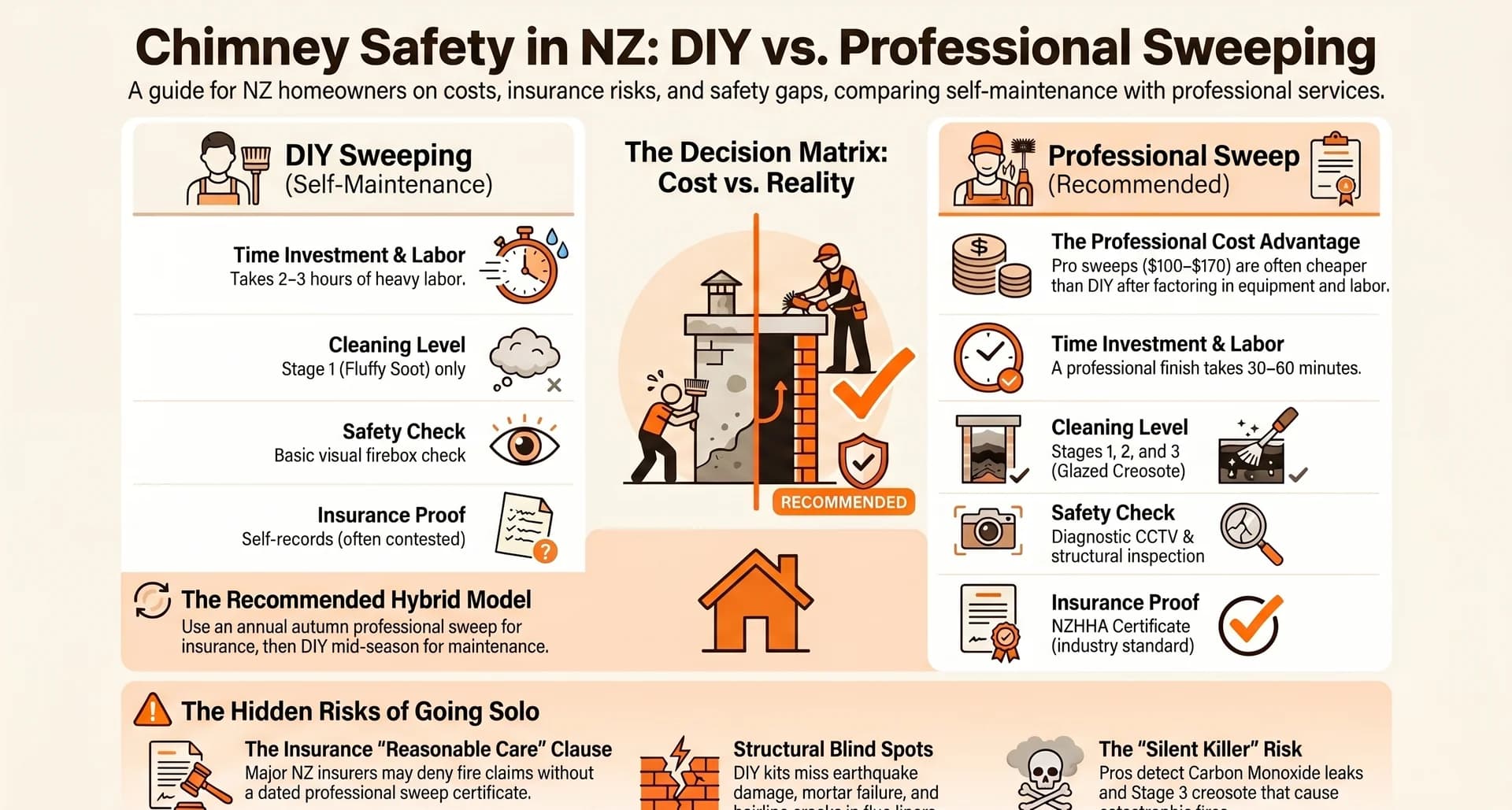
You can legally DIY-sweep your own chimney in New Zealand — no law says otherwise. But most NZ insurance policies require "reasonable steps" to maintain fire safety, and major insurers (FMG, AMI, Tower) explicitly prefer or require a professional sweep with a dated certificate before paying fire claims. DIY kits from Bunnings and Mitre 10 cost $40–$100 and handle Stage 1 soot, but cannot remove Stage 2 or Stage 3 creosote, miss earthquake damage, and produce no insurance-grade documentation. For most NZ homeowners, a $100–$170 annual professional sweep is cheaper than the insurance risk of DIY.
Key Answers
- Is it legal to sweep your own chimney in NZ?
- Yes. No NZ law requires a chimney to be swept by a certified professional. The only legal obligations are the NZ Building Code's general duty to maintain solid fuel appliances, and the Healthy Homes Standards for landlords. Both can technically be met by competent DIY work, though insurers may not accept it.
- Will my insurance still pay out if I DIY my chimney sweep?
- Probably not — and definitely not without strong documentation. Most NZ insurance policies require "reasonable steps" to maintain fire safety, and FMG, Tower, AMI, and AA Insurance all consider a professional NZHHA-format certificate the standard. DIY sweeping without photographic evidence or dated records is a routine reason for fire claims being declined.
- What DIY chimney cleaning kits are sold in NZ?
- Bunnings stocks Samba Chimney Sweep In a Box ($60–$80) and chemical cleaning sachets. Mitre 10 carries the Browns Flue Cleaning Kit ($80–$100) and Fire Wise Soot-Loose chemical cleaner ($15–$25). All are designed for surface-level Stage 1 soot only.
- Can DIY brushes remove creosote?
- DIY polypropylene brushes can remove Stage 1 fluffy soot. They cannot remove Stage 2 flaky creosote or Stage 3 glazed creosote, which require commercial-grade rotary brushes, chemical pre-treatment, or power-sweep chains that no DIY kit includes.
- Is the cost difference worth it?
- A DIY sweep costs $40–$100 in equipment plus 90–180 minutes of your time. A professional sweep costs $100–$170 and takes 30–60 minutes. The price gap is small once you factor in equipment cost, time, missed-issue risk, and insurance documentation value.
Key Takeaways
- DIY chimney sweeping is legal in NZ but no NZ insurer treats it as equivalent to a professional NZHHA-format certificate
- Bunnings and Mitre 10 stock DIY brush kits ($60–$100) and chemical cleaners ($15–$35), but all handle Stage 1 soot only — not Stage 2 or Stage 3 creosote
- A typical DIY sweep takes 90–180 minutes once setup, brushing, soot containment, and disposal are included — vs 30–60 min for a professional
- DIY misses earthquake damage, hairline liner cracks, mortar joint failure, and corroded stainless flues that a trained sweep catches during the standard inspection
- Hybrid approach (annual professional + mid-season DIY touch-ups) is widely recommended for daily heavy users in cold NZ regions
- Roof falls during DIY top-down sweeps are the leading cause of NZ chimney-related hospital admissions for homeowners
Can you sweep your own chimney in NZ?
Yes — DIY chimney sweeping is legal in New Zealand. No statute, Building Code clause, or Worksafe rule requires a certified professional. Insurance, however, is a different story.
The decision rests on three real factors: Stage 1 soot is removable with a quality DIY kit, Stage 2 and Stage 3 creosote is not. DIY misses hidden damage detection. DIY produces no insurance-grade documentation. The economic case for DIY breaks down once equipment cost and time are included; the insurance case for DIY breaks down even faster because no major NZ insurer treats DIY records as equivalent to an NZHHA professional certificate.
What does a DIY chimney sweep involve?
Drop sheets, sealed firebox, polypropylene brush fed up the flue, HEPA vacuuming, torch-and-mirror inspection, and council-compliant soot disposal — typically 90–180 minutes including setup and cleanup.
The physical brushing is the easy part. The setup, contained cleanup, and waste disposal often take longer than the sweep itself. P2 respirator is mandatory for soot exposure. Council disposal rules apply to soot quantities — Auckland, Wellington, and Christchurch all restrict large-volume disposal.
What DIY chimney cleaning kits are available in NZ?
Browns Flue Cleaning Kit at Mitre 10 ($80–$100), Samba Chimney Sweep In a Box at Bunnings ($60–$80), plus chemical sachets ($25–$35). All polypropylene-based and designed for occasional homeowner use.
NZ DIY kits use the same polypropylene bristle material as professional sweeps, but the rod assemblies are shorter, brush diameters are often wrong for NZ flue sizes (most NZ flues are 5"/125mm; many kits ship 6"/150mm), and no DIY kit includes a HEPA-filtered vacuum or inspection tools. Generic 6-pole kits from Trade Me or AliExpress NZ run $40–$60 with variable quality.
How do creosote sticks and chemical cleaners actually work?
Pressed logs of copper sulphate, manganese dioxide, and zinc chloride release vapours when burned. The vapours make creosote drier and easier to brush off. They reduce future buildup but do not remove existing deposits.
Effectiveness depends on burn temperature (sticks need a hot fire to vaporise), flue surface area, and frequency of use (manufacturers recommend monthly during the heating season). Chemical cleaners are useful as pre-treatment before mechanical brushing, never as a replacement for it. If a product claims to "clean your chimney without a brush," treat the claim with scepticism.
What can DIY sweeping miss that a professional catches?
Stage 2 and Stage 3 creosote, hairline liner cracks, earthquake damage to upper flue sections, mortar joint failure, damper warping, bird-nest fragments in offsets, corroded stainless liners, cap and cowl deterioration, and smoke chamber buildup.
Professional sweeps sell pattern recognition as much as physical labour. A trained NZHHA sweep has inspected hundreds of flues and knows what failure looks like — often before it becomes a fire risk. DIY sweeping cleans the flue but generates none of this diagnostic information. A professional NZ sweep catches these issues during the standard $100–$170 inspection.
Will my insurance pay out if I DIY my chimney sweep?
Probably not — and definitely not without strong documentation. Major NZ insurers (FMG, AMI, Tower, AA Insurance, State, Vero) accept NZHHA-format professional certificates as the standard of "reasonable care." DIY records are routinely contested.
The structural issue is third-party validation. A professional certificate carries weight because the technician's NZHHA membership and AS/NZS 2918 compliance are independent records. A homeowner notebook is not. NZ chimney sweep practitioners report that fire claims with current professional certificates are paid almost universally; claims without one are routinely declined.
How much does a DIY vs professional chimney sweep cost?
DIY: $40–$100 kit + $20–$40 respirator + 90–180 minutes of your time = $120–$280 real cost. Professional: $100–$170 with NZHHA certificate, 30–60 minutes, you do nothing.
When all costs are included — equipment, consumables, time at $40/hour equivalent, and disposal — DIY is rarely meaningfully cheaper than professional sweeping. The headline price gap collapses once the full picture is on the table. After year one, DIY drops to consumables and time only, but insurance exposure and missed-issue risk remain.
When is DIY sweeping a reasonable choice?
A straight stainless-lined flue, light usage (<10 fires/season), well-seasoned hardwood, full equipment kit including HEPA vacuum, P2 respirator, written insurance review, and biennial professional CCTV backstop.
DIY is reasonable when ALL these factors apply: the chimney is straight, single-storey, stainless-steel-lined; you have read your insurance policy thoroughly; you photograph every stage and keep dated records; you have read your council's soot disposal rules; and you will pay for a professional CCTV inspection at least every two years to backstop your DIY records. That checklist is more demanding than most homeowners expect.
When should you absolutely call a professional?
Any sign of chimney fire, masonry chimneys, multi-storey or offset flues, daily heavy use, recent earthquake of magnitude 5.0+ within 50km, suspected animal entry, Stage 3 glazed creosote, or rental property obligations.
These scenarios share a common pattern: the diagnostic value of a professional inspection vastly outweighs the labour cost of brushing. Calling a professional in these cases is not about cost — it is about not making a small problem worse.
Is a hybrid DIY-and-professional approach worth considering?
Yes. Annual professional sweep in autumn (March–April) + DIY mid-season check in late June + optional DIY end-of-season clean in October. Keeps total annual cost under $200 for moderate users.
The hybrid model satisfies insurers (you have a current professional certificate), reduces creosote between sweeps, and keeps total annual cost low for moderate users. It is widely recommended by NZ chimney sweep practitioners for daily heavy users in cold regions. The hybrid only works if you treat the autumn professional sweep as the non-negotiable annual event.
What are the safety risks of DIY chimney sweeping?
Roof falls (the leading DIY chimney injury in NZ), soot inhalation (PAHs are carcinogenic), wire-brush damage to stainless liners, mortar dislodgement in masonry chimneys, and partial creosote removal that creates fire fuel.
Three categories of risk: physical injury, soot exposure, chimney damage. The single most-cited safety incident in NZ chimney repair callouts is the homeowner attempting top-down sweeping in wet or windy conditions. Roof falls account for the majority of DIY chimney injuries reaching hospital. If you cannot work safely on your roof in dry, calm conditions, do not attempt a top-down sweep at all.
What is the bottom line?
DIY sweeping is legal but rarely the right call once you account for time, equipment, insurance exposure, and missed-issue risk. A professional sweep is the cheapest insurance policy you can buy against a $150k+ fire claim.
The headline price advantage disappears once you account for equipment cost, time, soot disposal, and the risk of declined insurance claims. NZ insurers accept professional NZHHA certificates as the standard of "reasonable care." Outside of narrow scenarios — simple straight flue in a low-use bach — a professional sweep is faster, safer, more thorough, and once you account for everything, almost always cheaper than DIY in the way that actually matters.
| Factor | DIY Result | Professional Result | Notes | Source |
|---|---|---|---|---|
| NZHHA Certificate Issued | None | Yes | NZHHA-format certificates are the industry standard for compliance. | [1, 2] |
| Insurance Acceptance | Routinely declined/contested | Accepted by all major NZ insurers | FMG, AMI, Tower, and AA Insurance prioritize professional certificates. | [1] |
| Documentation Value | $0 (Not insurance-recognized) | Protects $150k+ claim | Professional reports serve as critical proof of maintenance for insurers. | [1] |
| Stage 3 Glazed Creosote | Standard brushes ineffective | Removed with specialty treatment | Highly flammable glaze requires commercial pre-treatment and rotary tools. | [1, 3] |
| Stage 2 Creosote Removal | Cannot reliably remove | Removed with rotary brushes | Requires commercial-grade equipment or power-sweep chains. | [1] |
| Stage 1 Soot Removal | Adequate with quality kit | Adequate | Both methods effectively remove soft, flaky soot. | [1] |
| Earthquake Damage Detection | Missed (Limited to firebox) | Full flue/joint inspection | Crucial for seismic zones like Wellington and Christchurch. | [1, 3] |
| CCTV Inspection Available | No | Yes | Professional diagnostic sweeps use CCTV to detect hidden cracks. | [1, 3] |
| Service Fee | $0 | $96–$170 + GST | Professional fees vary by accessibility (bottom-up vs top-down). | [1, 4] |
| Equipment Cost | $40–$100 (kit) + $20–$40 (respirator/sheets) | $0 (Included in fee) | Kits available at Bunnings/Mitre 10; professionals use commercial-grade rotary brushes. | [1] |
| Time Cost (at $40/hr) | $60–$120 | $0 | Factoring in the value of the homeowner's time makes DIY comparable to professional costs. | [1] |
| Setup Time | 90–180 minutes total (incl. setup/cleanup) | Minimal (client does nothing) | DIY includes room preparation, sealing firebox, and dust sheet layout. | [1] |
| Active Brushing Time | Not in source | 30–60 minutes | Total professional service time is significantly lower due to commercial equipment. | [1] |
| Disposal | Self-managed (Council restricted) | Included (Sweep takes soot) | Soot is council-restricted waste in Auckland, Wellington, and Christchurch. | [1] |
Data compiled from research by Chimney Guys
Frequently Asked Questions
Do I need to wear a respirator for DIY chimney sweeping?
Yes. Chimney soot contains polycyclic aromatic hydrocarbons (PAHs) classified as carcinogenic. A P2-rated respirator (available at Bunnings or Mitre 10 for $20–$40) is the minimum. A surgical mask or fabric mask does not filter fine soot particles.
How do I dispose of chimney soot in NZ?
Most councils accept bagged, cooled soot in your standard rubbish bin in small quantities. Some councils — including Auckland, Wellington, and Christchurch — restrict disposal of large quantities. Check your council's hazardous waste guidance before disposing of more than a few kilograms.
Do DIY chemical cleaners actually work?
Chemical cleaners (Samba sachets, Fire Wise Soot-Loose) make creosote drier and more brittle, which helps a brush dislodge it. They do not "clean" the chimney on their own. Used as a pre-treatment before mechanical brushing, they are useful. Used alone, they leave most deposits in place.
My policy doesn't specifically mention chimney sweeping. Am I safe to DIY?
Most NZ policies use general "reasonable care" language rather than specifying chimney sweeping by name. Adjusters interpret reasonable care against industry standards — and the NZ industry standard is annual professional sweeping. Absence of a specific clause does not mean DIY is automatically accepted.
Can I provide my own photographs as proof of DIY maintenance?
Insurers can accept photographic evidence at their discretion, but the burden of proof is significantly higher than with a professional certificate. You would need before/after photos of the firebox, smoke chamber, and full flue interior — most homeowners cannot produce flue-interior photos without a CCTV camera kit.
Is it safe to use a regular vacuum cleaner for chimney soot?
No. Standard household vacuums lack HEPA filtration and will recirculate fine soot through the home, contaminating the air far worse than the original problem. Use a P2 respirator and either rent a HEPA shop vac or use a manual collection method (sealed bags only).
Can DIY sweeping actually start a chimney fire?
Indirectly, yes. Loose creosote dislodged into the smoke chamber but not properly removed becomes a free-floating fuel source on the next fire. NZ chimney sweep practitioners report several fires per year traced to incomplete DIY sweeping where Stage 2 deposits were partially loosened but not extracted.
Think You've Got It?
10 questions to test your understanding — instant feedback on every answer
Question 1 of 10
According to New Zealand insurance practices, why might a fire-related claim be declined if the homeowner performed a DIY chimney sweep?
Question 2 of 10
Which physical symptom is specifically associated with carbon monoxide poisoning according to the source material?
Question 3 of 10
How is 'Stage 3' creosote described by professional chimney sweeps?
Question 4 of 10
In the Wellington region, which environmental factor is cited as a reason for accelerated creosote buildup?
Question 5 of 10
What is indicated if bits of brick or mortar begin falling into the fireplace?
Question 6 of 10
According to the source material, what is the 'hidden cost' of a clogged chimney regarding firewood usage?
Question 7 of 10
Which safety precaution is recommended for homeowners attempting a DIY chimney sweep to protect against carcinogens?
Question 8 of 10
If a chimney can only be cleaned from the top down, how does the standard service cost change compared to a bottom-up clean?
Question 9 of 10
What is the primary function of chemical cleaners like creosote sticks or sachets?
Question 10 of 10
For homeowners who use their fire heavily, what 'hybrid' maintenance approach is suggested?
Need a chimney sweep?
Tell us where you are and what you need. We'll match you with a verified local sweep and have them in touch within one business day.