Creosote — The 3 Stages in NZ Chimneys (2026)
Creosote is the tar-like residue from burning wood at low temperatures — and the single biggest cause of chimney fires in NZ. This guide explains the three stages (fluffy soot, hardened tar, glazed coal-tar), why NZ wood burners produce more creosote than UK or US equivalents, how fast each stage develops, and what each level costs to remove. Covers firewood choices, burning style, prevention, and when to inspect.
Quick Answer
Creosote is condensed wood smoke that deposits on flue walls when smoke cools below 130°C. It forms in three escalating stages: Stage 1 (fluffy black soot, brushes off easily), Stage 2 (flaky hardened tar, requires rotary brushing), and Stage 3 (shiny glazed tar, often non-removable without flue replacement). NZ wood burners produce more creosote than UK or US equivalents because Kiwi homeowners commonly damp-down for overnight burns and use undersized or wet pine. Annual professional sweeping catches Stage 1 before it hardens. Skip a year or two and you face $300–$1,500+ in chemical, mechanical, or replacement costs.
Key Answers
- What is creosote made of?
- Creosote is condensed wood smoke — a mixture of unburned hydrocarbons, tar, water vapour, soot, and acidic compounds that deposit on flue walls when smoke cools below about 130°C. It is the same chemical family as the creosote used to treat fence posts, but it forms naturally inside any chimney burning solid fuel.
- What are the three stages of creosote?
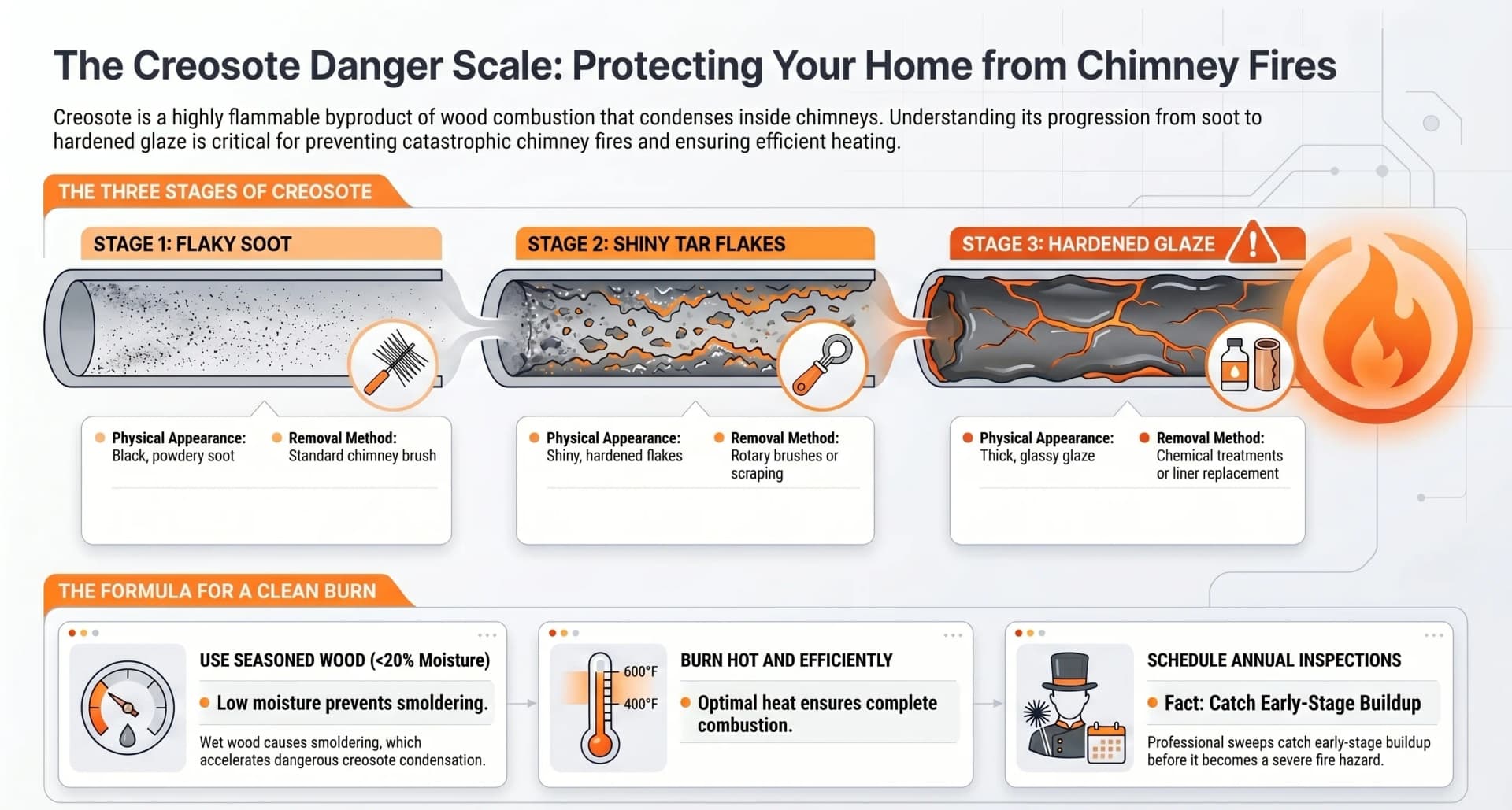
- Stage 1 is fluffy, black, sooty buildup that brushes off easily with a polypropylene brush. Stage 2 is flaky, crusty tar that has hardened on the flue walls and requires rotary brushing or chemical pre-treatment. Stage 3 is shiny, glazed, coal-like tar that is fused to the liner, highly flammable, and often impossible to remove without replacing the flue.
- Why does creosote form in some chimneys but not others?
- Creosote forms when wood smoke cools below the condensation point before leaving the flue. The biggest causes in NZ are damp-down overnight burning, wet pine (>20% moisture), oversized burners running cool, undersized chimneys, and short flue runs in single-storey homes. Hot, fast burns with dry hardwood produce far less creosote.
- How dangerous is creosote?
- Creosote is the primary fuel source in chimney fires. It is highly flammable — Stage 3 glazed creosote has been measured igniting at flue temperatures around 600°C, well within the range a hot fire can reach in a poorly maintained chimney. Chimney fires reach 1,100°C and damage flue liners, masonry, and roof structures.
- Can I clean creosote myself?
- Stage 1 creosote can be brushed out with a quality DIY kit. Stage 2 and Stage 3 cannot. DIY brushes lack the rotational torque, chemical pre-treatment, or power-sweep chains needed to remove hardened deposits. Attempting DIY on Stage 2 or Stage 3 typically loosens material into the smoke chamber, where it becomes free-floating fire fuel.
Key Takeaways
- Creosote is condensed wood smoke that forms on flue walls when smoke cools below 130°C — the same chemical family as fence-post creosote
- Stage 1 is fluffy soot (1–6mm, brushes off cleanly); Stage 2 is hardened tar (3–10mm, rotary brushing required); Stage 3 is glazed coal-tar (5–25mm, often needs flue replacement)
- Damp-down overnight burning is the single biggest cause of Stage 2 deposits in NZ chimneys — a 6–8 hour smoulder condenses tar all night
- Wet pine (>20% moisture) is the single biggest cause of overall buildup; a $30–$60 moisture meter is the cheapest creosote-prevention investment a NZ homeowner can make
- Heavy users with damp-down + wet pine can reach Stage 2 in one season and Stage 3 in 2–3 years — vs Stage 1 only for 10+ years with hot burns and dry hardwood
- Stage 1 removal: $100–$170. Stage 2: $200–$400. Stage 3 chemical/mechanical: $400–$900. Stage 3 flue replacement: $1,200–$4,600
- Annual sweeping is the cheapest prevention strategy — skipping three years typically costs 3–5× the price of three annual sweeps in remediation
What is creosote, exactly?
Creosote is condensed wood smoke. When wood burns, it releases water vapour, unburned hydrocarbons, tar particles, soot, and acidic gases that condense onto flue walls when smoke cools below ~130°C.
Chimney creosote is chemically similar to the creosote used to treat fence posts and railway sleepers, but it is a messy real-world mixture rather than a controlled distillate. It contains unburned hydrocarbons (the flammable tar fraction), soot and carbon particulate, water vapour and acid, and polycyclic aromatic hydrocarbons (PAHs) classified as carcinogenic. The proportions change as creosote ages — fresh deposits are mostly soot and water; older deposits dry, harden, and concentrate into the tar fraction, which is why creosote becomes more flammable as it ages, not less.
Why does creosote build up in your chimney?
Creosote forms when smoke cools below its 130°C condensation temperature inside the flue rather than escaping into open air. Three drivers: low burner temperatures, moisture in the wood, and flue geometry that lets smoke linger.
The five biggest causes in NZ wood burners are damp-down overnight burning (drops temperature below 200°C), wet pine above 20% moisture, oversized burners running cool, long or cold flue runs that lose heat, and restricted draft from bird nests or partial blockages. The single biggest cultural contributor is damp-down overnight burning — closing the air control to extend burn time produces a smoky, low-temperature smoulder that condenses tar onto the flue walls all night. Most chimneys condemned in heavy-use NZ homes are condemned because of cumulative damage from years of overnight damp-down, not acute neglect.
What is Stage 1 creosote?
Stage 1 is fluffy, black, sooty buildup that looks like coarse charcoal dust. Dry, easily disturbed, brushes off cleanly with a polypropylene rod-and-brush kit. Typical thickness 1–3mm in well-maintained flues.
Stage 1 is the deposit form most NZ homeowners will ever encounter — it is what professional sweeps remove during the standard annual $100–$170 sweep. A flue with Stage 1 only is in good condition: combustion was hot enough to keep the tar fraction airborne, and only the soot fraction settled. Modest flammability — needs sustained high temperatures to ignite. The hidden risk is letting Stage 1 accumulate beyond a year: deposits gradually compress and chemically transform into Stage 2 over 12–24 months in heavy-use chimneys. Annual sweeping resets the clock; biennial or skipped sweeping does not.
What is Stage 2 creosote?
Stage 2 is flaky, crusty, hardened tar that has chemically bonded to the flue wall — like coarse black flakes or dried roofing tar. Cannot be removed with finger pressure or a standard polypropylene brush. Highly flammable.
Stage 2 forms when Stage 1 deposits compress and oxidise over 12–24 months, or when sustained low-temperature burning condenses the tar fraction directly. Damp-down overnight burning with wet pine can produce Stage 2 in a single season. Removal requires chemical pre-treatment (Cre-Away, ACS Powder) burned in the firebox over 1–2 weeks before sweeping, plus a rotary brush head running at 200–800rpm, plus mid-sweep inspection to confirm coverage at offsets and the smoke chamber. Stage 2 is the level at which DIY sweeping clearly fails — Bunnings and Mitre 10 polypropylene brushes can scratch the surface but cannot dislodge the deposit. Pricing typically $200–$400 for full removal.
What is Stage 3 creosote?
Stage 3 is shiny, glazed, coal-like tar fused to the flue liner — looks like spilled molten tarmac that hardened in place. Highly flammable, often non-removable without replacing the flue. The most dangerous condition a chimney can be in.
Stage 3 forms when sustained low-temperature burning condenses heavy tar onto an already Stage 2-coated flue. The new tar fills gaps between Stage 2 flakes, reaches the flue wall, and forms a continuous glassy layer. Once fused, the bond between glaze and metal liner is stronger than between glaze and itself — it cannot be brushed off. Three remediation options in NZ: chemical fluidisation (PCR, Cre-Away Pro, $150–$400 product + 1–2 sweeps over 4–8 weeks), mechanical descaling (rotary chains or steel-wire heads, $400–$900, risks damaging stainless liners), or full flue replacement ($1,200–$4,600). In roughly half of NZ Stage 3 cases, the flue is also corroded or cracked enough that replacement is the only safe path.
How fast does creosote build up in NZ wood burners?
Range varies enormously — from 1–2mm Stage 1/year (moderate use, hot burns, dry hardwood) to Stage 2 in one season and Stage 3 in 2–3 years (damp-down overnight, wet pine, undersized flue).
Two patterns drive most variation: damp-down overnight burning (fastest path to Stage 2) and pine moisture content (fastest path to overall buildup). Both are common in NZ — pine is the most popular firewood by volume because it is cheap, and damp-down is the standard overnight method most homeowners are taught. The contrast is sharpest in cold-region homes: a daily winter user in Cromwell or Alexandra burning damp pine and damp-downing each night can reach Stage 2 within a single season, while the same burner run by a homeowner using dry blue gum or mānuka with hot fires only can stay at Stage 1 for 3+ years. Wood choice and burning style matter more than location.
How does your firewood choice affect creosote buildup?
Wet wood absorbs ~2.3MJ/kg of heat to evaporate moisture before burning, dropping burner temperatures below the smoke combustion threshold. Wet pine (>20% moisture) is the single biggest cause of NZ creosote problems.
Mānuka, kānuka, old-man pine (10+ years dead), and well-seasoned macrocarpa produce very low creosote (14–18% moisture, clean burn). Eucalyptus, blue gum, wattle, totara, rimu produce low to moderate. Properly seasoned radiata pine (18–22%) is fine. Marginally dry pine (22–26%) is the single biggest cause of creosote in NZ chimneys. Wet pine (>26%) and driftwood (variable + salt corrosion risk) should not be burned. Treated timber is illegal in many regions. Cheapest creosote-prevention investment a NZ homeowner can make: a $30–$60 moisture meter from Mitre 10 or Bunnings, with a rule of refusing to load anything above 20% moisture into the burner.
How does your burning style affect creosote buildup?
Burning style is the second big controllable factor. Hot, fast burns with full air control produce far less creosote than smouldering low-oxygen burns. Damp-down overnight burning is the single biggest cause of Stage 2 in NZ.
Top-down lighting + hot burn + clean shutdown = Stage 1 only, 1–2mm/year. Standard refuel + moderate air control = Stage 1, 3–5mm/year. Heavy load + significant damp-down = Stage 1+2, 5–10mm/year. Overnight damp-down with closed air supply = Stage 2 within a season. The practical issue with overnight damp-down: it works thermally — you wake to a warm house — but produces a 6–8 hour smouldering burn at well below 200°C with air restricted to the point where wood smoke barely combusts. Almost all of that smoke condenses inside the flue. Modern ULEB models are designed for low-rate combustion above the creosote threshold but only when used as designed; damp-down on a ULEB is just as harmful as on an old burner.
How can you tell which stage of creosote you have?
You cannot reliably tell from the firebox alone — it shows only the bottom 200–400mm of the flue. The dangerous deposits accumulate in the upper flue, smoke chamber, and around the cap. Reliable diagnosis requires a torch-and-mirror sweep or CCTV inspection.
Visual signs that suggest each stage: black powder falling between fires (Stage 1, normal); 5–15mm black flakes (Stage 2, sweep overdue); tar drips on firebox top after wet weather (Stage 2 or 3, immediate inspection); glossy black coating on firebox walls (Stage 3 likely further up); strong tar smell when burner is cold (volatile compounds exuding from Stage 2 or 3); reduced draft and smoke spilling into room (significant buildup); roaring noise + heat from chimney exterior (active fire — call FENZ on 111 immediately). Reliable options: annual professional sweep ($100–$170, includes inspection), CCTV inspection ($180–$350 standalone), or pre-purchase inspection (recommended for any home buy with a wood burner). If Stage 2 or 3 is suspected, do not light another fire until swept — lighting on top of suspected hardened creosote is the most common cause of severe NZ chimney fires.
What does it cost to remove each stage of creosote?
Stage 1: $100–$170 (annual NZHHA sweep). Stage 2: $200–$400 (rotary + chemical). Stage 3 chemical/mechanical: $400–$900. Stage 3 flue replacement: $1,200–$4,600. Skipping three years typically costs 3–5× three annual sweeps.
Costs scale sharply with buildup stage. Standard sweep with roof access $150–$220. Stage 2 with complex flue (multiple offsets + smoke chamber) runs $300–$550. Stage 3 chemical fluidisation involves multi-week conversion plus 2 sweeps over 4–8 weeks elapsed time. Mechanical descaling uses rotary chains and steel descaling heads — aggressive and risks damaging stainless liners. Post-fire clean and assess (forensic inspection + cleaning + insurer report) runs $300–$700 for a half-day. The Stage 3 replacement scenario also voids the long-term ownership benefit of a wood burner: a clean-running burner provides 15–25 years of service before age-related flue replacement; a neglected burner can need replacement within 5–8 years, halving the asset life.
How can you prevent creosote buildup in the first place?
Seven rules: burn dry wood (<20% moisture), burn hot (full air for first 30 minutes), right-size the burner, avoid overnight damp-down, fit a chimney cap with bird guard, burn hot for 20 minutes weekly, schedule annual autumn sweep.
The single highest-leverage discipline is rule 4: avoid overnight damp-down. NZ chimney sweep practitioners report that homes following all six other rules but still damping down overnight produce significantly more creosote than homes observing all seven. The 6–8 hour smouldering burn is enormously more damaging than any other single behaviour. Beyond burning behaviour, structural prevention helps: external flue insulation reduces heat loss in the upper flue, triple-skin flue systems retain more heat than single-skin equivalents, and properly-sized flue diameter matters (undersized = draft restriction = cooling smoke; oversized = smoke moves slowly and cools). The combination of disciplined burning, dry wood, and an annual professional sweep keeps almost every NZ chimney at Stage 1 indefinitely.
What is the bottom line?
Creosote is inevitable but the stage you accumulate is largely under your control. Burn dry hardwood hot, avoid overnight damp-down, sweep annually — and almost every NZ chimney stays at Stage 1 indefinitely.
The economic case for prevention is overwhelming. An annual NZHHA sweep at $100–$170 prevents the $200–$400 Stage 2 remediation, the $400–$900 Stage 3 chemical or mechanical removal, and the $1,200–$4,600 full flue replacement. It also prevents the catastrophic case — a chimney fire — which can cost $150,000+ and trigger an insurance claim that scrutinises every detail of your maintenance history. If your chimney has gone more than two years without a sweep, do not light another fire until it has been inspected. Stage 2 and Stage 3 deposits are the fuel for the most severe chimney fires in NZ, and their distribution inside the flue cannot be reliably assessed from the firebox. A $100–$350 inspection replaces guesswork with a documented condition report.
| Stage | Appearance | Thickness Range | Removal Method | Typical NZ removal cost in NZD | Common formation cause | Source |
|---|---|---|---|---|---|---|
| Stage 1: First-Degree (Sooty) Creosote | Light soot or flaky deposits; a thin layer of flakes or dust-like soot coating. | Thin layer (less than 6 mm / 1/4 inch). | DIY task using standard chimney brushes or cleaning logs. | $90 - $160 | Burning unseasoned wood or low burn temperatures; common during initial use even with proper practices. | [1-5] |
| Stage 2: Second-Degree (Tar-like) Creosote | Shiny black flakes or a sticky, hardened tar-like substance; resembles "tar corn flakes." | Thicker than Stage 1; restricts the flue pipe. | Professional services required; uses rotary brushes, loops with metal rods, or scrapers. | $200 - $450 | Restricted airflow (damper closed too much), use of glass doors, or cooler flue temperatures from slow-burning wood. | [1-5] |
| Stage 3: Third-Degree (Glazed) Creosote | Thick, hardened glaze; shiny, baked-on deposits that look like liquid tar running down the walls. | Up to 25 mm (1 inch) thick; can exceed 50 mm (2 inches) if "chimney fire fluff" is present. | Professional services required; involves chemical treatments, rotary chain whips, or chimney liner replacement. | $500 - $2,500+ | Inefficient burning, unseasoned wood, extremely cold upper flue, or oversized flue liners. | [1-5] |
Data compiled from research by Chimney Guys
Frequently Asked Questions
Is creosote the same thing as soot?
No. Soot is a component of creosote, not the same material. Soot is the dry carbon particulate that brushes out easily — Stage 1 creosote is mostly soot. Stages 2 and 3 are dominated by hardened hydrocarbons (the tar fraction), which are far more flammable and far harder to remove.
Is creosote toxic?
Yes — chimney creosote contains polycyclic aromatic hydrocarbons (PAHs) that are classified as carcinogenic. Skin contact causes irritation and photosensitivity. Inhalation of creosote dust is harmful, which is why a P2-rated respirator is standard for any DIY sweep work.
How thick can Stage 1 creosote get before it becomes Stage 2?
Roughly 6mm thick or 12–24 months of continuous heavy use, whichever comes first. Above that thickness or duration, the lower layers begin to compress and transition chemically. The exact transition depends on flue temperature cycling and wood type — a damp-down user can reach Stage 2 in a single winter season.
Can chemical cleaners remove Stage 2 creosote on their own?
No. Chemical cleaners (Samba sachets, Fire Wise Soot-Loose, Cre-Away) make Stage 2 deposits drier and more brittle but do not remove them. Mechanical brushing — usually rotary — is required after chemical pre-treatment. Anyone selling chemical-only Stage 2 removal is overstating what the product does.
Can Stage 3 creosote ignite spontaneously?
Not at typical operating temperatures — it ignites when flue temperatures reach roughly 600°C+, which a hot fire can produce in a heavily-loaded burner. The danger is that Stage 3 ignition triggers a self-sustaining chimney fire that cannot be put out simply by closing the air supply, because the deposit is the fuel and it is exposed to a chimney full of air.
Is it ever safe to keep using a chimney with Stage 3 creosote?
No. A flue with confirmed Stage 3 deposits should be taken out of service until remediation. Continuing to burn with Stage 3 present is the highest-risk scenario in residential chimney safety.
How long does it take to go from Stage 1 to Stage 2?
12–24 months in normal use, or as little as a single season with damp-down overnight burning. Heavy users in cold regions (Otago, Southland, Canterbury, the Mackenzie Country) reach Stage 2 faster than moderate users in milder climates.
Think You've Got It?
13 questions to test your understanding — instant feedback on every answer
Question 1 of 13
What is the primary substance found in the black residue commonly referred to as chimney creosote?
Question 2 of 13
Which stage of creosote is characterised by shiny, black flakes that resemble 'hard tar corn flakes'?
Question 3 of 13
According to the source material, what is the ideal moisture content for seasoned firewood to ensure efficient combustion?
Question 4 of 13
Why is 'smouldering' (dampening down the air intake for an all-night burn) considered inefficient?
Question 5 of 13
What is the primary danger of Stage 3 creosote besides the risk of a chimney fire?
Question 6 of 13
When cleaning a catalytic combustor (cat) on a wood stove, why is it vital to use a soft-bristled brush or a gentle vacuum?
Question 7 of 13
Which material is highlighted for its superior 'thermal mass' and ability to release heat slowly over 12-24 hours?
Question 8 of 13
What common fireplace accessory is used to prevent wind from blowing smoke back down the chimney and to keep rain out?
Question 9 of 13
According to the 'hot burn' method, how should you primarily control the burn rate of your fire?
Question 10 of 13
At what temperature does wood achieve 'complete combustion', breaking down into pure heat, CO2, and water vapour?
Question 11 of 13
What is the recommended action if a chimney inspection reveals Stage 3 creosote that cannot be safely removed with tools?
Question 12 of 13
Which formula is suggested as the best way to reduce creosote buildup during the burning season?
Question 13 of 13
In a rental property in New Zealand, who is typically responsible for ensuring the chimney is safe and regularly cleaned?
Need a chimney sweep?
Tell us where you are and what you need. We'll match you with a verified local sweep and have them in touch within one business day.