Chimney Sweep FAQ NZ — 12 Questions Homeowners Ask
The 12 most common questions NZ homeowners ask their chimney sweep — answered with the data Fire and Emergency NZ, the NZ Home Heating Association, and NZ insurers actually use. Frequency, cost, what is included, certificates, insurance, and the practical questions that come up at the kitchen table.
Quick Answer
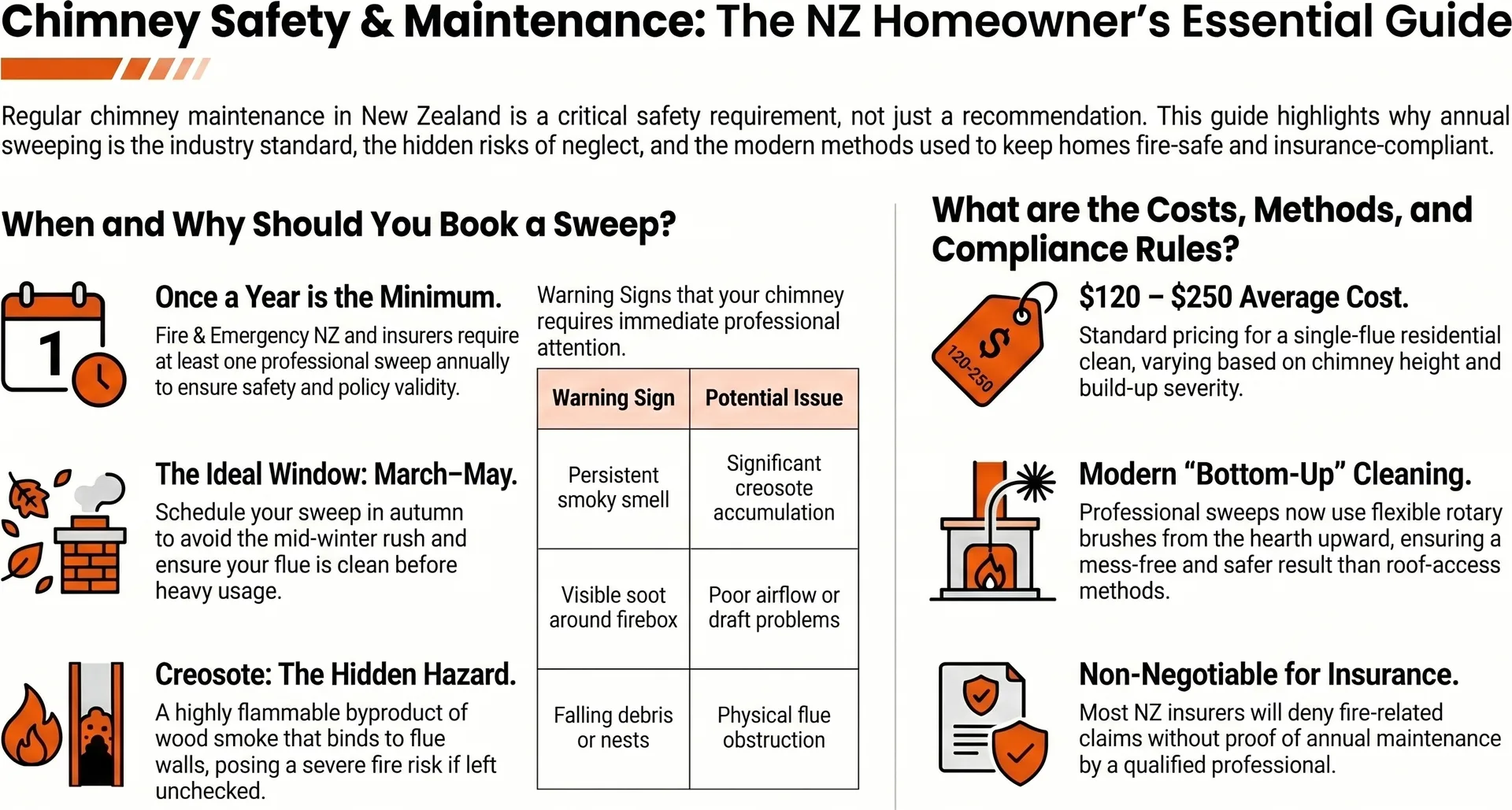
Annual professional sweeping is the baseline that Fire and Emergency NZ (FENZ), the NZ Home Heating Association, and the NZ Insurance Council all converge on. Light use is once per year (book March-May for autumn rates); heavy daily users in winter need bi-annual sweeping. Cost: $96-$120 + GST for a bottom-up clean (now the dominant method, replacing roof-access sweeping); $160 + GST for top-down access; $120-$250 total range depending on flue accessibility and creosote build-up. The certificate that comes with the visit is required by every major NZ insurer to pay out on fire claims.
Key Answers
- How often should I sweep my chimney in NZ?
- Annually at minimum — Fire and Emergency NZ, the NZ Home Heating Association, and the NZ Insurance Council all align on yearly sweeping. Heavy daily users need bi-annual (once before season, once late winter). Damp coastal regions like Wellington accelerate creosote hardening, so annual is the floor not the ceiling.
- How much does a NZ chimney sweep cost?
- Bottom-up clean: $96-$120 + GST. Top-down (roof access): around $160 + GST. Total range $120-$250 for a standard residential single-flue including inspection certificate. Multi-flue properties get the first flue at full price and 50-70% on each additional flue booked at the same visit.
- Will my insurance pay for a chimney fire?
- Only with a current sweep certificate. FMG reports 20% of all NZ house fire claims involve chimneys. Most insurers (FMG, IAG, AA, Tower, Vero, State) require evidence of annual professional cleaning before paying out — without the certificate, claims are routinely reduced or denied.
- Can I sweep my chimney myself?
- Technically yes — DIY rotary brush kits cost $100-$250. Practically no — most NZ insurers do not accept DIY sweeping as "reasonable steps to prevent loss" under standard policy wording. The $130-$200 professional sweep with certificate is much cheaper than a denied insurance claim.
- When should I book my annual sweep?
- March-May (autumn). Sweeps are 10-20% cheaper than mid-winter and available within days instead of 2-3 week waits. You also have time to address any defects found before peak winter use. Booking in June often means a July or August appointment.
Key Takeaways
- Annual professional sweep + certificate is the universal NZ standard — FENZ, NZHHA, and NZ Insurance Council all converge on this
- Cost: $96-$120 + GST for bottom-up clean (preferred method); $160 + GST top-down; $120-$250 total range
- Without a current sweep certificate, NZ insurers routinely reduce or deny chimney fire claims — and 20% of all FMG house fire claims involve chimneys
- Bottom-up sweeping with HEPA-vacuum capture is replacing roof access — safer, cleaner, and effective on most modern wood burners
- Damp coastal climates (Wellington, Kapiti, Hutt Valley) accelerate creosote hardening — annual is the minimum, not a buffer
How long does a sweep take?
30-60 minutes for an annual on a single flue with light creosote.
30-60 minutes for an annual on a single flue with light creosote. 60-90 minutes for first-time clean or moderate creosote. Add 30 minutes for a CCTV inspection.
Should I light a fire after a sweep?
Wait 24 hours after a sweep before lighting a fire to allow fine particulate to settle.
Wait 24 hours after a sweep before lighting a fire to allow fine particulate to settle. Some sweeps run a small test fire as part of the visit — that's fine. Avoid burning a heavy load on a freshly-swept flue.
Can a chimney sweep also fix problems they find?
Most can do minor repairs (gasket replacement, cap replacement, mortar repointing) on the same visit.
Most can do minor repairs (gasket replacement, cap replacement, mortar repointing) on the same visit. Larger repairs (flue liner replacement, structural masonry) usually need a separate quote and visit. Always ask upfront.
What's the worst thing for my chimney?
Burning wet wood.
Burning wet wood. Wood above 25% moisture creates 3x more creosote, halves the heat output, and is the leading cause of NZ chimney fires. Buy a $30 moisture meter — pays for itself in one avoided incident.
What if I have multiple chimneys?
Bundle them in one visit.
Bundle them in one visit. Most NZ sweeps charge full price for the first flue, 50-70% for each additional. A 4-flue heritage home is $400-$650/year vs $720-$1,000 if booked separately.
Do I need to be home during the sweep?
Yes — you need to provide access, sign the certificate, and discuss any findings.
Yes — you need to provide access, sign the certificate, and discuss any findings. Most sweep visits take 60-90 minutes total including discussion. Plan to be home for the duration.
What should I do before the sweep arrives?
Don't light a fire for 24-48 hours before so the flue is cool.
Don't light a fire for 24-48 hours before so the flue is cool. Move furniture and rugs at least 1m from the firebox. Have your previous sweep certificate ready (if you have one). Have moisture meter readings if you've been testing your wood.
Will the sweep make a mess?
Modern sweeps use HEPA-filtered industrial vacuums and drop sheets.
Modern sweeps use HEPA-filtered industrial vacuums and drop sheets. A well-equipped sweep leaves the firebox cleaner than they found it, with zero soot in the room. If they don't bring a vacuum, find a different sweep.
Can I be there if the sweep goes on the roof?
Yes.
Yes. Many sweeps welcome a homeowner watching from below, especially if they're showing you something on the chimney top. If the sweep does roof work, they should always set up safety equipment per WorkSafe height-work rules.
What if I don't trust the sweep's findings?
Get a second opinion.
Get a second opinion. Either book another sweep for an independent inspection or request a CCTV recording showing the issue. NZ has enough sweeps in most regions that getting a second opinion costs $80-$200 — worth it before agreeing to large repairs.
Does the sweep need to be NZHHA-accredited?
Not legally required, but strongly preferred.
Not legally required, but strongly preferred. NZHHA accreditation means the sweep has completed standardised training and follows the industry's quality standards. Most insurers don't specify accreditation but FMG and some commercial insurers prefer it.
What's the most overlooked maintenance item?
Cap inspection.
Cap inspection. The cap is the cheapest, easiest part to replace ($400-$900 installed) but failures cascade into expensive damage. Most homeowners never inspect their cap until water staining appears. Build it into your annual sweep checklist.
| Fireplace Use Level | Recommended Sweep Frequency | Estimated Cost Range (NZD) | Regional Coverage (NZ) | Service Inclusions | Insurance & Certificate Purpose | Key Maintenance Requirements | Source |
|---|---|---|---|---|---|---|---|
| Heavy | Twice per year (bi-annual); once before season and once in late winter/after heaviest use. | Up to \$250+ (higher for multi-flue, heavy build-up, or roof-only access @ \$160+ GST). | Wellington region, Kapiti, Horowhenua, Porirua, Johnsonville, Tawa, Pukerua Bay. | Deep cleaning of thick creosote, bird nest removal, airflow diagnostics, and structural safety evaluations. | Landlords have a legal obligation to provide proof of maintenance to prevent invalidating property insurance. | Roof access may be required for specific models (e.g., Pyroclassic) or cap blockages; damp coastal climates accelerate wear. | [1-5] |
| Moderate | Annual sweeping (ideally March-May); early booking recommended for flexibility. | \$120 - \$250 (standard range for residential single-flue). | Greater Wellington, Lower Hutt, Upper Hutt, Paraparaumu, Waikanae, Paekākāriki. | Full flue clean, inspection for cracks/damage, checking cowl/flashing, and identifying structural issues. | Ensures compliance with policy wording; maintenance evidence is required by the New Zealand Insurance Council. | Avoid burning rubbish/driftwood; replace crumbling fire bricks; bottom-up sweeping uses rotary brushes and HEPA vacuums. | [1, 3-5] |
| Light | Once per year (baseline); minimum recommended before winter season. | \$96 - \$250 (varies by method and complexity). | Wellington, Kapiti Coast, Horowhenua, Hutt Valley, Porirua, Otaki, Levin. | Chimney sweeping, soot/creosote removal, visual inspection of firebox/flue/baffles, vacuuming, and safety reporting. | Professional certificates are non-negotiable for insurance claims; proof of annual maintenance prevents denied claims after fires. | Burn dry, seasoned wood (<25\% moisture); bottom-up cleaning is preferred for safety; landlords must ensure regular cleaning. | [1-4] |
Data compiled from research by Chimney Guys
Frequently Asked Questions
What does a professional sweep actually do?
Visual inspection of the firebox and exterior chimney, mechanical cleaning of the flue with rotary brushes (bottom-up using flexible drill-driven shafts is now standard), HEPA vacuum capture so no soot enters the room, baffle and air tube check, debris removal from the firebox, and issue of an inspection certificate documenting the work and any defects found.
Why is bottom-up sweeping replacing the roof method?
Bottom-up is safer (no working at height in NZ wind), cleaner (industrial HEPA vacuums capture soot at source), and faster. Roof access is now reserved for specific burners (Large Jotul, Pyroclassic, Jayline Classic with welded baffles) and for cap or flashing repairs.
How long does a sweep take?
Standard sweep + inspection: 30 to 90 minutes depending on creosote level and flue accessibility. First-time clean of a long-neglected flue can run 60-90 minutes. Add 30 minutes for a CCTV inspection if you have suspected internal damage.
What is creosote and why does it matter so much?
Creosote is the tar-like residue that condenses on flue walls when wood smoke cools below 130°C. It is the primary fuel of chimney fires — Stage 3 glazed creosote ignites at temperatures as low as 370°C, well within the range a hot fire reaches. The annual sweep catches Stage 1 (fluffy) before it hardens into Stage 2 (crusty) or Stage 3 (glazed coal-tar).
Why is the Wellington climate harder on chimneys?
Damp coastal air, high humidity, and wind-driven negative pressure all accelerate residue buildup. Moisture causes creosote to bind and harden faster than in dry inland regions. Wellington and Kapiti homeowners often need stricter adherence to annual sweeping than the same household in Central Otago.
What if I have multiple flues?
Bundle them in one visit. Most NZ sweeps charge full price for the first flue and 50-70% for each additional flue. A 4-flue heritage home is typically $400-$650 per year all-in versus $720-$1,000 if booked separately.
Do I need to be home during the sweep?
Yes. You need to provide access, sign the certificate, and discuss any findings or recommended repairs. Plan to be home for the 60-90 minute visit including discussion.
What should I do before the sweep arrives?
Do not light a fire for 24-48 hours so the flue is cool. Move furniture and rugs at least 1m from the firebox. Have your previous sweep certificate ready (if you have one). Have any moisture meter readings on your firewood ready if you have been testing.
Will the sweep make a mess?
No. Modern sweeps use HEPA-filtered industrial vacuums and drop sheets. A well-equipped sweep leaves the firebox cleaner than they found it with zero soot in the room. If they do not bring a vacuum, find a different sweep.
What if the sweep finds something wrong?
Most can do minor repairs (gasket replacement, cap replacement, mortar repointing) on the same visit for an additional charge. Larger repairs — flue liner replacement, structural masonry, baffle replacement — usually need a separate quote and visit. Get a second opinion before agreeing to anything over $1,000.
Does the sweep need to be NZHHA-accredited?
Not legally required for residential work, but strongly preferred. NZHHA accreditation means standardised training and adherence to industry quality standards. FMG and most commercial insurers prefer NZHHA-accredited sweeps; some require it for landlord and rental property certificates.
What is the worst thing I can do for my chimney?
Burn wet wood. Wood above 25% moisture creates 3x more creosote, halves the heat output, and is the leading cause of NZ chimney fires. A $30 moisture meter pays for itself in one avoided incident. Never burn rubbish, plastic, or driftwood — driftwood salt corrodes metal flue liners.
Think You've Got It?
12 questions to test your understanding — instant feedback on every answer
Question 1 of 12
According to Fire and Emergency New Zealand (FENZ) and the NZHHA, what is the minimum recommended frequency for sweeping a chimney?
Question 2 of 12
For a household in the Wellington region that uses their wood burner daily throughout the winter, how often should they consider booking a sweep?
Question 3 of 12
What is the likely impact on sweep frequency if a homeowner regularly burns wet or unseasoned wood?
Question 4 of 12
In the Wellington and Lower Hutt regions, what is the typical average cost range for a professional residential chimney sweep?
Question 5 of 12
Why is a professional sweep certificate critically important for New Zealand homeowners regarding insurance?
Question 6 of 12
How does the burning of hardwoods generally compare to softwoods in terms of flue maintenance?
Question 7 of 12
Which regional factor in Wellington can cause creosote deposits to bind and harden more quickly against flue walls?
Question 8 of 12
At what approximate temperature can glazed creosote ignite, potentially causing a chimney fire?
Question 9 of 12
Who is typically responsible for ensuring the chimney is safe and regularly cleaned in a New Zealand rental property?
Question 10 of 12
If a homeowner notices a strong smoky or tar-like smell during the warmer summer months, what does this usually indicate?
Question 11 of 12
What is the primary purpose of a fireplace baffle, and why must it eventually be replaced?
Question 12 of 12
Which of the following is a symptom of carbon monoxide poisoning that homeowners should be aware of?
Need a chimney sweep?
Tell us where you are and what you need. We'll match you with a verified local sweep and have them in touch within one business day.