Chimney Sweep Certificate NZ — Insurance Guide
What an NZ chimney sweep certificate actually is, why every major insurer (FMG, IAG, AA, Tower, Vero, State, ASB) wants to see one, and what happens to your fire claim without it. Includes the insurer-by-insurer requirement breakdown and what a compliant certificate must contain.
Quick Answer
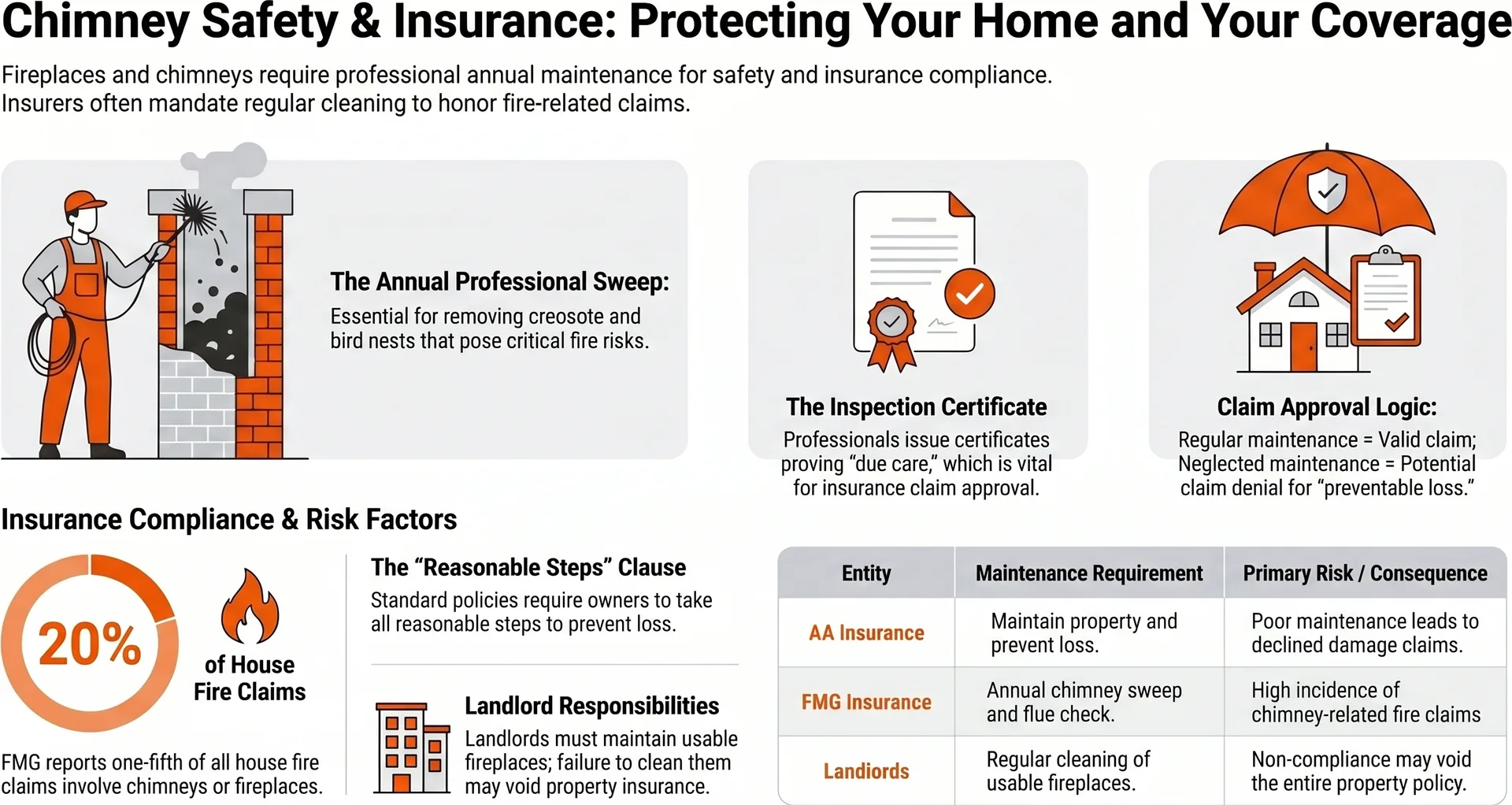
A chimney sweep certificate is the written record from your professional sweep documenting that your flue was cleaned, inspected, and is safe to use for the next 12 months. FMG reports 20% of all NZ house fire claims involve chimneys, and most insurers — including IAG, AA, Tower, Vero, and State — either require or strongly recommend annual professional sweeping. Without a current certificate, claims for chimney fires are routinely reduced or denied because the policyholder is judged to have failed the "reasonable steps to prevent loss" clause in their policy. The cheapest insurance is the $130-$200 annual sweep.
Key Answers
- Do I need a chimney sweep certificate for NZ home insurance?
- Most NZ insurers either require or strongly recommend it. AA Insurance and FMG recommend annual sweeping; IAG generally requires evidence of annual maintenance for fire claim payouts. Standard policies require homeowners take "all reasonable steps" to prevent loss — neglecting an annual sweep is routinely treated as a breach.
- What is on a sweep certificate?
- Date of sweep, sweep details (name, NZHHA accreditation if applicable), property address, flue inspected, condition of firebox and flue, any defects found, recommended repairs, and confirmation the system is safe to use. Keep the certificate for at least 12 months — until the next annual sweep replaces it.
- What happens to my claim without a current certificate?
- Reduced or denied. Insurers cite the "reasonable steps to prevent loss" clause. AA Insurance and IAG documentation explicitly mention that lack of maintenance can be cited as failure to secure the home. FMG recommends annual sweeping as the standard maintenance baseline. Without proof, the burden of proving the chimney was safe falls on the homeowner — and is rarely successful.
- How much is the certificate worth?
- Conservatively: $30,000-$80,000 of insurance protection for $130-$200 per year. A typical chimney fire restoration is $15,000-$60,000; a full structural fire can run to the property sum insured. The annual sweep is the cheapest insurance hedge in NZ home maintenance.
- Can a DIY sweep substitute for the certificate?
- No. NZ insurers do not accept DIY sweeping as evidence of "reasonable steps". The certificate must come from a professional sweep — preferably NZHHA-accredited. The whole point of the certificate is independent third-party verification that the flue was inspected and is safe.
Key Takeaways
- 20% of all FMG NZ house fire claims involve fireplaces or chimneys — making annual sweeping the highest-value preventive maintenance in home insurance
- Most NZ insurers (FMG, IAG, AA, Tower, Vero, State, ASB) either require or strongly recommend a current annual sweep certificate for fire claims
- Without a current certificate, claims are reduced or denied under the "reasonable steps to prevent loss" clause in standard policy wording
- $130-$200 annual sweep buys $30,000-$80,000+ of insurance protection — the highest leverage maintenance dollar in NZ home ownership
- Keep certificates for at least 12 months and store digitally — landlords need to retain them indefinitely for tenancy compliance
What is a chimney sweep certificate?
A written document signed by the sweep that confirms the chimney was professionally cleaned, when it was cleaned, what condition the flue was in, and what work was performed.
A written document signed by the sweep that confirms the chimney was professionally cleaned, when it was cleaned, what condition the flue was in, and what work was performed. NZ insurers use it as proof of due care before paying chimney-related claims.
Why do NZ insurers require chimney sweep certificates?
Insurance operates on the principle of utmost good faith — you must exercise reasonable care while insured.
Insurance operates on the principle of utmost good faith — you must exercise reasonable care while insured. For chimneys, reasonable care means annual professional sweeping per FENZ, NZHHA, and NZS 8108 standards. The certificate is the evidence.
What does FMG specifically require?
FMG reports that ~20% of their fire claims involve chimneys or fireplaces.
FMG reports that ~20% of their fire claims involve chimneys or fireplaces. They require an annual sweep certificate dated within 12 months of the claim event. Generic invoices without flue condition details are routinely rejected.
What if I've lost an old certificate?
Contact the original sweep — most keep records for 5-7 years and will reissue for a small fee ($20-$50).
Contact the original sweep — most keep records for 5-7 years and will reissue for a small fee ($20-$50). Also check your email archive for PDF attachments and your bank statements for the payment date.
Can a sweep refuse to give me a certificate?
If you paid for sweeping services, you're entitled to documentation of the work performed.
If you paid for sweeping services, you're entitled to documentation of the work performed. Refusal to provide a certificate after a paid clean is grounds for a Disputes Tribunal claim under the Consumer Guarantees Act.
How should I store certificates?
Both digitally (cloud storage like Google Drive, plus an email backup to yourself) and physically (fire-safe box or off-site).
Both digitally (cloud storage like Google Drive, plus an email backup to yourself) and physically (fire-safe box or off-site). The strongest insurance defence is 3+ years of consecutive annual certificates.
What if my sweep's business has closed?
Schedule a fresh sweep with a different operator immediately.
Schedule a fresh sweep with a different operator immediately. The fresh certificate covers you forward. For historical evidence, your bank statements and the closed sweep's accountant may have records, but a fresh certificate is the priority.
| Insurer | Annual sweep required (yes/no) | Certificate kept (yes/no) | Claim impact if missing | Recommended action | Source |
|---|---|---|---|---|---|
| AA | No (recommended) | Yes (recommended) | Policy requires taking all reasonable steps to prevent loss; lack of maintenance may be cited as a failure to secure the home | Maintain and secure home by having chimney swept regularly to prevent build-up [1] | [1] |
| FMG | No (recommended) | Not in source | Policies cover damage but suggest maintenance to avoid loss; 20% of fire claims involve chimneys | Get a professional chimney sweep annually to clean flues and check for bird nests [2] | [2] |
| IAG (generic advice) | Yes (inferred) | Yes (inferred) | Claims may not be paid unless the chimney has been professionally swept and inspected annually [3] | Ensure annual professional sweep and inspection to meet standard insurance requirements [3] | [3] |
| ASB | Not in source | Not in source | Inferred: Insurance payout may be impacted if regular maintenance (annual sweep) is not performed [3] | Obtain an Inspection Certificate from a professional sweep for insurance purposes [3, 4] | [3, 4] |
| State | Not in source | Not in source | Inferred: Evidence of annual service often required by many insurance companies [5] | Arrange annual inspection and sweep to ensure compliance with general insurance maintenance clauses [5] | [5] |
| Tower | Not in source | Not in source | Inferred: Many insurers require evidence of due care and maintenance for claims [5] | Book annual sweep; service providers note most insurers require evidence of maintenance [5] | [5] |
| Vero | Not in source | Not in source | Inferred: Claims may be declined if you cannot prove professional cleaning [6] | Keep professional sweeping records as insurance companies may not cover chimney problems without proof [6] | [6] |
Data compiled from research by Chimney Guys
Frequently Asked Questions
Which NZ insurers require an annual sweep certificate?
FMG, IAG, AA, Tower, Vero, State, and ASB all either require or strongly recommend annual professional sweeping with documentation. IAG and FMG are the most explicit; AA recommends but cites the broader "reasonable steps" clause; the others infer it through standard maintenance language in their policies.
How long do I need to keep the certificate?
Until the next annual sweep replaces it (12 months minimum). Landlords should retain certificates indefinitely as part of property compliance records — Tenancy Services and the Fair Insurance Code both reference maintenance documentation in dispute resolution.
My insurer never asks to see it — do I still need one?
Yes. The certificate is required when you file a claim, not when you renew the policy. The first time you need it is the worst time to discover you do not have one. Treat it like the WoF on your car — invisible until something goes wrong, then critical.
What if the sweep finds defects on the inspection?
The certificate will note the defects and any required repairs. The system is generally not certified as "safe" until the defects are addressed. Common defects: degraded gaskets, cracked firebricks, damaged baffle plates, damaged or missing chimney caps. Most are $50-$500 to fix.
I am a landlord — what extra rules apply?
Landlords are legally responsible for chimney maintenance and safety. Tenancy Services requires the wood burner be safe and operational throughout the tenancy. Most landlord insurance policies require annual sweep certificates — without one, the property may not be covered for fire damage, even if the tenant caused the fire.
When should I book my annual sweep?
Spring or summer (January-March in NZ) for the cheapest rates and immediate availability. Booking in autumn or early winter often means a 2-3 week wait and 10-20% premium pricing. Spring booking also lets you address any defects before peak winter use.
Do landlords pay or do tenants?
Landlords. Chimney maintenance is part of the property fabric, not a tenant utility. Tenancy Services treats chimney sweeping as the landlord obligation. The certificate must be in the landlord (or property manager) name — not the tenant.
What about old chimneys with no compliance history?
A first-time inspection by a qualified contractor is essential. NZ has no "grandfather clauses" in fire safety codes — old installations are still expected to meet current safety standards or be decommissioned. Pre-1900 brick chimneys often have lime mortar that has degraded to dust — DIY removal is dangerous (a small chimney weighs around 500kg, large ones 8 tonnes).
Think You've Got It?
10 questions to test your understanding — instant feedback on every answer
Question 1 of 10
What is the primary purpose of a chimney inspection certificate as described in the maintenance source materials?
Question 2 of 10
According to the AA Insurance policy guidelines, what general obligation do policyholders have regarding their property?
Question 3 of 10
What percentage of house fire claims seen by FMG Insurance involve fireplaces or chimneys?
Question 4 of 10
What determines whether a service provider like Mike's Chimneys issues a full 'Inspection Certificate' rather than just a repair quote?
Question 5 of 10
In a rental property scenario, who does Tenancy Services identify as being responsible for the regular cleaning of a usable chimney?
Question 6 of 10
What is a likely consequence if a homeowner makes an insurance claim for a chimney fire but lacks evidence of annual professional sweeping?
Question 7 of 10
Why might a professional chimney sweep insist on working from the roof for certain wood burner models, such as a Pyroclassic or a Jayline Classic?
Question 8 of 10
Which of the following symptoms is identified in the materials as a potential sign of carbon monoxide poisoning from a faulty fire?
Question 9 of 10
What structural warning sign suggests that a chimney's mortar and brickwork are being eaten away by tar or acids?
Question 10 of 10
According to the advice from experts like Michael van de Elzen, what is a critical autumn task to perform on a lifestyle block to prevent fire risks?
Need a chimney sweep?
Tell us where you are and what you need. We'll match you with a verified local sweep and have them in touch within one business day.