Chimney Smoke Problems NZ — Troubleshooting Guide
Why smoke comes back into NZ homes, how to diagnose cold flue, wet wood, blocked flues, negative pressure and wind downdraught, and when FENZ, NZHHA, and AS/NZS 2918 guidance says to stop and call a professional.
Quick Answer
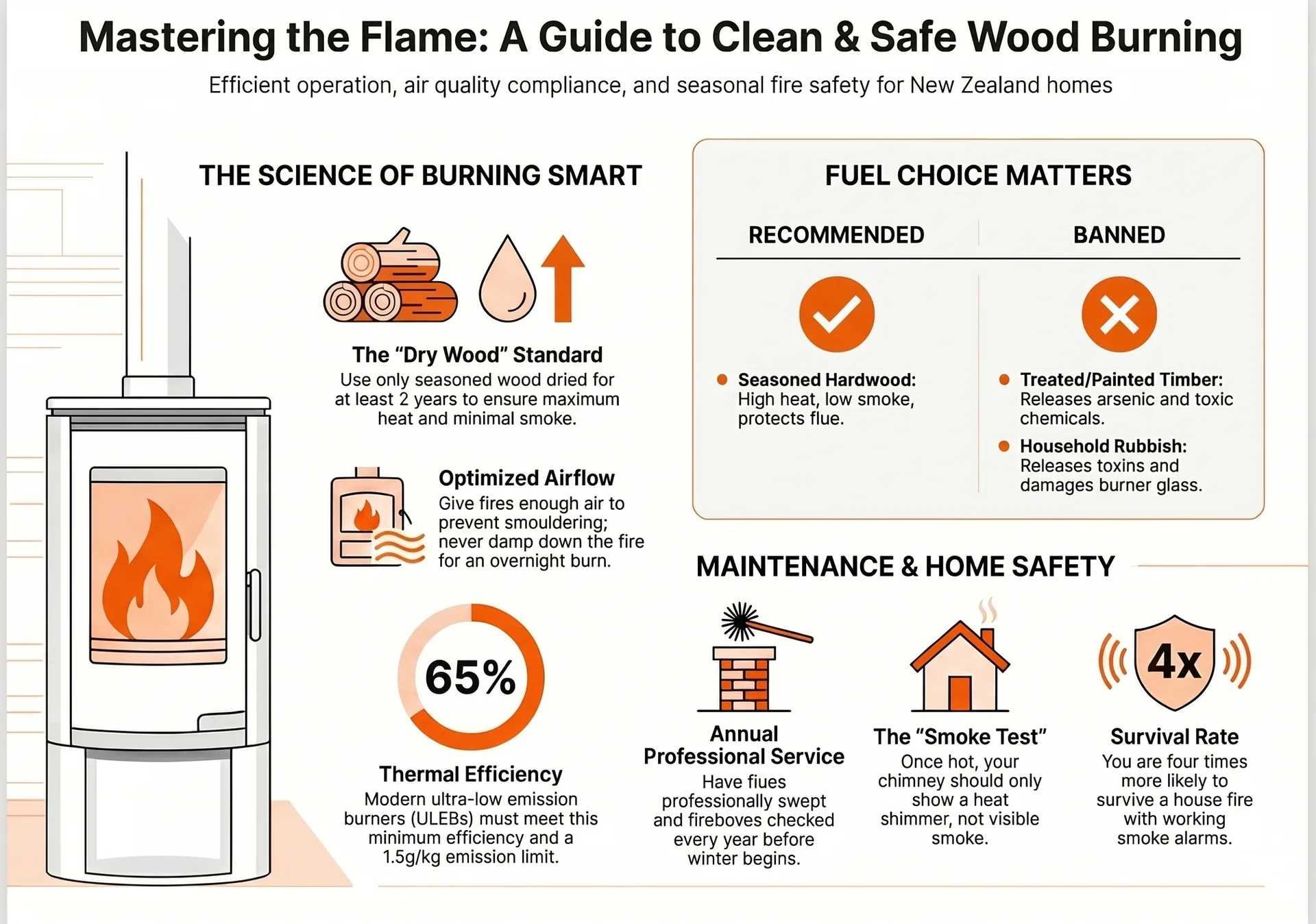
Chimney smoke coming back into the room usually means the flue has not established upward draft or the house is pulling air down the flue. Start with the safe checks: use a hot top-down start, open a window 20–30 mm, turn off extractors, and confirm firewood is below 20–25% moisture content. NZHHA says once the fire is hot you should see only a "shimmer of heat" from the chimney — any visible smoke after the initial lighting phase is a sign of inefficient combustion. Stop using the burner and call a sweep if smoke is constant, you smell creosote, suspect a blocked flue, or wind downdraught keeps returning.
Key Answers
- Why does smoke come back into the room when I light the fire?
- The most common cause is a cold flue. A cold air plug in the chimney is heavier than early smoke, so smoke spills into the room until heat establishes draft. Use a small hot top-down start or warm the flue briefly before loading fuel. NZHHA advises checking outside once the fire is burning well — you should see only a "shimmer of heat," not visible smoke. Visible smoke after the initial lighting phase signals inefficient combustion, not just a cold start.
- Why does smoke get worse when the rangehood or dryer is running?
- That points to negative house pressure. Extractor fans — rangehoods, dryers, bathroom fans — exhaust indoor air faster than it is replaced, pulling makeup air down the chimney. Open a nearby window 20–30 mm; if smoke clears, the burner needs more makeup air. For modern airtight NZ homes this is a common issue, and a permanent passive air vent may be the long-term fix. The NZHHA and MBIE building guidance both recognise negative pressure as a cause of poor draft in compliant installations.
- Can wet firewood cause smoke and chimney risk?
- Yes — and it compounds over time. Wet wood cools the firebox, produces more smoke and soot, and accelerates creosote buildup. NZHHA recommends firewood seasoned for a minimum of two years, or kiln-dried. Test a freshly split face with a moisture meter: aim below 20% for clean burning; above 25% is a safety and compliance red flag. Burning wet wood can breach NESAQ good-practice standards, which set a maximum of 1.5 g/kg particle emissions for compliant urban burners installed since 2005.
- What is "damping down" and why is it a problem?
- Damping down means restricting the air supply to keep a fire going overnight at low output. It sharply increases smoke and creosote production. NZ Building Code-compliant wood burners designed to AS/NZS 2918 are specifically engineered to prevent damping down — modern certified units are not intended to smoulder. NZHHA guidance says fires should be given enough air to prevent smouldering; restricting airflow reduces efficiency, dirties the flue faster, and produces more PM10 and PM2.5 particulate matter that harms respiratory health.
- When is chimney smoke a professional problem?
- Call a sweep if smoke is constant after warm-up, draft suddenly disappears, you suspect a bird nest or blockage, or there is a strong tar or creosote smell when the burner is cold. FENZ recommends annual chimney sweeping before the first fire of the season. A professional sweep can clean and CCTV-inspect the flue. If the issue involves flue sizing, cowl design, or installation compliance, the relevant standard is AS/NZS 2918:2001 — the NZ Building Code standard for domestic solid-fuel burning appliances.
Key Takeaways
- Cold flue start-up is the first check: establish draft with a hot top-down start before loading heavier fuel.
- NZHHA's visual test — a "shimmer of heat" only — is the practical standard for confirming a clean burn from outside.
- Negative pressure from rangehoods, dryers, and bathroom fans can reverse chimney draft in airtight NZ homes; opening a nearby window 20–30 mm tests this immediately.
- Wet firewood above 25% moisture increases smoke, PM10/PM2.5 emissions, and creosote risk; NZHHA recommends a minimum two-year seasoning period.
- Damping down overnight increases smoke and soot and is not compatible with Building Code-compliant modern wood burners.
- FENZ recommends annual sweeping before the first winter fire; persistent smoke, tar smell, or suspected blockage means stop using the burner and call a sweep.
- Masterton urban area has failed PM10 national standards — Greater Wellington has banned new open fire installations there as a result.
Why is smoke coming back into my room when I light the fire?
Almost always a cold flue. A cold air plug sits in the chimney — it is heavier than early smoke, so smoke spills out until heat flips the draft upward. Use a top-down start or briefly warm the flue before loading fuel.
This is the most common smoke complaint in NZ and the easiest to fix. The chimney acts as a column of air. Cold air is dense; early smoke is warm and lighter — but not warm enough to overcome a very cold column in winter. The fix is to heat the flue quickly before loading the main fuel. A top-down light (large logs at base, kindling on top with a firelighter) builds heat at the top of the flue and establishes draft within a few minutes. If the chimney has been cold all summer, briefly heating the flue with lit newspaper before lighting can help. NZHHA advises checking outside once the fire is burning well: if you see only a "shimmer of heat" from the chimney stack, combustion is correct and efficient.
What is negative house pressure and how do I test for it?
Modern airtight NZ homes can exhaust air faster than it enters, pulling makeup air down the chimney. Turn off all extractors and open a window 20–30 mm while lighting — if smoke clears, the burner needs more makeup air.
NZ homes built to recent energy-efficiency standards are much more airtight than older homes. When a rangehood, dryer, bathroom fan, or heat-recovery ventilation system exhausts air, it creates a lower-pressure zone indoors. The chimney becomes the path of least resistance for makeup air — so air (and smoke) comes down rather than up. The test is simple: open a nearby window 20–30 mm and turn off all mechanical extractors before you light the fire. If the smoke problem resolves, you have confirmed negative pressure. A permanent passive air vent near the burner is the standard long-term fix. MBIE building guidance recognises this as a known installation issue with solid-fuel appliances in otherwise-compliant homes.
What does wet firewood do to my chimney?
Wet wood cools the firebox, produces more smoke and soot, and accelerates creosote buildup in the flue. NZHHA recommends firewood seasoned for at least two years or kiln-dried. Test a freshly split face with a moisture meter: below 20% is the target.
Water is the enemy of a clean burn. A firewood moisture content of 25% or above is a common cause of smoke problems that homeowners blame on the burner or the flue. What is really happening: the fire is spending energy evaporating water instead of producing heat. That lowers firebox temperature, reduces draft, and produces far more smoke and particulate matter — including PM10 and PM2.5 particles that Greater Wellington Council warns can penetrate deep into the lungs. Over time, wet wood accelerates creosote buildup, which is both a fire risk and a sweep frequency driver. NZHHA's recommended standard is a minimum two-year seasoning period for split firewood, or purpose-kiln-dried wood. The practical check is a moisture meter on a freshly split face. Most hardware stores stock them. Aim below 20%.
What is "damping down" and why should I stop doing it?
Damping down means restricting the air supply to keep a fire smouldering overnight. It dramatically increases smoke, PM10 emissions, and creosote buildup. Modern NZ Building Code-compliant burners are designed to prevent it.
Damping down was once a common overnight practice — restrict the air, slow the burn, keep the house warm through the night. But it is one of the worst things you can do to a modern burner and the main air quality around it. When a fire smoulders due to restricted airflow, it produces far more smoke and fine particulate matter, dirties the glass faster, coats the flue with creosote faster, and reduces combustion efficiency. Canterbury's ECan and Greater Wellington both cite smouldering fires as a primary cause of the PM10 pollution that places like Masterton, which has been designated a "polluted airshed" failing national PM10 standards, cannot meet. Modern wood burners certified to AS/NZS 2918 are not designed to be damped down — operating them that way accelerates wear and voids some warranties. NZHHA advice is clear: give the fire enough air to prevent smouldering.
What is the NZHHA "shimmer of heat" check?
Go outside and look at the chimney while the fire is burning hot. A clean burn produces only a shimmer of heat — not visible smoke. NZHHA says visible smoke after the initial lighting phase indicates inefficient combustion.
The NZHHA advice on this is direct and useful: once your fire is well underway and hot, go outside and check the chimney. You should see only a shimmer of heat rising from the stack. Any visible smoke at that stage — not the first few minutes of lighting, but after the fire is properly going — means combustion is inefficient. The most common causes are wet firewood, restricted airflow (damping down), or a fire that is not burning hot enough. This is a practical field check anyone can do without equipment. It is also a check that NESAQ air quality enforcement can use: visible smoke from an urban burner during a burn is evidence that the appliance is not meeting the expected clean-burn standard. If your fire regularly produces visible smoke, it is worth a fuel quality check and a sweep before it becomes an enforcement issue.
What are the compliance standards behind chimney smoke in NZ?
All wood burners installed in urban areas since September 2005 must meet NESAQ standards: 1.5 g/kg max particle emission and 65% minimum thermal efficiency. The installation standard is AS/NZS 2918, cited by the NZ Building Code.
The National Environmental Standards for Air Quality (NESAQ) apply to new wood burners in urban areas — defined as properties under two hectares — installed since 1 September 2005. The benchmarks are a maximum of 1.5 grams of particles per kilogram of dry wood burned and at least 65% thermal efficiency. These apply to the burner's design and certification, not just operation, but operating the burner with wet wood or by damping down means the actual emissions during a burn likely exceed the standard the appliance was tested against. For installation compliance, building consent authorities evaluate solid-fuel appliances against the Building Code and AS/NZS 2918:2001 — the domestic solid-fuel burning appliances standard. Freestanding appliances generally need to meet a 5-year durability standard; inbuilt appliances and flues require 15 years. Smoke problems that cannot be resolved with fuel quality and lighting technique should be assessed against whether the original installation was compliant.
How do Canterbury and Wellington air quality rules affect smoke?
Canterbury requires burners to be registered in a Solid Fuel Burner Database with a legal lifespan. Wellington's Masterton has failed national PM10 standards and banned new open fires. Both regions link visible smoke to compliance risk.
Canterbury's Environment Canterbury (ECan) approach is the most structured in NZ. All new Canterbury installations must be registered in a Solid Fuel Burner Database, which tracks age and expiry. In Canterbury Clean Air Zones, low-emission burners generally expire after 20 years in Christchurch, Rangiora, Kaiapoi, and Ashburton, and after 15 years in Timaru. An expired burner cannot legally be used. Financial assistance of up to $5,000 is available for eligible owner-occupiers replacing expired burners. Greater Wellington has designated Masterton as a "polluted airshed" because it fails to meet national PM10 standards. As a result, new open fire installations are banned there, and burning treated timber is specifically highlighted as dangerous because it releases arsenic. Both regions link visible winter smoke to a community health problem — not just a home maintenance issue.
When should I stop using the fire and call a professional?
Stop immediately if smoke is constant after warm-up, draft suddenly disappears, you suspect a blockage, or there is a tar or creosote smell when the burner is cold. FENZ says house fires increase significantly in winter — do not ignore persistent smoke symptoms.
FENZ is specific about the winter fire risk: house fires increase significantly during winter months. Having working smoke alarms — installed in sleeping areas specifically — makes residents four times more likely to survive a house fire. That context matters for chimney smoke: persistent or unexplained smoke is not just an inconvenience, it is a fire-risk signal. The stop-and-call triggers are: smoke that does not clear after the warm-up phase, draft that suddenly disappears mid-fire (possibly a blockage collapsing), any smell of tar or creosote when the burner is cold (creosote is accumulating), and wind downdraught that keeps returning despite a good cowl. A qualified sweep can clean the flue and CCTV-inspect for blockages, cracks, or creosote buildup. If the issue involves installation compliance, the reference standard is AS/NZS 2918:2001, and a building professional or council can advise on whether the current setup meets the NZ Building Code.
| problem type | root cause | DIY fix | when to call a sweep | severity level (low/medium/high) | Source |
|---|---|---|---|---|---|
| Smoky chimney (excessive smoke) | Using wet/treated wood or poor burning technique (smouldering) | Use only dry, untreated wood; don't damp down for overnight burns; learn smoke-free lighting | Every year before winter to clean creosote and debris from the flue | High | [1, 2] |
| Smoke blowing back into home | Blocked or dirty flues (creosote/nests) or faulty dampers/seals | Check for obvious external obstructions; ensure dampers are open; check air vents | Immediately if there is a blockage, bird nest, or visible flue damage | High | [3] |
| Toxic pollutants/odor | Burning rubbish, plastic, treated timber, or driftwood | Only burn dry, untreated wood; put rubbish/plastic in the bin | If chemical buildup or corrosion from treated wood is suspected in the flue | High | [1, 2] |
| Smoky room (when opening door) | Opening the door too quickly or negative air pressure | Open door slowly; ensure room has enough ventilation; don't damp down overnight | If smoke persists despite proper technique or if downdraft is suspected | Medium | [1, 3] |
| Downdrafts | Negative air pressure or nearby structures affecting airflow | Increase room ventilation; check for external obstructions near chimney | To install a chimney cowl or cap to prevent downdrafts | Medium | [3] |
| Fire too hot but smokey when airflow reduced | Incompatibility between fuel load and airflow settings | Adjust fuel load size; ensure wood is seasoned to avoid needing high air just to stay lit | Annual maintenance to check draft control and internal components | Medium | [1] |
| Dirty glass door | Burning wet wood, smouldering fire, or restricted airflow | Use dry, seasoned wood; give the fire more air; avoid damping down | During the annual professional service to check seals and flue health | Low | [1, 2] |
| Large unburnt bits of wood | Poor wood quality (wet/unseasoned) or insufficient oxygen/heat | Use kiln-dried or seasoned wood (minimum 2 years); adjust air vents to increase heat | Annual inspection to ensure firebox and baffle are functioning correctly | Low | [1, 2] |
Data compiled from research by Chimney Guys
Frequently Asked Questions
How do I test whether house pressure is causing smoke?
Open a nearby window 20–30 mm and turn off the rangehood, dryer, and bathroom extractors while lighting the fire. If the smoke clears quickly, the burner needs more makeup air. A permanent passive air vent may be the long-term fix. MBIE building guidance recognises negative pressure as a recognised cause of draft problems in otherwise compliant solid-fuel appliances.
What is the best lighting method for a smoky cold flue?
Use a top-down light: place larger logs at the base, smaller pieces above, then kindling and a firelighter on top. This establishes heat quickly at the top of the flue. Alternatively, warm the flue with a small piece of lit newspaper held near the open flue before lighting. The goal is to heat the flue quickly so draft establishes before the main fuel load.
What moisture level should NZ firewood be?
Aim for below 20% on a freshly split face, measured with a moisture meter. Above 25% is a safety and air-quality red flag. NZHHA recommends a minimum two-year seasoning period or kiln-dried wood. Burning wet wood contributes to PM10 and PM2.5 particulate emissions — the fine particles that Greater Wellington Council says can penetrate deep into the lungs.
What does wind downdraught look like?
Wind downdraught usually appears only in certain wind directions or exposed weather conditions — smoke puffs back despite good dry fuel and a warm flue. Check for a missing or damaged cowl, nearby trees, or rooflines that funnel wind down the chimney. An anti-downdraught cowl fitted by a qualified installer is usually the fix.
When should I stop using the fire immediately?
Stop if smoke is constant after warm-up, draft suddenly disappears mid-fire, you suspect a bird nest or debris blockage, or there is a strong tar or creosote smell when the burner is cold. These conditions need a sweep and possibly CCTV inspection before the fire is used again. FENZ says house fires increase significantly during winter months — do not ignore persistent smoke symptoms.
How often should the chimney be swept?
FENZ recommends annually before the first fire of the season. Annual sweeping is also the practical point to catch cracked parts, blocked flues, cap or cowl damage, and creosote buildup before winter demand starts. A professional sweep following the annual maintenance standard also supports the Building Code Clause B2 durability record for solid-fuel appliances.
Why does NZHHA matter for chimney smoke problems?
NZHHA is relevant when smoke points to installation, flue sizing, or compliance rather than simple lighting technique. It references AS/NZS 2918:2001 — the installation standard cited by the NZ Building Code for solid-fuel appliances. NZHHA also gives the practical "shimmer of heat" check: look at your chimney from outside once the fire is running hot; if you see visible smoke rather than just heat shimmer, combustion is inefficient.
Think You've Got It?
10 questions to test your understanding — instant feedback on every answer
Question 1 of 10
According to industry guidelines, what should you ideally see coming from your chimney once a wood burner is hot and well underway?
Question 2 of 10
What is a common cause of 'negative air pressure' that can lead to smoke being drawn back into the home?
Question 3 of 10
For how long should seasoned firewood ideally be managed or dried to ensure it provides maximum heat and minimum smoke?
Question 4 of 10
Under the Building Code, what is the minimum required durability for an inbuilt solid fuel-burning appliance and its flue?
Question 5 of 10
What is the maximum particle emission limit allowed for new wood burners installed on urban properties of 2 hectares or less?
Question 6 of 10
Which specific harmful chemical is released into the air when burning ground-treated timber offcuts, such as decking?
Question 7 of 10
If smoke enters the room when you open your wood burner door, what is a likely culprit according to maintenance specialists?
Question 8 of 10
Why is it discouraged to 'damp down' a fire for an overnight burn in a modern wood burner?
Question 9 of 10
How much more likely are you to survive a house fire if you have working smoke alarms installed where you sleep?
Question 10 of 10
Which of these is a recognised solution for preventing downdrafts and keeping debris out of a chimney?
Need a chimney sweep?
Tell us where you are and what you need. We'll match you with a verified local sweep and have them in touch within one business day.