What to Do After a Chimney Fire NZ — Recovery Guide
A complete recovery guide for NZ homeowners after a chimney fire. Immediate safety steps, the insurance claim process, the 5 damage types professional restorers identify, restoration timelines (1 week to 6+ months), when to repair vs replace the flue, and how to prevent the next one. Grounded in FMG, FENZ, and IICRC restoration data.
Quick Answer
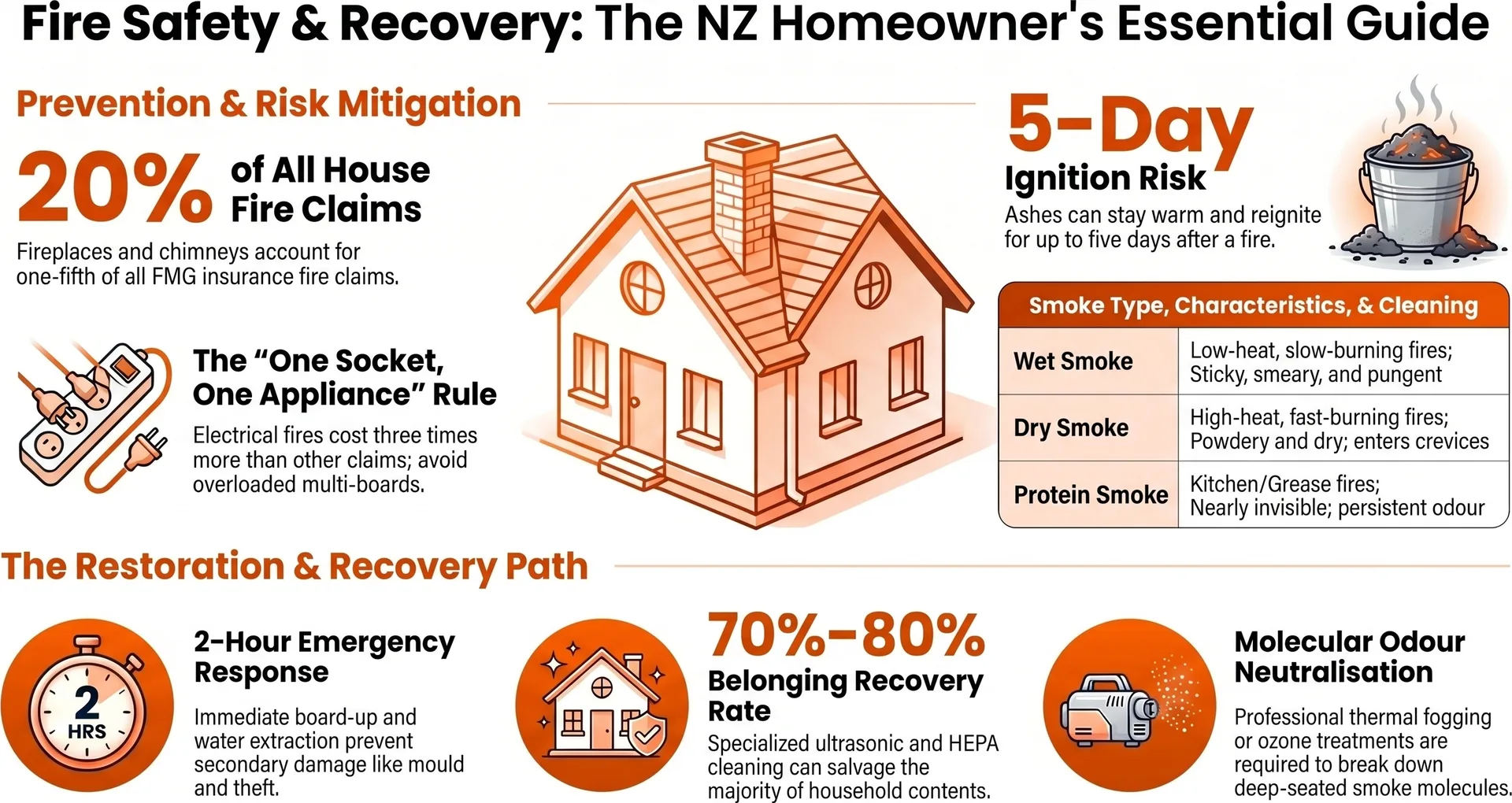
Never re-enter the property until Fire and Emergency NZ (FENZ) declares it structurally sound. Never relight the fire — even after FENZ leaves — until a qualified chimney service contractor inspects the flue. Call your insurer immediately; FMG, IAG, AA and most NZ insurers send an assessor within 24-48 hours. Photograph everything before any cleanup. Restoration timelines: minor smoke damage 1-3 weeks, moderate fire damage 1-3 months, severe structural fire 3-6 months or longer. Acidic soot becomes permanent within days, so engage professional restorers within 24 hours.
Key Answers
- What do I do immediately after a chimney fire?
- Call 111 if not already done. Evacuate everyone. Do not re-enter until FENZ declares the property safe. Do not relight the fire under any circumstances until a qualified chimney contractor inspects the flue and certifies it. Call your insurer within 24 hours to start the claim and lock in an assessor visit.
- How widespread is chimney fire damage in NZ?
- FMG reports 20% of all NZ house fire claims involve fireplaces or chimneys. Most chimney fires reach 1,100°C — hot enough to warp steel, crack flue liners, ignite framing through invisible cracks, and spread smoke into wall cavities and HVAC ductwork far from the fire itself.
- What kind of damage am I dealing with?
- Five types: wet smoke (sticky, low-heat slow burn), dry smoke (powdery, high-heat fast burn), protein smoke (invisible, persistent odor), acidic soot (etches metal and stone), and secondary water damage from firefighting hoses. Each requires different remediation. Smoke damage is often more widespread than the visible fire damage.
- What does my insurance cover?
- Standard NZ home insurance covers fire damage, smoke and soot cleanup, water damage from firefighting, structural repairs, contents replacement, and temporary accommodation (loss of use). Coverage limits and excesses vary. Policies require maintenance — a current sweep certificate is critical for fast claim approval.
- How long does restoration take?
- Minor smoke + light soot: 1-3 weeks. Moderate fire damage with structural repair: 1-3 months. Severe structural fire requiring rebuilding: 3-6 months or longer. Early professional intervention can recover 70-80% of belongings; delayed action lets soot acidity become permanent within days.
Key Takeaways
- NEVER relight the fire after a chimney fire — even if it looks fine — until a qualified contractor inspects the flue
- 20% of all FMG NZ house fire claims involve fireplaces or chimneys; chimney fires reach 1,100°C and cause invisible damage to framing and ductwork
- Acidic soot becomes permanent within days — engage professional fire restoration within 24 hours to recover 70-80% of belongings
- Smoke damage is more widespread than visible fire damage — wall cavities, HVAC ducts, and adjacent rooms all need testing
- There are no "grandfather clauses" in NZ fire codes — assessors can deny claims for code violations even on installations decades old
How do I know if I had a chimney fire?
Common signs: a neighbour reported flames or sparks from your chimney top, unusual roaring noise from the flue, dense black smoke, distorted or partially missing flue cap, scorch marks on flashing, soot deposits on the roof, unusual smoke smell that persists.
Common signs: a neighbour reported flames or sparks from your chimney top, unusual roaring noise from the flue, dense black smoke, distorted or partially missing flue cap, scorch marks on flashing, soot deposits on the roof, unusual smoke smell that persists. Slow-burning chimney fires are often only diagnosed later by visible flue or flashing damage.
Should I clean the firebox before the inspection?
No.
No. Soot patterns and ash deposits are evidence the inspector and insurance loss adjuster need. Wait until after the CCTV inspection and any insurance assessor visit before cleaning anything.
Why is a CCTV inspection mandatory after a fire?
A camera goes the full length of the flue and records video — the only way to see internal cracks, distortion, or liner damage that can't be reached by hand.
A camera goes the full length of the flue and records video — the only way to see internal cracks, distortion, or liner damage that can't be reached by hand. Insurance requires the report; safety requires the verification before relighting.
What if my insurance claim is denied?
Three escalation paths: (1) the insurer's internal complaints process, (2) the Insurance & Financial Services Ombudsman (IFSO) — free, binding for claims under ~$200k, (3) Disputes Tribunal for under $30k.
Three escalation paths: (1) the insurer's internal complaints process, (2) the Insurance & Financial Services Ombudsman (IFSO) — free, binding for claims under ~$200k, (3) Disputes Tribunal for under $30k. Most disputes settle at the internal complaints stage if you have documented chimney maintenance.
Can I keep using the fireplace while waiting for repairs?
Absolutely not.
Absolutely not. Even minor flue damage can let combustion gases or sparks into the wall cavity, causing a delayed structural fire days or weeks later. Wait for the written all-clear from a certified sweep.
How do I prevent a second chimney fire?
Three habits eliminate 95% of risk: annual sweep with written certificate; burn dry wood under 25% moisture; don't smoulder fires overnight (run hot, run short).
Three habits eliminate 95% of risk: annual sweep with written certificate; burn dry wood under 25% moisture; don't smoulder fires overnight (run hot, run short). CCTV inspection every 3-5 years catches problems early.
| damage severity (minor/moderate/severe) | restoration time | typical NZ cost range | insurance excess | what's covered | when to replace flue vs repair | Source |
|---|---|---|---|---|---|---|
| minor | 1 to 3 weeks | Average savings of $8,000 via rapid response (approximate recovery cost often lower/stabilized) | Commonly a standard policy excess applies (check individual policy for specific amount) | Structural repairs, professional smoke/soot cleaning, contents replacement/repair, temporary accommodation (loss of use), water damage from firefighting | Repair/Clean: If limited to soot/smoke without structural compromise. Sweeping/inspection required if soot is powdery (dry soot). | [1, 2] |
| moderate | 1 to 3 months | Varies by scope; professionals can reduce average claim costs by 25% | Subject to policy specific terms and common excess considerations | Professional fire/smoke/soot restoration, decontamination, structural fixes to walls/ceilings/floors, specialized content cleaning (ultrasonic) | Replace: If heat damage has caused metal warping, masonry cracking, or if code violations are found during mandatory inspection. | [1, 2] |
| severe | 3 to 6 months or longer | Full reconstruction costs (dependent on property sum insured/valuation) | Standard policy excess (potential for multiple if separate buildings affected) | Full property recovery, reconstruction of destroyed elements, electrical rewiring, replumbing, long-term health and safety remediation | Replace: Mandatory if flue structural integrity is lost, framing is charred, or steel elements lose load-bearing capacity from extreme heat. | [1] |
Data compiled from research by Chimney Guys
Frequently Asked Questions
Why can I not relight the fire after a chimney fire?
Chimney fires reach 1,100°C and almost always crack the flue liner, warp metal components, or compromise mortar. Relighting on a damaged flue can ignite hidden fires in wall framing within hours. The flue must be inspected by a qualified chimney contractor (NOT a general builder, NOT an insurance assessor, NOT FENZ) before any further use.
Who do I call first?
111 during the fire. After FENZ leaves: your home insurer (start the claim, schedule assessor). Then a qualified chimney contractor (NZHHA-accredited preferred) for the flue inspection. Then a fire and smoke restoration company if there is any visible smoke damage beyond the firebox.
How do I document the damage for insurance?
Take high-resolution photos and video of every affected surface BEFORE any cleanup. Photograph the firebox, flue exterior, ceilings, walls, floors, and adjacent rooms. Photograph any contents showing soot or water damage. Do not dispose of any damaged items until the insurance assessor or independent assessor has inspected them.
What is the difference between an insurance assessor and an independent assessor?
Insurance assessors are paid by the insurer and may focus on surface cleaning and surface repairs. Independent assessors are hired by you and advocate for replacement of materials that cannot be fully restored — smoke-damaged insulation, contaminated electronics, etched metal. If the insurer assessment seems superficial (under an hour), an independent assessment is worth the $400-$800 cost.
When does the flue need to be replaced vs repaired?
Repair: limited soot/smoke damage with no structural compromise; cracks limited to the firebrick. Replace: when heat damage has caused metal warping, masonry cracking, framing char, or steel elements losing load-bearing capacity. Modern code (AS/NZS 2918:2001) requires replacement of the flue if structural integrity is lost.
How much does fire restoration cost?
Minor smoke restoration: $2,000-$8,000. Moderate fire damage with structural repair: $15,000-$60,000. Severe structural fire: full sum-insured rebuild. Insurance covers most of this for compliant installations with current sweep certificates. Use of professional restorers (vs DIY cleaning) often reduces total claim costs by 25%.
What about smoke smell that will not go away?
Surface cleaning alone cannot remove molecular smoke contamination from porous materials, drywall cavities, and HVAC ducts. Professional restorers use thermal fogging (heated vapor that penetrates the same cavities as the original smoke) and ozone or hydroxyl generators to break down odor compounds at a molecular level. Expect 2-3 treatments over 1-2 weeks for moderate cases.
How do I prevent the next chimney fire?
Annual professional sweep (mandatory for insurance), burn only dry seasoned wood under 25% moisture, never burn rubbish or driftwood, install a quality cap to prevent bird nesting, treat ash as live for 5+ days in a steel bucket, and upgrade to long-life photoelectric smoke alarms with 10-year batteries (FENZ recommendation).
Think You've Got It?
12 questions to test your understanding — instant feedback on every answer
Question 1 of 12
According to statistics from FMG Insurance, what percentage of house fire claims involve fireplaces or chimneys?
Question 2 of 12
What is the most critical safety rule to follow immediately after a house fire has been extinguished?
Question 3 of 12
How long can ashes remain warm enough to reignite a fire after they have been removed from a fireplace?
Question 4 of 12
In the context of New Zealand property restoration, how long does the process typically take for 'moderate' fire damage affecting multiple rooms?
Question 5 of 12
Which type of smoke residue is characterized as being nearly invisible but having an extremely persistent odour, often originating from kitchen fires?
Question 6 of 12
Professional assessors use specific techniques to find hidden damage. Which method is used to identify heat-affected areas not visible to the naked eye?
Question 7 of 12
Why are 'grandfather clauses' absent from the Fire Safety Code regarding appliance installation?
Question 8 of 12
Which of the following items is typically considered non-salvageable after being exposed to fire and smoke?
Question 9 of 12
When neutralizing persistent smoke odours, which method involves generating a heated vapour to penetrate the same cavities the smoke reached?
Question 10 of 12
What is the primary purpose of an 'Emergency Board-Up' immediately following a fire?
Question 11 of 12
How should soaked ashes be stored after being removed from a fire?
Question 12 of 12
According to the provided guides, why is water damage from firefighting often as destructive as the fire itself?
Need a chimney sweep?
Tell us where you are and what you need. We'll match you with a verified local sweep and have them in touch within one business day.