Chimney Fire Causes & Prevention — NZ 2026
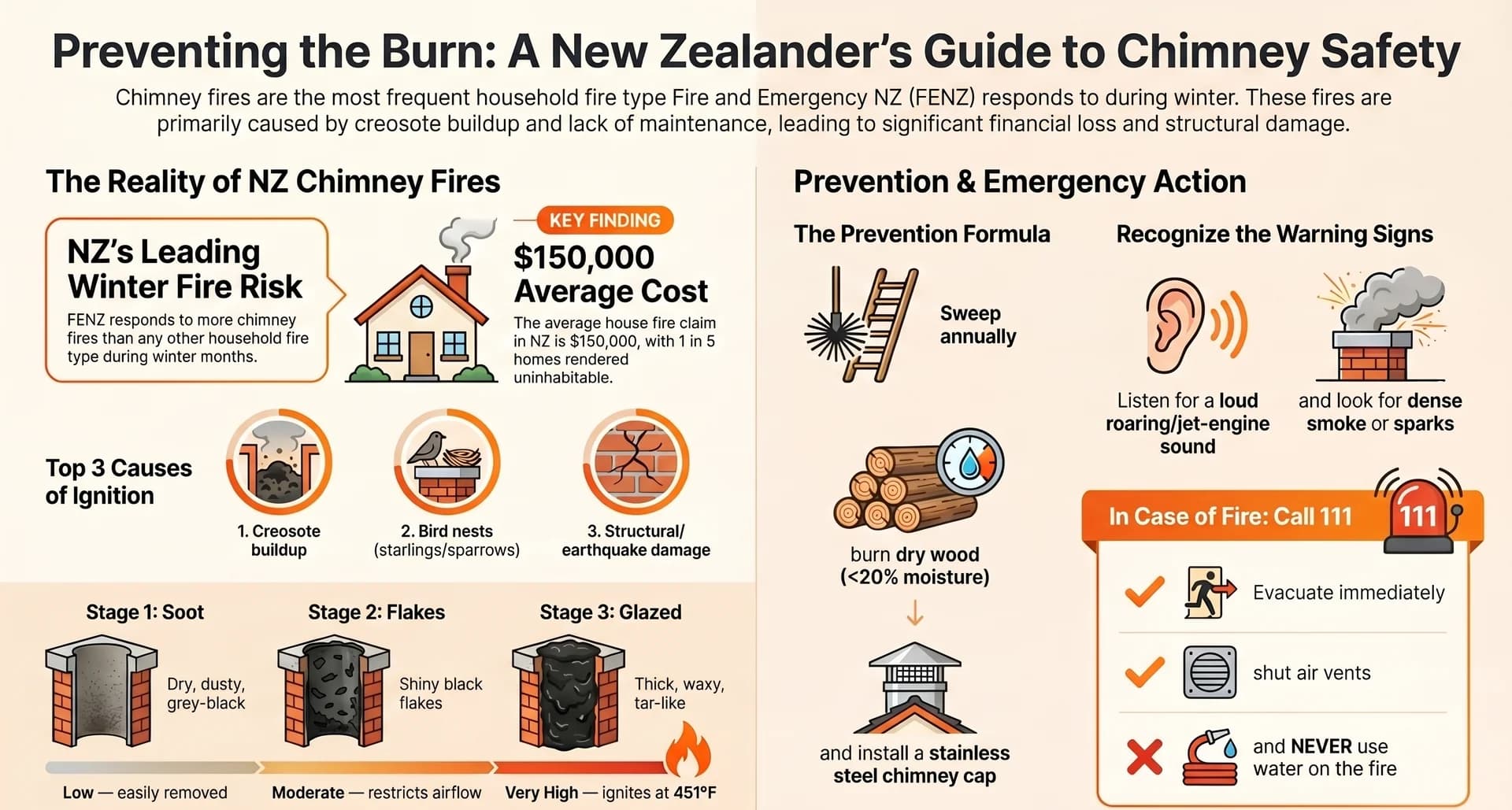
Chimney fires in New Zealand are caused by creosote buildup inside the flue — the result of burning wet wood, running fires on low smouldering settings, and skipping annual sweeps. FENZ responds to more chimney fires than any other household fire type during winter. Prevention is straightforward: sweep annually, burn dry seasoned wood below 20% moisture, and never let creosote progress past Stage 1.
Quick Answer
Chimney fires in New Zealand are caused by creosote buildup inside the flue — the result of burning wet wood, running fires on low smouldering settings, and skipping annual sweeps. FENZ responds to more chimney fires than any other household fire type during winter. Prevention is straightforward: sweep annually, burn dry seasoned wood below 20% moisture, and never let creosote progress past Stage 1.
Key Answers
- What causes most chimney fires in NZ?
- Creosote buildup is the primary cause. When wood burns incompletely — due to wet fuel, restricted airflow, or smouldering — smoke condenses in the flue and forms deposits that ignite at high temperatures. Stage 3 glazed creosote burns at over 1,100°C.
- How common are chimney fires in New Zealand?
- FENZ responds to more chimney fires than any other household fire type during winter. AMI's claims data shows indoor fires (including chimney and roof fires) are the second most common cause of house fire insurance claims in New Zealand, behind cooking.
- Can a chimney fire burn down your house?
- Yes. A chimney fire can reach temperatures exceeding 1,100°C — enough to crack masonry, warp metal flues, ignite roof timbers, and spread fire through the ceiling cavity. The average NZ house fire claim costs approximately $150,000 (AMI data), with 1 in 5 rendering the home uninhabitable at over $265,000.
- How do you prevent a chimney fire?
- Annual professional chimney sweeping, burning only dry seasoned wood below 20% moisture content, running fires at adequate temperatures (never smouldering), and installing a chimney cap to prevent bird nests and debris blockages.
- What should you do if your chimney catches fire?
- Call 111 immediately. Evacuate everyone from the house. Close the wood burner door and any dampers to restrict oxygen. Do not attempt to extinguish it yourself. Do not use water on a chimney fire — thermal shock can crack the flue lining.
Key Takeaways
- Creosote buildup is the primary cause of chimney fires — it forms when wet wood burns incompletely and smoke condenses in the flue
- FENZ responds to more chimney fires than any other household fire type during winter, with the average house fire claim costing $150,000
- Stage 3 glazed creosote ignites at over 1,100°C — enough to crack masonry, warp flues, and spread fire to roof timbers
- Bird nests are the second most common cause — starlings, sparrows, and mynas nest in unused chimneys over summer
- Prevention formula: sweep annually, burn dry wood below 20% moisture, maintain adequate airflow, and install a chimney cap
- NZ earthquake damage creates hidden chimney cracks that compromise fire containment — post-quake inspections are critical
What causes chimney fires in New Zealand?
Creosote buildup inside the flue is the primary cause of chimney fires in New Zealand. When wood burns incompletely, smoke cools as it rises and condenses on the chimney walls, leaving behind tar-like deposits that become increasingly flammable over time.
The overwhelming majority of chimney fires are preventable. Annual sweeping removes creosote before it reaches dangerous levels, and burning dry wood dramatically reduces the rate of buildup.
How common are chimney fires in NZ?
FENZ responds to more chimney fires than any other household fire type during winter. Chimney fire incidents peak during June–August when wood burners and fireplaces are in constant daily use across New Zealand.
The financial impact of chimney fires extends well beyond the fire itself. Smoke damage to furniture, carpets, and soft furnishings often exceeds the cost of structural repairs. Water damage from firefighting adds further cost. And insurance claims without proof of annual chimney maintenance are routinely declined by NZ providers.
What is creosote and how does it cause chimney fires?
Creosote is the byproduct of incomplete wood combustion. As smoke rises through the flue, it cools and condenses on the chimney walls, leaving behind deposits that progress through three increasingly dangerous stages.
Stage 3 glazed creosote is the primary fuel in chimney fires. A single flue can hold over 45 kg of glazed deposits. Once ignited, a chimney fire can reach temperatures exceeding 1,100°C — enough to crack masonry, warp stainless steel flue liners, melt mortar joints, and spread fire to the roof structure through radiant heat transfer. The critical point: creosote progresses from Stage 1 to Stage 3 quietly. Homeowners rarely notice the transition because the deposits are inside the flue, invisible from the firebox. By the time performance symptoms appear — smoke backing up, reduced draft, tar smell — the buildup may already be at dangerous levels. This is why annual professional sweeping matters: it catches creosote at Stage 1, before it becomes a fire hazard.
What burning habits increase chimney fire risk?
The way you burn your fire has more impact on chimney fire risk than the type of appliance you use. Four burning habits are responsible for the majority of dangerous creosote buildup in NZ homes.
Burning wet or unseasoned firewood with moisture content above 20% produces excessive smoke because the fire's energy is wasted evaporating water rather than combusting the wood. This heavy smoke cools rapidly in the flue, condensing into creosote at a rate 3–4 times faster than dry wood. Running fires on low, smouldering settings is the single biggest cause of Stage 2 and Stage 3 creosote in NZ homes. When you shut down the air intake to make the fire last longer, combustion temperatures drop below the point where gases fully burn. Burning resinous softwoods exclusively produces more creosote because their sap contains volatile compounds that don't fully combust at lower temperatures. The NZ "hot mix" approach — blending 50% pine with 50% hardwood — reduces creosote production while keeping ignition easy. Overloading the firebox restricts airflow around the logs, reducing combustion efficiency. Load your firebox to manufacturer specifications — typically two-thirds full maximum.
How do bird nests and blockages cause chimney fires?
Bird nests are the second most common cause of chimney fires in New Zealand after creosote buildup. A blocked flue traps heat, restricts airflow, and provides dry combustible material directly in the path of rising hot gases.
In New Zealand, starlings, house sparrows, and common mynas are the primary chimney-nesting species. They build nests during spring and summer (September–February) when chimneys are unused. A single starling nest can fill 30–50 cm of flue space with dry twigs, grass, feathers, and droppings. Bird nest removal by a professional chimney sweep costs approximately $160+ GST in most of New Zealand. This is significantly cheaper than a chimney fire — and NZ law protects most native bird species, so nests with eggs or chicks should be handled by a qualified professional.
What role does chimney condition play in fire risk?
A chimney in poor structural condition is more likely to allow a fire to spread beyond the flue and into the home's structure. Even a small chimney fire contained within a sound flue may become catastrophic in a damaged one.
New Zealand's seismic activity means chimney damage is more common here than in most countries. The Canterbury earthquake sequence (2010–2011), the Kaikōura earthquake (2016), and ongoing seismic activity across the country have damaged thousands of chimneys. Many have hairline cracks that are invisible from outside but compromise the flue's ability to contain fire. Post-earthquake chimney inspections should be mandatory, yet many NZ homeowners have never had one.
What are the warning signs of a chimney fire?
A chimney fire may be dramatic and obvious — or it may burn slowly and go undetected. Knowing the warning signs for both types is critical.
Many NZ homeowners have experienced chimney fires without realising it. Slow-burning chimney fires can smoulder inside the flue for hours without dramatic external signs, yet cause significant structural damage that increases the risk of a future catastrophic fire. A professional chimney sweep will identify evidence of past fires during a standard inspection.
What should you do if your chimney catches fire?
If you suspect a chimney fire, act immediately. The first 5 minutes determine whether the fire stays contained in the flue or spreads to the house.
Call 111 and request Fire and Emergency. Evacuate everyone from the house, including pets. Close the wood burner door and all air vents to restrict oxygen supply. Close the damper if you can do so safely. Do not use water on the fire — pouring water into a hot chimney causes thermal shock that can crack the flue liner, and steam expansion in a confined space is explosive. After the fire, do not use the fireplace or wood burner until a professional chimney sweep has inspected the full length of the flue. Contact your insurance company — most NZ home insurers cover chimney fire damage, but you'll need the FENZ incident report and your maintenance records. FENZ treats chimney fires seriously and crews will use thermal imaging cameras to check for heat transfer into wall cavities and roof spaces that could reignite hours later.
How do you prevent chimney fires in NZ?
Chimney fire prevention comes down to three practices: maintain the flue, burn the right fuel, and burn it correctly. Every recommendation from FENZ, the NZHHA, and NZ insurance providers points to these same fundamentals.
Use the "hot mix" approach — 50/50 pine and hardwood — to balance easy ignition with cleaner burning. In earthquake-prone regions, get a structural chimney inspection after any significant seismic event. For coastal properties, inspect the flue more frequently — salt air accelerates corrosion, weakening the flue's ability to contain fire. Keep your sweep certificate with your insurance documents — you'll need it for any fire-related claim.
Does your insurance cover chimney fires?
Most NZ home insurance policies cover chimney fire damage, but coverage is conditional on the homeowner having taken reasonable steps to maintain the chimney — which in practice means annual professional sweeping.
Claims may be declined if there is no record of annual chimney maintenance, if the homeowner is using an unconsented or non-compliant wood burner, if there is evidence that prohibited materials were burned, or if known structural issues identified in a previous sweep report were ignored. Keep all chimney sweep certificates, retain any inspection reports, and file these with your insurance policy documents. A $100–$170 annual sweep is the cheapest insurance policy you can buy against a $150,000+ fire claim.
How does NZ's climate affect chimney fire risk?
New Zealand's climate creates several unique chimney fire risk factors that don't apply in drier countries. Understanding these helps NZ homeowners manage risk more effectively.
NZ's wet climate makes it harder to season firewood properly. Rainfall during storage, high ambient humidity, and limited drying days mean wood often reaches the fireplace above the critical 20% moisture threshold. Proper firewood storage — off the ground, covered on top, open sides for airflow — is essential. Wellington, Canterbury, and exposed coastal areas experience strong prevailing winds that can force smoke back down the chimney (backdrafting). Repeated backdrafting deposits creosote lower in the flue where it accumulates faster. Anti-downdraft cowls solve this problem for most NZ homes. Coastal properties throughout NZ experience accelerated flue corrosion from salt-laden air. Stainless steel 316-grade flue liners resist salt corrosion better than standard 304-grade steel.
What is the bottom line?
Chimney fires in New Zealand are caused by creosote buildup, bird nest blockages, and structural damage — and virtually all of them are preventable.
FENZ responds to more chimney fires than any other household fire type during winter, and the average house fire claim costs $150,000. The prevention formula is simple: sweep your chimney professionally at least once a year, burn only dry seasoned wood below 20% moisture, maintain adequate airflow (never smoulder), and install a chimney cap. Keep your sweep certificates with your insurance documents. That combination eliminates the conditions that cause chimney fires, protects your insurance coverage, and costs less than $200 per year.
| Stage | Appearance | Removal Difficulty | Fire Risk Level | Cleaning Method | Recommended Action | Source |
|---|---|---|---|---|---|---|
| Stage 1 | Powdery dust, dust-like soot coating, or flaky deposits | Easy; usually removed with standard sweeping | Low; not dangerous if maintained, but can restrict flue | Rotary power sweeping brush or sturdy chimney brush | Annual maintenance and regular cleaning; can be a DIY job if certified or trained | [1-5] |
| Stage 2 | Sticky, tar-like deposit; looks like chunky tar flakes, shiny black flakes, or crunchy clusters ("biscuits") | Moderate; harder to remove than Stage 1 deposits | Moderate; danger of chimney fire begins and flue restriction increases | Stiff bristle brush, scraping tools, or specialized professional tools | Professional intervention suggested; chemical modifiers (such as Cre-Away) can be used to assist removal | [1-5] |
| Stage 3 | Thick tar-like coating; hardened, glossy, or shiny wax-like solid sheet (glaze) | Severe; extremely difficult to remove, nearly impossible, or not worth the effort | Extreme; highly flammable, catches fire at lower temperatures, serious fire hazard | Chemical treatment (PCR Poultice), heavy chains, or special rotary chain whips | Immediate professional intervention; cease use of appliance; often requires complete liner replacement | [1-5] |
Data compiled from research by Chimney Guys
Frequently Asked Questions
Are chimney fires more common in certain parts of NZ?
Yes. Regions with high wood burner usage — Dunedin (42.2%), Nelson (~47%), Timaru (50.5%), Central Otago (62.5%), and the Wairarapa (63.5%–72.6%) — see proportionally more chimney fires. Cold climates drive heavier use, which accelerates creosote buildup.
Is overnight burning dangerous?
Running a wood burner on very low settings overnight is the most common cause of heavy creosote buildup in NZ homes. The fire smoulders for 8–10 hours with minimal air, producing thick smoke that condenses throughout the flue. If you need overnight heat, a heat pump is safer. If you must burn overnight, use dry hardwood and maintain enough airflow to see visible flames.
Can possums block chimneys in NZ?
Yes, though less commonly than birds. Possums occasionally nest in larger chimney cavities, particularly in rural properties or homes backing onto bush. Their nesting material is bulkier and can create severe blockages. A chimney cap prevents both bird and possum entry.
Do chimney cleaning logs work?
Chimney cleaning logs (creosote sweeping logs) can help reduce Stage 1 and early Stage 2 creosote buildup when used between professional sweeps. They work by releasing chemicals that dry and loosen deposits. However, they cannot replace professional sweeping. They do not remove heavy buildup, cannot detect structural damage, and NZ insurers do not accept them as proof of maintenance.
Think You've Got It?
10 questions to test your understanding — instant feedback on every answer
Question 1 of 10
What is the primary chemical component found in creosote that results from the combustion process?
Question 2 of 10
Which description best characterises 'Stage 3' creosote buildup?
Question 3 of 10
At what flue temperature does smoke typically begin to condense on the inner walls to form creosote?
Question 4 of 10
Why is the earthquake risk in Wellington a specific concern for homeowners with chimneys?
Question 5 of 10
What is the recommended maximum moisture content for firewood to ensure efficient burning and minimal creosote?
Question 6 of 10
What 'slow-burning' chimney fire sign might be visible on the exterior of the house?
Question 7 of 10
Which practice, intended to save fuel, is actually discouraged because it increases creosote production?
Question 8 of 10
What should a homeowner do if they discover Stage 3 'glazed' creosote in their chimney?
Question 9 of 10
According to the source materials, how frequently should a chimney be cleaned as a general rule of thumb?
Question 10 of 10
Why are creosote removing logs or 'sweeping logs' advised to be used with caution?
Need a chimney sweep?
Tell us where you are and what you need. We'll match you with a verified local sweep and have them in touch within one business day.