Best Firewood in NZ — Heat, Burn Time & Price (2026)
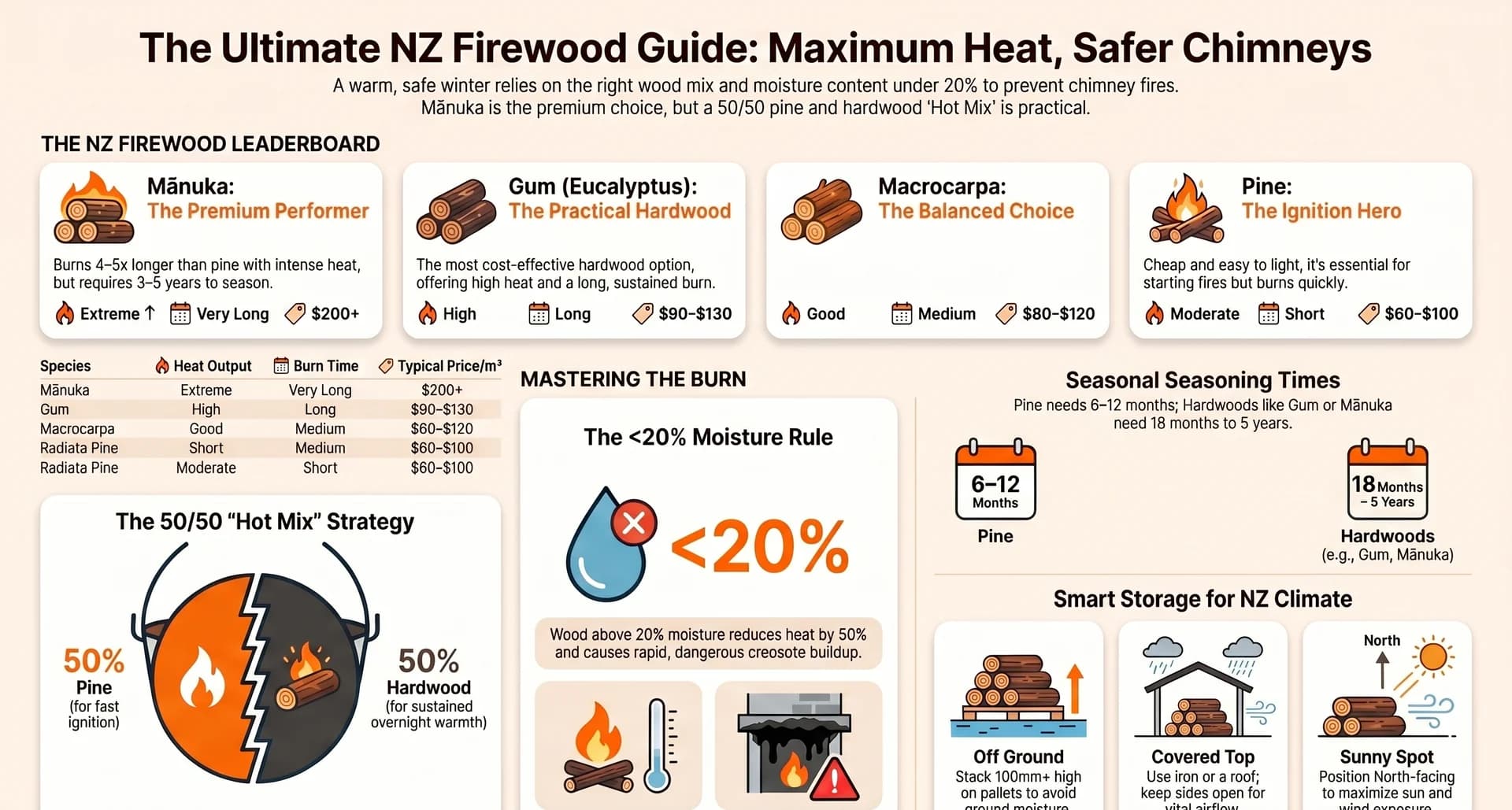
Mānuka is the best-performing firewood in New Zealand — it burns the longest, produces the most heat, and creates the least creosote. But at $200+ per cubic metre, it's expensive and hard to source in bulk. For most NZ homeowners, a "hot mix" of 50% pine and 50% hardwood offers the best balance of ignition speed, heat output, burn time, and cost. The single most important factor isn't the species — it's moisture content.
Quick Answer
Mānuka is the best-performing firewood in New Zealand — it burns the longest, produces the most heat, and creates the least creosote. But at $200+ per cubic metre, it's expensive and hard to source in bulk. For most NZ homeowners, a "hot mix" of 50% pine and 50% hardwood (gum, macrocarpa, or mānuka) offers the best balance of ignition speed, heat output, burn time, and cost. The single most important factor isn't the species — it's moisture content. Any wood burned above 20% moisture produces excessive smoke, poor heat, and rapid creosote buildup that leads to chimney fires.
Key Answers
- What is the best firewood to burn in NZ?
- Mānuka ranks highest for heat output and burn time — it burns approximately 4–5 times longer than pine. However, for practical everyday use, a 50/50 "hot mix" of pine (easy ignition) and hardwood such as gum or macrocarpa (sustained heat) is the most popular and cost-effective approach for NZ woodburner owners.
- How dry should firewood be before burning?
- Firewood must have a moisture content below 20% for efficient, safe burning. Wood above 20% produces excessive smoke, reduces heat output by up to 50%, and accelerates creosote buildup in the chimney — the primary cause of chimney fires in NZ.
- How long does firewood need to season in NZ?
- Seasoning times vary dramatically by species: pine needs 6–12 months, macrocarpa 12–18 months, gum (blue gum/eucalyptus) 12–18 months, and dense hardwoods like mānuka or beech up to 3–5 years. NZ's wet climate can extend these times, making proper storage essential.
- What does NZ firewood cost per cubic metre?
- Pine costs $60–$100/m³, "hot mix" (pine/hardwood blend) runs $120–$150/m³, gum is $90–$130/m³, macrocarpa $80–$120/m³, and premium hardwoods like mānuka or pōhutukawa cost $200+/m³. Prices vary by region and season — buying in summer or early autumn saves 10–20%.
- Is it safe to burn pine in a wood burner?
- Yes. Pine is safe to burn and is the most common firewood in New Zealand. However, pine produces more creosote than hardwoods due to its resin content. Blending pine with hardwood (the "hot mix" approach) and maintaining adequate airflow minimises creosote production. Annual chimney sweeping is essential for any household that burns pine regularly.
Key Takeaways
- Mānuka is NZ's top-performing firewood but at $200+/m³ it's impractical as a sole fuel — use it as a premium addition to your mix
- The "hot mix" (50% pine, 50% hardwood) is NZ's most popular firewood blend, offering the best balance of cost, ignition, and sustained heat
- Moisture content matters more than species — any wood above 20% moisture produces poor heat and 3–4x more creosote
- Buy firewood in summer for 10–20% savings and allow time for proper seasoning before winter
- Store firewood off the ground, covered on top, open on sides, in a sunny windy spot — NZ's wet climate demands proper storage
- Never burn treated timber, painted wood, MDF, plastics, or driftwood — they produce toxic fumes and can void your insurance
How are NZ firewood species ranked?
Firewood performance in New Zealand is determined by three factors: heat output (how much warmth per kilogram), burn time (how long a load lasts), and practical availability (can you actually buy it in bulk at a reasonable price).
The ranking shows that mānuka and native beech top the performance charts, but their limited availability and high cost mean most NZ households can't rely on them as a primary fuel. Gum and macrocarpa occupy the practical sweet spot — strong heat output, reasonable cost, and good availability across most regions.
What makes mānuka the top-ranked firewood in NZ?
Mānuka (Leptospermum scoparium) is New Zealand's highest-performing firewood species. It burns approximately 4–5 times longer than plantation pine, produces intense sustained heat, and creates minimal creosote due to its high combustion temperature.
Mānuka is one of NZ's densest native hardwoods, packing more energy per cubic metre than any other commonly available species. However, at $200+ per cubic metre compared to $60–$100 for pine, and requiring 3–5 years to season properly, it isn't always practical. The practical approach is to use mānuka as a premium addition to your firewood mix rather than as the primary fuel. Add 2–3 pieces of dry mānuka to a pine or gum base for extended evening burns.
What is the "hot mix" and why do most NZ households use it?
The "hot mix" is New Zealand's most popular firewood blend — a 50/50 mix of softwood (usually pine) and hardwood (usually gum, macrocarpa, or mānuka). This approach combines the easy ignition and affordability of pine with the sustained heat and longer burn time of hardwood.
At $120–$150/m³ pre-mixed, the hot mix is significantly cheaper than buying pure hardwood. Pine ignites quickly, eliminating the frustration of trying to start a fire with dense hardwood alone. The hardwood component burns hotter than pine alone, reducing overall creosote production compared to burning 100% pine. Virtually every NZ firewood supplier offers a hot mix option. Start with pine kindling to establish the fire, then add hardwood once you have a hot coal bed. For extended burns use predominantly hardwood; for quick warmth use more pine.
How do NZ softwoods compare for firewood?
Softwoods are the most affordable and widely available firewood in New Zealand, but they vary significantly in performance. Pine is the baseline — everything else is compared against it.
Plantation pine is New Zealand's most common firewood. It's cheap ($60–$100/m³), seasons quickly (6–12 months), and lights easily. Its weakness is burn duration — a full load burns through in 1–2 hours compared to 3–4 hours for hardwood. Pine also produces more creosote than hardwoods due to its resin content. Douglas Fir is an underrated NZ firewood. It burns cleaner than pine, lasts significantly longer, produces low ash, and is water-resistant — useful for outdoor firewood storage in NZ's wet climate. Macrocarpa is technically a softwood but burns more like a medium-density hardwood — approximately twice as long as pine with noticeably higher heat output. The critical safety note: macrocarpa sparks and pops significantly. Never burn macrocarpa in an open fireplace — it can throw embers onto carpets and furniture. In an enclosed wood burner with a door, macrocarpa is excellent.
How do NZ hardwoods compare for firewood?
Hardwoods are the premium option for NZ firewood — they burn longer, hotter, and produce less creosote than softwoods. The trade-off is cost, availability, and longer seasoning times.
Gum (Blue Gum / Eucalyptus) is the most practical hardwood for NZ woodburner owners. It's plantation-grown, widely available, and offers excellent heat output at a reasonable price. Gum burns approximately twice as long as pine with higher sustained heat. Black Beech is a South Island favourite with exceptional performance. It burns extremely long and hot with a pleasant nutty aroma. Availability is limited to regions near native bush. Tōtara and pōhutukawa are excellent firewood but should only be burned if sourced from legitimately felled or fallen trees. NZ native species are protected under various conservation regulations, and buying illegally harvested native timber contributes to habitat destruction.
How much does firewood cost across NZ?
Firewood prices in New Zealand vary by species, region, season, and whether the wood is delivered green or seasoned. Buying in summer or early autumn — before demand surges — typically saves 10–20%.
Most NZ firewood suppliers charge $30–$80 for delivery, depending on distance. Urban Auckland and Wellington deliveries tend to cost more ($50–$80) due to traffic and access constraints. For a typical NZ household using a wood burner as primary evening heating (4–5 fires per week, May–September), annual costs range from $480–$1,200 for pine only, $720–$1,200 for hot mix, $450–$910 for gum/hardwood, and $800–$1,000+ for mānuka. Buy in summer when firewood is cheapest, buy green and season yourself for 20–30% savings, and buy in bulk for per-metre discounts on loads of 4+ cubic metres.
How long does each species need to season?
Seasoning is the process of air-drying firewood until its moisture content drops below 20%. Burning wood above 20% moisture wastes energy, produces excessive smoke, and accelerates creosote buildup in your chimney.
Pine needs 6–12 months, Douglas Fir 9–12 months, macrocarpa 12–18 months, gum 12–18 months, mānuka 3–5 years, and beech 2–4 years. NZ's variable climate means seasoning times depend on species, storage conditions, and region. The West Coast, Southland, and Fiordland have high rainfall that extends seasoning times by 3–6 months. Canterbury and Central Otago have dry conditions ideal for natural seasoning. Test moisture with a $20–$40 meter from Bunnings or Mitre 10 — insert probes into a freshly split face and target below 20%.
Why does moisture content matter more than species?
Moisture content is the single most important variable in firewood performance — more important than species, price, or how you stack the fire. Wet wood of any species produces poor heat, excessive smoke, and rapid creosote buildup. Dry pine outperforms wet mānuka every time.
When you burn wet wood, the fire's energy is consumed evaporating water rather than producing heat. The resulting heavy smoke condenses on the flue walls far more rapidly than smoke from dry wood — depositing creosote at 3–4 times the normal rate. A single winter of burning consistently wet wood can advance creosote from safe Stage 1 to dangerous Stage 2 or Stage 3. Wet wood produces roughly half the heat of dry wood from the same volume. This means you burn through twice as much wood to heat the same space, doubling your fuel costs. Buying seasoned wood or seasoning your own is cheaper in the long run — even at a 20–30% price premium for pre-seasoned loads.
How should you store firewood in NZ's climate?
New Zealand's wet climate makes proper firewood storage essential. Poorly stored wood will reabsorb moisture, negating months of seasoning. The goal: keep rain off the top, allow airflow through the sides, and keep the bottom off wet ground.
The four rules: stack off the ground on pallets or bearers at least 100 mm above soil; cover the top with corrugated iron or tarpaulin extending beyond the edges; leave sides open for wind circulation; and position on the north-facing (sunniest) side of the property. Stack bark-side up on outer rows to shed rain, leave 2–3 cm gaps between pieces for airflow, and bring 2–3 days' worth inside near the fire to pre-warm before burning.
How much firewood do you need for a NZ winter?
The amount of firewood you need depends on your climate, how often you burn, the size of your home, and whether your wood burner is your primary or supplementary heat source.
Light use (1–2 nights/week) requires 2–4 m³. Moderate use (3–4 nights/week) needs 4–7 m³. Heavy daily use as primary heat source requires 7–10 m³. Continuous all-day burning as sole heat source needs 10–14 m³. For Dunedin, Invercargill, Central Otago, and West Coast add 20–30% above these figures. For Auckland, Northland, and Bay of Plenty reduce by 20–30%. Buy your full winter's supply in summer or early autumn — this gives green wood time to season, avoids the winter price premium, and guarantees supply.
How does your firewood choice affect your chimney?
Your firewood species and moisture content directly determine how much creosote builds up in your chimney — and therefore how often you need professional sweeping and how high your chimney fire risk is.
The overwhelming majority of chimney fires in NZ are caused by creosote buildup from burning wet wood and/or running fires on low smouldering settings. Switching from wet pine to dry hardwood (or even dry pine) can reduce creosote production by 3–4 times — dramatically extending the time between sweeps and reducing chimney fire risk. Best practice: burn a 50/50 hot mix of dry pine and dry hardwood, maintain adequate airflow to see visible flames (not smouldering), and sweep annually.
What should you never burn in your wood burner?
Burning the wrong materials in your wood burner is dangerous, illegal, and damaging to your chimney. Treated timber, painted wood, MDF, plastics, rubber, driftwood, glossy paper, and household rubbish should never be burned.
Under the Resource Management Act 1991, most regional councils in NZ regulate what you can burn in domestic fires. Burning prohibited materials — particularly treated timber, plastics, and rubbish — can result in infringement notices and fines. Canterbury's Environment Canterbury is particularly active in enforcement, with fines of $300 for residential and $1,000 for commercial burning violations. If a chimney fire investigation reveals evidence that prohibited materials were burned, your insurer may decline the claim on the basis that you breached policy conditions.
What is the bottom line?
Mānuka is NZ's best-performing firewood, but for everyday use, a "hot mix" of 50% pine and 50% hardwood is the most practical and cost-effective choice for NZ woodburner owners.
The single most important factor isn't which species you burn — it's moisture content. Any wood burned above 20% moisture produces poor heat, excessive smoke, and rapid creosote buildup that leads to chimney fires. Buy your firewood in summer, season it properly (6 months for pine, 12–18 months for gum and macrocarpa), store it off the ground with a covered top and open sides, and test moisture with a $20–$40 meter from Bunnings or Mitre 10. Burn at adequate temperatures with visible flames — never smoulder — and sweep your chimney annually.
| species name | type (hardwood/softwood) | heat output rating | burn time | seasoning time | price per cubic metre | creosote risk | best use case | Source |
|---|---|---|---|---|---|---|---|---|
| Red Gum (Manuka) | Hardwood | High | Long | 3-5 years | Higher | Low | Overnight fires, sustained burning | [1-3] |
| Gum (Eucalyptus) | Hardwood | High | Long | 3-5 years | Higher | Low | Sustained burning, overnight heating | [1, 3-6] |
| Wattle | Hardwood | Very High | Very Long | Not in source | Higher | Low | Long nights, slow hot burn | [4-6] |
| Kanuka | Hardwood | Very High | Long | Not in source | Not in source | Low | Sustained burning, low-intensity fires | [2, 6] |
| Macrocarpa | Softwood | High | Long | 1-2 years | Not in source | Low | Enclosed fireboxes, sustained heating | [1, 3, 5, 7] |
| Douglas Fir | Softwood | High | Long | 9-12 months | Not in source | Low | Kindling, starting a fire, wet winters | [1, 3, 5, 7] |
| Beech | Hardwood | High | Long | 3-5 years | Not in source | Not in source | Sustained burning | [3, 6] |
| Old Man Pine | Softwood | Moderate | Moderate | 1-2 years | Not in source | High | Starting a fire, sustained burning | [1, 3, 4, 7] |
| Plantation Pine | Softwood | Moderate | Short | 6-12 months | Lower | High | Kindling, starting a fire, quick warmth | [1, 3-5] |
| Poplar | Hardwood | Moderate | Moderate | Not in source | Not in source | Not in source | Quick heat, wetter soils | [2, 6] |
Data compiled from research by Chimney Guys
Frequently Asked Questions
Can you burn native NZ wood?
Yes, if legally sourced. Native timber from resource consent-cleared land, storm damage, or dead fall is legal to burn. However, it's illegal to harvest native trees from public conservation land without a permit. Most native firewood sold in NZ comes from land clearing for farms, roads, or development. Always ask your supplier about the wood's origin.
Should I buy a firewood storage shed?
A purpose-built firewood shed is the best storage option for NZ conditions. Open-sided designs with a solid roof keep rain out while maintaining the airflow needed for ongoing seasoning. A basic 4–6 m³ capacity shed costs $300–$800 from NZ suppliers like Bunnings, Mitre 10, or specialist firewood storage retailers. If you burn 6–10 m³ per winter, the shed pays for itself within 1–2 seasons by reducing wood waste from moisture reabsorption.
Think You've Got It?
12 questions to test your understanding — instant feedback on every answer
Question 1 of 12
What is the primary difference between how hardwoods and softwoods typically burn in a fireplace?
Question 2 of 12
Why is Macrocarpa specifically discouraged for use in open fireplaces?
Question 3 of 12
To be considered 'seasoned' and ready for efficient burning, the moisture content of firewood should ideally be below what percentage?
Question 4 of 12
Which of the following is a visual indicator that a piece of firewood has been correctly seasoned?
Question 5 of 12
Why is 'Old Man Pine' often discouraged for regular use in home wood burners?
Question 6 of 12
What is the recommended role for softwoods like plantation Pine or Douglas Fir in a fire management strategy?
Question 7 of 12
What is the main reason driftwood should be avoided in home fireplaces?
Question 8 of 12
Which native New Zealand hardwood is known for burning hot and slow, and is often used for sustained warmth through the night?
Question 9 of 12
Approximately how long can it take for dense hardwoods like Gum or Mānuka to fully season?
Question 10 of 12
True or False: Burning well-seasoned hardwood instead of wet softwood can reduce the frequency with which you need to have your chimney swept.
Question 11 of 12
What is a specific advantage of Douglas Fir for firewood storage in damp climates like Wellington's?
Question 12 of 12
Which storage practice is essential to prevent firewood from rotting or staying damp?
Need a chimney sweep?
Tell us where you are and what you need. We'll match you with a verified local sweep and have them in touch within one business day.